Author: Stephanie Suh

  • ‘The Open Boat,’ by Stephen Crane – review

    The Open Boat and Other StoriesThe Open Boat by Stephen Crane

    My rating: 4 of 5 stars

    Four men in a dinghy adrift on a sea for 30 hours. The tempest of waves and a great shark occasionally circling around the perimeter of the boat. And the men rowing endlessly as if it were their only tangible way of protesting against their fates. It all happened in reality because the author Stephen Crane himself experienced the ordeal as one of the four men from the sunk SS Commodore off the coast of Florida en route to Cuba, where Crane had been sent as a war correspondent. The short story of the Open Boat is as realistic as it can be based upon a factual event the author himself was fatefully partaken in.

    The four survivors of the vessel were aggregates in a dinghy bound by a remote hope of finding a rescue crew in the middle of the ocean that moved them with terrible grace of waves. The men were a captain, a cook, an oiler, and a correspondent, who was the author himself. There was a subtle brotherhood of men built in the boat who took care of each other. Crane surmised that the captain’s heartfelt devotion to the safety of the motley crew resulted in comradeship, which the author himself had always regarded as a hypocritical concept of men until then.

    There were indeed moments of despair as their drifting became protracted, and the author saw this as nature not regarding human as important. He would jeer at any signs of nature in any deity form because thinking of the captain and the two other seamen who had worked so hard on the sea in such distress was the abominable injustice.

    Stephen Crane was a great American realist writer who later influenced Ernest Hemingway. Born in 1871 as a ninth child of Protestant Methodist parents in Newark, NJ, his literary talent began when he wrote his first poem at the age of eight. Although brilliant, Crane was not academically inclined, so he left University of Syracuse and became a kind of itinerant writer. It is said that Crane was a naturalist writer who emphasized observation in the portrayal of reality based on scientific principles of objectivity and detachment applied to the story of human characteristics. However, in my opinion, he was more of a realist writer who focused on objective, truthful presentations of details of the ordinary lives influenced by Gustave Flaubert and George Eliot. In this story, Crane’s use of vocabulary was pithy and straightforward with elegant expressions of emotions and feelings that so appropriately described the situations in which the characters were trapped.

    After Crane’s untimely death at the age of twenty-eight in a Black Forest sanitorium in Germany, Crane’s works began to gain their long overdue acclaim, one of which was this story of the sunk vessel and his own experience thereof. Stephen Crane’s works should deserve wider readership because he’s the first and foremost American writer in Realism literary movement who paid attention to the lives of the ordinary by being the experience of living among the ordinary and writing the existential presentations of the ordinary lives.

    저장

  • When I was little

    wp-1539030760789.jpg
    Anne Shirley and Matthew Cuthbert from “Anne of Green Gables”

    Thus declared Oxford-graduated Dyer as if American writers had been his only sovereign muses, and no one else. Maybe his temperament and literary taste were congenial to economic wits and individualism of American writing.

    In my case, the very first novel that I fell head over heels was Jane Eyre by Charlotte Bronte. Then came The Sign of the Four by Sir Arthur Conan Doyle, which was a birthday present from my father. Thenceforth, Anne Of Green Gables by Lucy Maud Montgomery spread thru my mind and lingered in my heart.

    I still love all of the aforesaid books, and I think it’s the standard of taste and reason that makes us drawn to our preferences. For this reason, I am always drawn to writers whose writing styles are evocative of sentiments as well as intelligent of reason, so riveting and impressive that a sense of emulation springs forth from the well of my mind.


    저장

  • Reality Bites

    fb1e63ed9e34cf4247bb652afa012362--green-fairy-advertising-poster

    A day’s work is finished -in Adventure
    Tasks are fulfilled – in Suspense
    Tales are told – in Literature
    Truth is lived – in Experience.


    Author’s Note: Office work is undeniably uniformly cosmopolitan and universal: Keyboards, Documents, Phones, Letters, Bosses, Colleagues, Visitors, Meetings, Deadlines, etc… Fulfilling daily tasks every new day is like undertaking the proverbial twelve labors of Hercules in one way or another however I deem it fit . Or I can also relate it to Perseus’s task of killing Medusa in the sense that I must tackle any obstacles in accomplishing what unexpected tasks I am assigned to on a short notice under many deadlines. It’s a classic case of life imitating art in which my performance adumbrates what role I can play the best even without scripts but with what I have. Then there is always tomorrow, God willing, and I look to tomorrow because the Gospel also consoles my well-spent day thus: “Therefore do not be anxious about tomorrow, for tomorrow will be anxious for itself. Sufficient for the day is its own trouble.” How comforting and pacifying it is to lull a tempest of angst, premonition and existential vertigo. 


  • Kinship of Aeneas, George Orwell, and J.K. Rowling

    1images

    I see them almost every day with carts chockablock with their haggard belongings at a coffeeshop in the morning. They come in disheveled, reeking of abandonment of hygiene, but they seem past caring of it, let alone resigned to unwelcome glances of strangers. They are no less than Mendicants, Vagabonds, Tramps, Panhandlers, Beggars, or the Homeless themselves, defying the laws of social evolution and Marxist dialectic changes. You see,  they have withstood epochal changes.

    It was one Monday morning while I was perking up my spirit still under the spell of weekend reverie with a cup of coffee in my regular Starbucks shop nearby my workplace when a homeless woman approached me and cadged for money to buy coffee. I conceded her plea because her forlorn spirit manifesting in her once beautiful face evoked pathos, which would have stung me with a pang of conscience if I had let it foregone. Besides, the fact that she was a woman living in the street, where all foreseeable and unforeseeable risks were lurking to violate her dignity as a fair sex, vexed my mind and heart. It was all too a fortiori opportune to read the article with the lethargic face of the homeless woman still fresh on my mind.

    Never mind piousness, didacticism, and self-righteousness. It goes against the grain to decry poverty at the door of the poor themselves, which is always easy and convenient to pin down based on personal faults, but that would attest superciliousness of being not one of the unfortunate kinds. That is to say, the homeless is the result of addiction to substances, laziness, and careless ways of modus vivendi; therefore, the homeless are unworthy of sympathy nor empathy.

    As a matter of fact, the liberals wade in with their de rigueur weary blaming of the heartless conservatives for their preferential treatment of the given, the fortunate, the haves, while the conservatives lambast the cry babies’ importuning their sorry states as a tendency of the cossetted dependency substratum. Both of the parties do nothing but grandstanding against one another for their voting rights that exclude these “marginals” of society they could not care less. However, the causes of homelessness are one collective social evil comprising many a factor; it’s a complex one involving mental health issues for sure, skyrocketing rent fees as a result of rampant trend of gentrification, prevalent lay-offs and unresolved unemployment rates, low wages, integration of families, and a variety of personal elements that are oftentimes looked on with insignificance as trifles. George Orwell, whose brief period of impecuniousness upon returning from Paris to London forced him to live as a tramp as plainly narrated in his empirical Down and out in Paris and London, conceded: “… if they [the homeless] are worse than other people, it is the result and not the cause of their way of life.” That is to say, no one wants to be homeless with a will.

    Come to think of it, our human conditions are precarious and many times operated outside the boundary of planned stratagem, for human life is woven by unexpected variables and vicissitudes that befall any one like you never know. Aeneas, a royal Trojan hero in Virgil’s Aeneid, became homeless in the wake of the fall of Troy and found himself and his homeless followers dependent upon the kindness of Dido, the queen of Carthage and her people. The great Russian writer Maxim Gorki and the American Jack London were once homeless. And there is J.K Rowling, who lived a life of near-homelessness with her infant daughter without a job before the first book of the Harry Potter series was published. Woe betides anyone who patronized them for the want of the gumption before they became somebody.

    Whether or not we like it, the caste of the homeless will most likely to proliferate unless political leaders stop pontificating about their party ideologies that lose touch with the realistic world of everyday life of the ordinary people. They say the extravagant lifestyles of the aristocracy and their haughty treatment of the poor were the sine qua non of the French Revolution, which was the radical reconstruction of the class system that excluded the welfare of the poor. Then why do I yoke the images of the haughty aristocrats to those of the present-day politicians who seem to thrust the issues of rising homelessness into the bottom of a filing bin and to keep pointing fingers at the homeless for their misfortune? Maybe in an irony of fates, if these politicians wake up one morning and find themselves in the shoes of the unfortunate, they might understand it, but I hope it will not be too late then.

    저장

  • On keeping a journal

    99200c36127f0bc3abd6452ca892b451
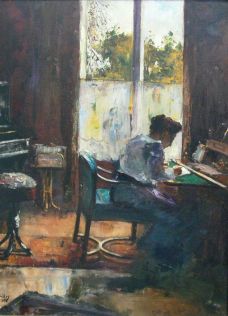
    Frau am Schreibtisch (Woman at writing desk ) by Lesser Ury

    Keeping a journal is, I believe, a vehicle for creating myself, my sense of selfhood. Every page of my dairy is to be breathed with my heart that does not have to entertain anybody but myself.  It’s also proof that I have lived situations which today would seem uncertain and fretful, that I have climbed up the paths of my life thus far to reach the peaks so ambitious, so adventurous. Above all, I want to bring out every treasure that is buried deep in my heart. So writing day in and day out in my Midori Traveler’s Notebook is my daily ritual to remember what it is to be me, which is always the whole point of doing it.

    I carry about my traveler’s notebook  everywhere I go to write my journal and reading pointers from books I read, and some occasionally attempted drawings for practice. There are three notebooks: One is used categorically for my freedom of thoughts, feelings, and just about anything that is to be kept only for myself. It’s not to be shared by anyone, so my soul can rest herself there. Another one is for notes I take from reading that I need to refer to when I write book reviews. And the last one is reserved for jotting down anything out of brainstorm, from devising storyboards for my short stories, to scratching some images of my poems, to making bullet lists to do, and to practicing my newly inspired drawings for more balanced nourishment of my soul. Most of the times – that is 5 days a week – before heading into my job, I usually go to a coffee shop and write in my beloved Midori. It is during this writing time when I feel creative and special out of the melee, out of the existential horrors of every day, and out of the humdrum of daily life.

    I love combining drawings and a variety of crafting to my writing to heighten the expressions of feelings and deepen the depths of thoughts in the way I want them to. The only obstacle I have to huddle is drawing. As someone whose aesthetic standard is as high as that of Pope Julius II, who commissioned Michelangelo to fresco the Sistine Chapel,  I only wish I could draw things I see to its exactness with fine details. But then I always remind myself of the adage: “A flower does not compare itself to other flowers. It just blooms.”

    SAAM-1929.6.52_2
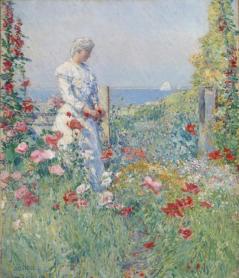
    In the Garden by Celia Thaxter

    Therefore, keeping a diary is a veritable record of myself, a personal treaties on the breadth and depth of being who I really am. It sounds grandiose, but writing in my Midori gives rise to the elevation of my weltanschauung in reflection of contextualizing concepts and beliefs kept in me and also helps me unearth hidden treasure in the realm of unconscious mind. And by creating a kind of work relating to the crafts of the arts, I like to think that I am fulfilling my purpose of life to live a meaningful life, for the sake of ego qua meaningfulness. That said, I like to cherish Kurt Vonnegut’s advice that the arts are what makes the human life bearable and livable in dealing with existential matters of daily lives, for practicing any form of the arts – however clumsily or amateurishly done –  is a noble means to attend My Secret Garden of Mind full of Begonias of Fancy, Roses of Beauty, Tulips of Passion, Lavenders of Devotion, all blooming and bountiful around Spring of Eternal Youth.


    저장

  • Musee d’orsay in Paris – review

    Musée d'Orsay in Paris - a travel guide and tour as with the best local guide (Paris Travel Stories Book 4)Musée d’Orsay in Paris – a travel guide and tour as with the best local guide by Wander Stories

    My rating: 5 of 5 stars

    Of all the world famous museums, my favorite is Musee d’Orsay in Paris because it possesses most of the paintings of Impressionism, to which I am partial because of its prevalent portrayal of ordinary life of people with simple but innovative techniques of using color and light like never before. In fact, I enjoyed a virtual tour of this lovely museum with a guide of Musée d’Orsay in Paris by Wander Stories, a wonderful reference book on this lovely museum with rich information on the history of the museum, biographies of artists, let alone the backgrounds of their paintings they created, all of which beautifully presented in a wealth of rich color photos and illustrations to conjure up the vivaciousness of life right before your eyes in the comfort of wherever you may be.

    The birth of Musee d’Orsay starts with the zeitgeist of our modern era when the spirit of liberty and expressionism was born out of a pyrrhic victory over the antediluvian customs and dogmas upheld by a few select. Originally, the land surrounding the museum was part of a private garden belonging to Queen Margaret, the wife of King Henry VI. In the 19th century, the Palais d’Orsay was used for the Court of Accounts, most of which were burned down to the ground during the uprising of the Paris Commune in 1871. Then in 1897 the government decided to build a new railway station to facilitate transportation of passengers to the center of Paris directly, preparatory to the upcoming 100 World Fair. During WWII, the station was used as a mailing center to send packages and letters to prisoners of the war and to receive them after the war. Finally, the station was re-born as Musee d’Orsay exhibiting all the arts from the second half of the 19th century with a presidential blessing of Francois Mitterrand in December 1986.

    Musee d’Orsay embodies individualism freed from the rigid status quo of the old academics in the French arts scenes. It houses famous impressionist and post impressionist paintings of the 19th by Gustave Courbet, Eduard Manet, Edgar Degas, Camille Pissarro, Pierre-Auguste Renoir, Claude Monet, Vincent Van Gogh, and so forth. All of these painters were revolutionary vanguards of Impressionism, a new genre depicting everyday life of the ordinary not of mythological or even loyal figures and the simple beauty of nature in the most artistically innovative methods of painting that had not been seen in the paintings of previous eras.

    Vincent Van Gogh’s “The Siesta” in the museum deserves a special recognition both by its artistic merit and personal background of the painting. It was painted when Gogh was a patient in a mental asylum. Initially beginning his career as a preacher, Gogh was soon disillusioned with arid rigidity of Christianism, and turned himself to the word of painting in attempt to find a solace for his restless soul. He often copied the works of Jean Francois Millet and thought more highly of him than of Manet. Gogh’s use of vibrantly contrasting colors, such as blue and yellow, violet and organic, Gogh portrayed rural France at its most vividness dynamically.

    As with many creative artists, Gogh lived a difficult life of being let down by his low self-worth. To illustrate, Gogh had a drunken brawl with Paul Gaughin, in which Gogh threatened Gauguin with a razor then fled a local brothel, where he ended up cutting off the lower part of his let ear lobe. Moving from one asylum to another, Gogh’s creative ingeniousness was recognized and encouraged by Dr. Gachet, an Impressionist enthusiast who drove this extraordinary patient of his to creative indulgence, leading Gogh to create 70 more paintings in 70 days, although he sold only two paintings in his lifetime. The last day of Gogh was just like another working day, for he shot himself in the chest while painting in a wheat field. Notwithstanding the tragic end and life wrinkled in anguishes and distresses, Gogh’s resilient spirit driven by his creative madness is enshrined in his paintings that have stood the test of times all around the world, canonizing him as a key figure in transformation from Impressionism to modern art in art history.

    Musée d’Orsay in Paris by Wander Stones is a lively reference book about the museum and the oeuvres of the aforesaid and other famous painters with beautifully displayed photos and detailed information on the paintings and the painters in easy language. This is also a lovely book to be viewed on a Kindle Fire with easy references to pages and stunningly colorful photos effortlessly downloaded on the device to enjoy the tour of the museum anywhere, magically transporting you in front of each of the paintings in the museum. Or if you plan to visit the museum, then reading this book will prepare you with arms of information. All in all, the knowledge from the book will help you appreciate the beauty of the arts at their best because as defined by Sir Edmund Burke the standard of reason and beauty is all the more appreciated by the faculty of the mind affected with the works of imagination and the elegant arts, which is universal in all humans and of sentiment common to all mankind.