Category: Miscellany

Anything that’s on my mind.

  • “On Falling In and Out of Love With Dead Artists as an Art Historian” by Allison Leigh, published in Literary Hub on November 5, 2026 (Saturday Reading)

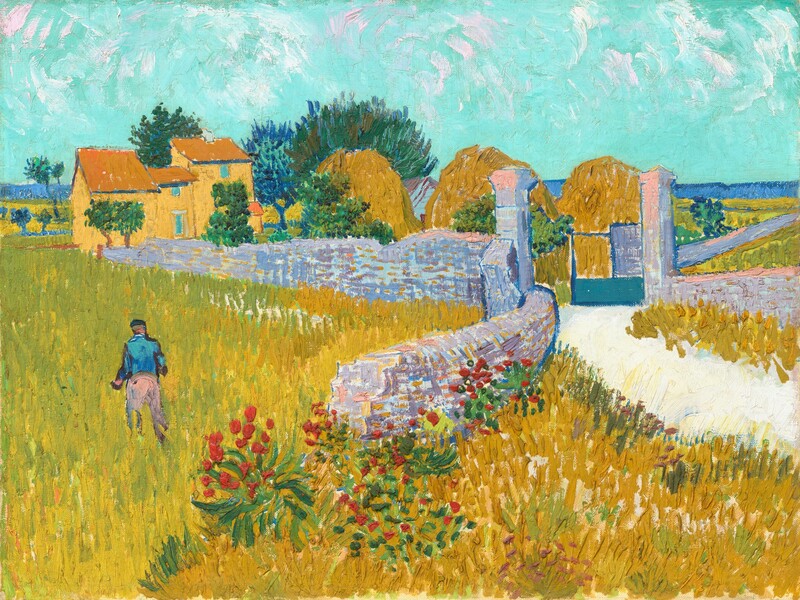
    FARMHOUSE IN PROVENCE
    Vincent van Gogh

    I have a confession to make. I am a ghost lover. A lover who finds love in language made flesh. Aeneas, Virgil, Sappho, Anne Brontë, and Clarice Lispector remain as I have read and thought of them, without the disappointment of their human foibles in life. My ghost love is not necessarily erotic; it is closer to the Elizabethan sense of the word “friend,” which could mean “lover.” Perhaps I don’t belong to the current period of time, or I am simply made that way. And I love it.

    “On Falling In and Out of Love With Dead Artists as an Art Historian” is an Augustinian confession by Allison Leigh, an art historian who fell in love with the artists despite their infamous misogynistic tendencies and appalling behavior towards women. Leigh described her growing attachment in the way a method actor becomes the character she plays. But to me, she seemed more like an investigative journalist covering an artistic scandal who then found herself infatuated with the artist. Or shall I call it erotic Stockholm syndrome?

    Honestly, it seems to me that Leigh’s love of the infamous misogynistic artists must have come from her attraction to men with similar tendencies, such as the handsome Russian Karl Briullov. I say this because I could never feel for an artist who enjoyed painting women being stabbed to death, as Eugène Delacroix did, or for Picasso, who slapped his girlfriends simply because they went out without his permission. And anyway, I never liked Picasso. While people rhapsodized about how creative and ingenious his art was, I found nothing to admire about him except his ability as a businessman.

    Artists, especially painters, express themselves in colors and shapes, unlike writers or poets. I do not feel as close to their minds, and honestly I couldn’t care less, except for Michelangelo, who endured Leonardo da Vinci’s contemptuous comparison of marble sculptors to bakers. I am not trying to stage a pugilistic contest between a painter and a writer or poet, but I see no reason to be attracted to abusive men, no matter how lonely they were when they tried to be artistic by forever sulking and being uncaring. In this regard, Vincent van Gogh was a romantic man before he was an artist, with his generosity, compassion, and warmth.

    You can’t put art before man. I can’t admire the art when I don’t admire the artist. How can you separate the creation from the creator? Artists need not be saints or model citizens. But art does not absolve an artist of vice. That is why my admiration for Charles Dickens has been tainted since I learned that he tried to send his sane wife away to an asylum.
  • 2027 Pushcart Prize Nomination

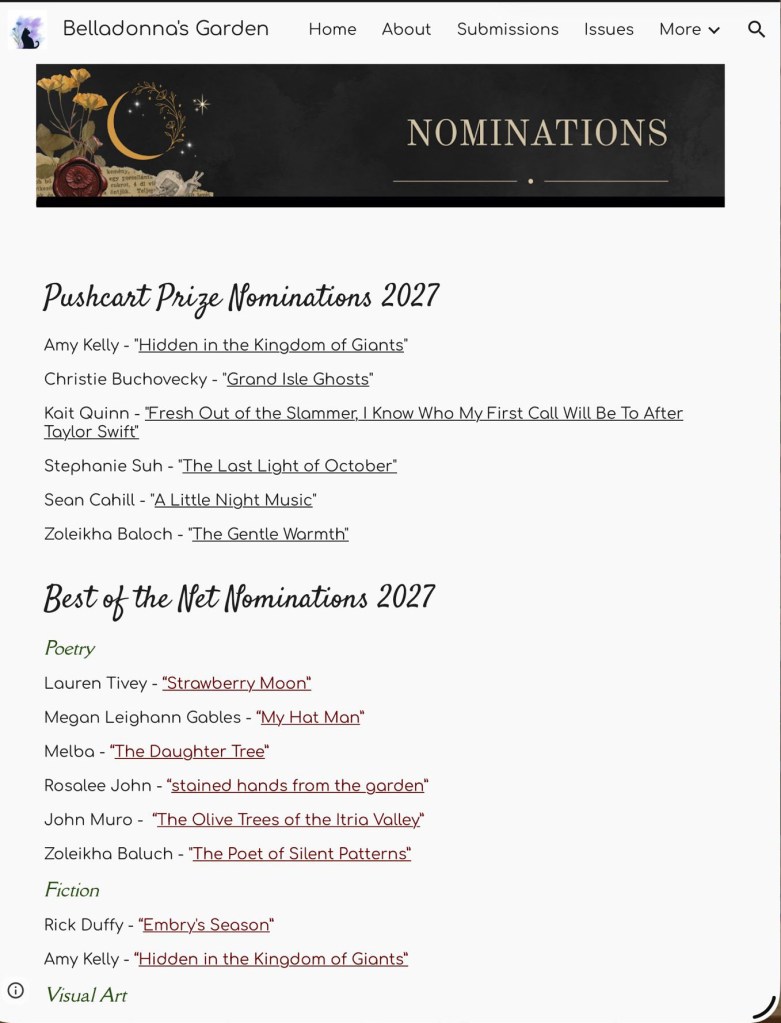
    I am delighted to share that my poem “The Last Light of October” has been nominated for the 2027 Pushcart Prize by Belladonna’s Garden.

    My heartfelt thanks to Editor-in-Chief Shari Wilder for this honor.

    Announcement image courtesy of https://www.belladonnasgardenlit.com/issues/winter-2026-issue-2/stephanie-suh

  • Sunday Letter – 2

    Sunday, September 6th, 2026

    Hi Freddo,

    It’s September, and fall will arrive soon. In fact, the cooler temperatures are already its harbingers, and I am all for it. How’s the weather in Rome? And how are your projects coming along? Last time I heard, you were working on a translation of a certain book from English into Italian. Are you still working on it? Can you tell me what the book is about?

    I want to show you my prose poem I wrote yesterday. It’s one of my recent experiments with story-like poems. I write poems that read like prose. The best thing about prose poems is that there is no complication of characters with existential dilemmas and metaphysical questions about who they are—questions that not many people care about. But these days, too many poems and stories can read like ideological catalogs, social agendas, or personal traumas that are not easy to read and take to heart. While I get that shared traumatic experiences may help those who find themselves therein, that is not my cup of tea. I don’t want to write about my ethnicity or race in the context of living in America as an Asian immigrant woman. I don’t want to be labeled as an “ethnic” woman writer whose work is shelved outside of the so-called mainstream book sections in bookstores. That is why I admire someone such as Kazuo Ishiguro, who wrote The Remains of the Day. His background does not prescribe the consciousness, subject, or voice he is permitted to inhabit; you would not necessarily know that a Japanese-British man wrote it in posh British English. There are no boundaries of race, gender, or age in the language of the mind and heart. You can be whoever you want to be and show the world the way you are.

    Today’s letter reads like a rant from an anxious woman irritated by a boisterous party of popular or best-selling writers. So be it. I do not want to be restrained in the realm of written words where I can be myself. I do not like being boxed in by what people expect me to be and write, because that is not who I am. You would find it a bit hard to relate to my literary zeal to write the truth about myself because you would not feel the pressure of ink in your own color, but that is okay. I do not expect you to understand my stance. However, I would be incredibly happy to see you on my side when people scoff at my poems and prose.

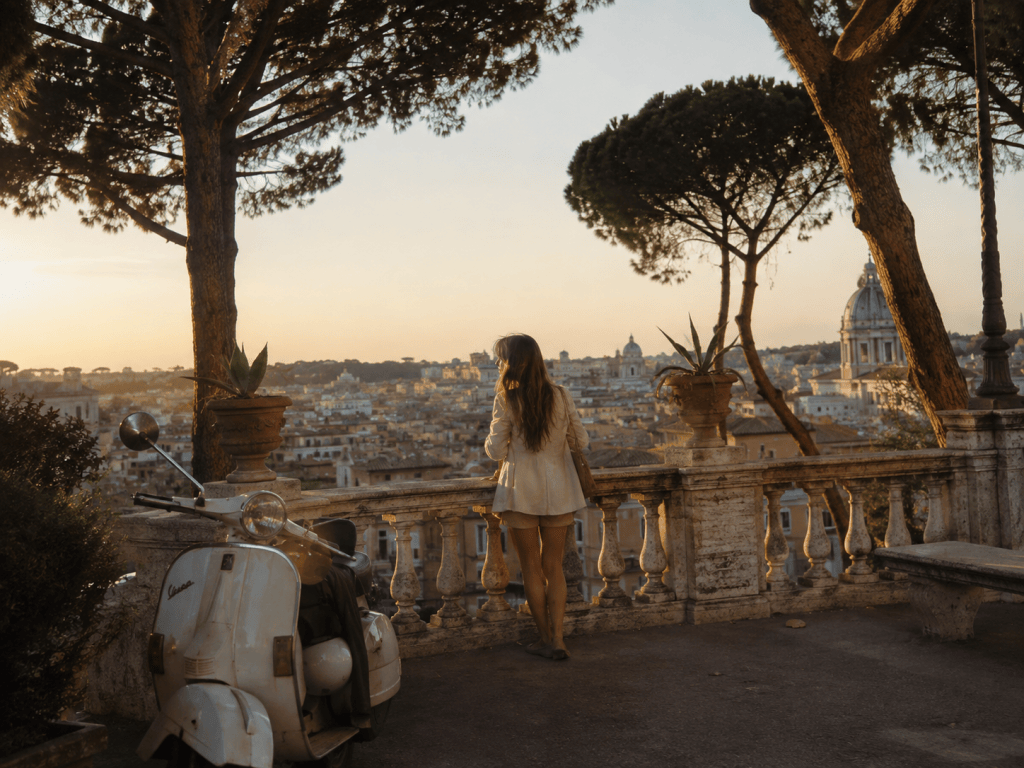
    Dreaming of a dusk on the Aventino Hill looking over Rome with you,

    Stefania

  • Sunday Letter – 1

    Sunday, August 23, 2026

    Hi Freddo,

    I thought the heat had gone and had prepared for autumn clothes, but it was a vain hope. It was a trick of nature. The heat persists, and it is very hot. So, I have been staying in the living room with my cats because it is the coolest room and has an air conditioner. I hear that the heat wave has hit Italy, too. I hope you are okay.

    I just finished reading Elizabeth Taylor’s A View of the Harbour. It is about an English coastal village called Newby, where people’s lives are interwoven through weakness, treachery, and misunderstanding, for which they pay with loss and departures. It is written in the third person—an omniscient point of view that sees all and knows all. The perspective often shifts to that of the elderly, bedridden Mrs. Bracey, who watches people as if she were watching a television soap opera. But she can’t see the stories behind the people she watches, and, in fact, she doesn’t care. I wonder if God would be like her. He sees us from above but doesn’t want to interfere with our affairs, even when we want him to, because God couldn’t care less about them unless they relate to his worship.

    It seems that the sea always provokes the passion smoldering beneath conventions and norms, stirring the urge to let the flame ride the crest of the waves, clash furiously against wave upon wave, and then become one with the deep blue. In this regard, the sea alters none of it: human instinct, desire, the primitive id. The harbour is the superego because we know what we should and shouldn’t do under the community’s safe-harbor rule. Seen from the sea, the harbour is prudence.

    These are the things that came to mind after reading the book. I suspect that this multiplicity of interpretations is what Taylor wanted. In the post–Second World War era, people had lost their collective values and systems of belief, leaving them in an existential dilemma. But the sea doesn’t know it. The harbour keeps all of it inside, like a graceful swan with her legs paddling frantically beneath the water to preserve her poise.

    What do you think? Do you want to read the whole book? If you do, you will feel as though you are watching a British television drama, with various characters who seem ordinary yet harbor extraordinary secrets, and stories that unfold without ostentatious romance, extravagant affairs, or dashing bravado. For me, it’s viewable because it is relatable.

    Are you coming to California after the heat has subsided on both sides of the ocean? Let me know, and we can plan something together, like Prudence and Geoffrey in the book.

    Regards,

    stefania

  • Queen’s cats

    Share a photo of your pet and tell us one thing that makes them uniquely them.

    Camile (L) and Toro (R) on their look out from Queen’s Castle

    My cats think they are human. They like Häagen-Dazs ice cream and want to lounge in the living room with me, let alone jump on my bed when I say good night each night. Did I also mention that they’re bilingual?

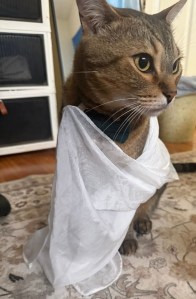
    Toro in Toga channeling into an ancient Roman aristocrat

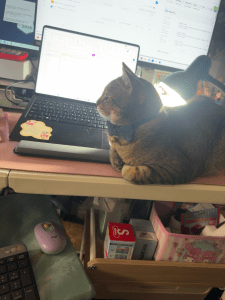
    Toro, the 6-year-old tabby, is a little tiger who wants to help me when I work from home, always insisting on typing emails and notes on my work laptop, which need my spellcheck. He takes breaks and lunch with me, so I am never alone at home. And Toro’s being human doesn’t stop there. He knows when my brother calls because he always sits next to me, his little furry body resting on my side.

    Camille’s magic eyes

    Camille, the 4-year-old black cat, is a little black panther who looks just like Gigi from Kiki’s Delivery Service. Although Camille speaks no Korean, he understands when I tell him my secret wishes and how grateful I am that he lives with me because I am lucky to live with such an adorable black cat.

    Toro as my assistant

    Whoever says cats are naturally independent and feral has not seen Toro and Camille. They are very affectionate and loving. I see their spirits in amber and emerald eyes. I feel their little hearts on my chest and at my feet.

    And they slowly blink their big eyes and bunt their little heads when I say, “I love you so much in every universe.”

  • prompt returns

    Daily writing prompt
    What’s a promise you made to yourself that you’ve actually kept?

    I collect promises like Swarovski jewelry, from necklaces to earrings, to bracelets, and more. I love pretty things, so I change them, but it all comes down to a few select ones that I usually wear to my heart’s liking. So are my promises. There are many, but only a few of them remain, and one of them makes it out to a World Cup final.

    I have always wanted to write a book that I can leave as my legacy, just so to prove I have lived, that I, Stephanie Joori Suh, lived, saw, and wrote. The thought that one day my body will become a speck of dust or ashes gives me a panic attack amounting to losing my eyesight completely. The ancient Greek poetess Sappho also felt the same, as found in one of her surviving fragments. Besides, there is something in me urging me to write as it is my nature. My father once told me that he had the same urge to write poetry, as his mother did too. Maybe it’s in the genes, like a family of practicing ancient secret rites.

    What I have done is to write my first chapbook of poetry this year. It is a collection of poems I wrote from my East Coast years to the present West Coast years. I auto-published a short story before as a Kindle Read, but this is my first time submitting a poetry chapbook to editors of ten presses. Some of them are for chapbook prizes, and some are regular chapbook submissions. And… one of them sent me an email last Wednesday that they wanted to publish my chapbook. I do not want to open a champagne early until I have an actual chapbook of mine in hand. Still, I feel I am in the procession of poets from the misty past and continuing as long as humanity remains.