Author: Stephanie Suh

  • My Cat Toro and Samuel’s Hodge

    Toro is a very fine cat indeed

    Since I don’t like the word “pet,” I won’t say it when I refer to my two-year-old tabby, tom Toro, a family member. Toro pays a portion of his rental fee and is a controller of rodents in our dilapidated humble apartment we long to escape. But that’s another story, and this story I am going to unravel is for Toro.

    Toro before entering the clinic

    It was that time again to get Toro’s annual physical exam, also required for his Hills prescription Urinary care food. So we took a trip to the vet at Little Tokyo, and all’s well that ended well. His weight was steady at 11 pounds, the same as the last year (what an excellent dieter he is!). He got his FVRCP, FelV, and nails done and was proven generally healthy. What a relief because I had been concerned about his taking more naps than usual and tired expressions with half-cast eyes. The doctor told me that it was customary for cats to show such symptoms as they grew bigger. So albeit my mom thinks that I am overly concerned about Toro’s otherwise fine status quo, aren’t we all concerned about the general well-being of our flurry fur babies?

    Samuel Johnson and Hodge

    It all makes me think of the story of Samuel Johnson and his cat Hodge. Samuel Johnson, one of the greatest men of letters from 18th century England and the author of A Dictionary of the English Language, had his beloved sale-furred cat Hodge, who was immortalized in literary works and as a bronze statue outside his guardian’s once resident abode. We first come to know of Johnson’s cat Hodge thanks to his lawyer friend and biographer James Boswell’s Life of Johnson. Johnson used to go out to buy Hodge’s favorite food, oysters. He refused to let his loyal and faithful Jamaican-born master-servant Francis Barber because he felt that it would be degrading to Francis to do such errands for him. But I like to think that it was more affection toward Hodge, whom he called thus: “He is a very fine cat, very fine indeed.” When Hodge was nearing to cross the rainbow bridges due to his old age, Johnson would get valerian, an herbal painkiller extracted from the flower to lessen his fur baby’s pain. But the end of Hodge wasn’t lost in the inner circle of the ether, for his life was memorialized in ‘An Energy on the Death of Dr. Johnson’s Favorite Cat’ by Percival Stockdale, published in 1778:


    The general conduct if we trace
    Of our articulating race,
    Hodge’s, example we shall find
    A keen reproof of human kind.

    Samuel Johnson is one of my most admirable literary persons because of his humanist rules of thought articulated in his mastership of the English language. Hence it gives me a feeling of kinship with his love of Hodge. His affection for Hodge felt genuinely caring and familial, which was never mawkish or superficial. So, likewise, my cat Toro is a muse of my writings: whimsical, independent, intelligent, and affectionate. Sometimes, I wonder if Toro is really a little boy bespelled a tom. Well, what more can I say? Toro is a very fine cat, very fine indeed.


    Hodge’s bronze statue was inaugurated in 1997 by Sir Roger Cook, the then-Lord Mayer of London. Note the oyster at his paw as his eternal token of Johnson’s affection.
  • On my own

    I’d rather be a witch
    Without a family
    Solitary but lovely
    With no one to claim
    Not even one to lose
    Than be a materfamilias
    With no sign of tenderness
    Not even a hint of softness
    As if it were a mark of weakness.
    I won’t belong to a matriarchy.

  • Turn of the screw

    One more chance
    and the soul’s deep
    misery in the abyss
    would be beatitude;
    Universe!
    Save the soul
    in bottomless watery
    fit where no light dares
    to reach, not even God
    cares to send his grace
    to the despondent
    whose prayer for his
    grace is a turn of the screw.

  • Live, Die, Repeat, Repeat…

    Life is still beautiful, even if it deceives you.

    I wanted to find the Church’s stance on reincarnation and, above all, what the Bible said about this seemingly endless shapeshifting until the purification of the soul is complete, so to speak. What about the Christian belief that we live only once and have no return of life?

    According to “A Concise Dictionary of Theology,” reincarnation is the belief or metempsychosis (“animate afterward”) that the soul preexists its embodiment. After death, the soul exists in a ghostly state before animating one again, a body of the same in a different state, which sounds a lot like a demon or malevolent spirit possessing the body of the living. It is this very belief in resurrection and official rejection of the preexistence of wandering souls without corporeal substance that denies reincarnation itself. By maintaining an endless series of chances, the doctrine of reincarnation reduces the seriousness of God’s grace and, most importantly, human liberty exercised in one life that is ended by once-and-for all death.

    Furthermore, in the Catechism of the Catholic Church, death is the end of man’s earthly pilgrimage. When the single course of our earthly life is completed, we shall not return to other earthly lives as “it is appointed for men to die once” [Hebrews 9:27]. Christianity defends the duality of the body and the soul. However, reincarnation defends dualism that both beings exist separately and that the body is simply an instrument of the soul; existence by successive existence as an altogether different body is repeatedly assumed each time one recycles life. Thus reincarnation denies the idea of the resurrection of the body, as evidenced by the resurrection of Christ, and most primarily rejects the Christian doctrine of salvation. Therefore, there is no reincarnation after death.

    I feel much better now than before. While I succumbed to the belief in reincarnation, I couldn’t accept the thought of my present life as punishment for my wrongdoings in my past lives. To think that I have to live in a miserable state of discipline until my subsequent due recycling puts me on the verge of lunacy in the form of murderous headache for which I recently found myself in the ER. Viktor E. Frankl, the survivor of concentration camps during World War 2 and the founder of Logotherapy, urged us to trust that there is meaning in suffering, which helps us lead to our purposes in life. Samuel Johnson, one of the most significant 18th-century English men of letters and the author of A Dictionary of the English Language, describes life as progress from want to want, not from enjoyment to enjoyment. Forget the arguments about the religious dogma dictating an institutionalized belief for mass mind control. Or it so, then so be it. After all, reincarnation is also another offshoot of mysticism developed into religious thought. Then I will follow the light that gives me a sense of hope. And for this reason, I proclaim that my body and soul are inseparable and that I live only once, and that’s it.

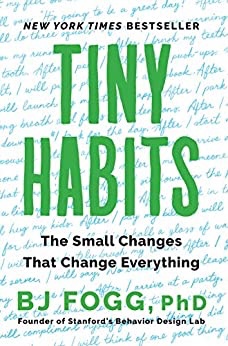
  • ‘Tiny Habits: The Small Changes That Change Everything’ by B.J. Fogg

    My rating: 4 of 5 stars


    When you feel that something important about your approach to your current life isn’t working, you should adopt a new way of sailing your ship at life’s sea. Hence, following my read of Aristotle’s Way by Edith Hall, I continued pursuing the answer in Tiny Habits by BJ Fogg, a self-help book based on Aristotle’s dictum that virtue is a habit in 21st-century parlance.

    Fogg’s approach to habit-forming practice is categorized into small steps that require no intellectual, or philosophical commitments, as in the case of new year’s resolutions. He refers to motivations and willpower as “fair-weathered” friends who hooray and holler at our resolutions to change at first but disappear into the lost memories of the first initiation when our souls plunge at the lowest later. Instead, we must befriend “Aspirations” and “Outcomes” as faithful friends who will help us build a Behavior Design that best matches our disposition and lifestyle by which we can realize our affirmation as the functionary of noble ideas. For example, if you want to save $500 as an emergency fund, you can start by curtailing your Starbucks visits or bringing your lunchbox to work, rather than saving a lump sum of money from your paychecks; as the saying, “Drop by door fills the tub.” Fogg refers to such small practice as the principle of “Golden Behavior,” which you can do when you feel like calling it a day, even on your most challenging day.

    Notwithstanding the noble intentions and the greatness of simplicity in Fogg’s guide to habit-forming, some carbuncles I find incongruent in his examples of his successful people who are comparatively well-off business owners or professionals. Of course, that is not to avert his excellent idea that the simple is the best. Still, I hoped to find examples of everyday working-class people struggling to make their lives better who have fewer resources, such as seeking help from a person like Fogg, a Behavior Scientist at Stanford University. Maybe I could inadvertently judge his study results only with limited information based on my reading. Still, I only wish that he would include a broad social spectrum of subjects in the advantage of Golden Behavior. But then I could be a captious reader feeling left out of the selected successful achievers.

    In all fairness, the book is worth reading if you are especially keen on Aristotle’s way of happiness, which I regard as personable and approachable, compared to Plato’s metaphysical way of interpreting how to live a perfect life. But let’s forget about the ancient Greek school of philosophy. Still, Tiny Habits do matter.


    View all my reviews