Category: book review

  • She-Ras, Xenas, and Wonder Women

    images
    Ancient Amazonians courtesy of google

    Before the mercantile empire of ‘Amazon’ amid the Sea of the Internet, there once was an eponymous band of fierce women warriors whose famed ferocity and fearlessness was enshrined in the Classical literature and history. It is said that they were real women soldiers living in ancient Eurasia with husbands and children who seemed to know something about how to maneuver the sphere of personal life and that of military commitments. The subject of this mysterious ancient militant women from this month’s National Geographic History intends to deconstruct such mysticism surrounding the factual evidence thereof and demystify the origin of the meta women fighters modern feistily feminists and politicians love to panegyrize.

    First, the origin of Amazonian warriors comes not from the Amazonian jungle who are believed to be scantily clothed with breasts deformed women prone to attack men without reason. They were, in fact, the female warriors among Scythian and other nomadic Steppe cultures across the Eurasian plain as embedded in Homer’s The Illiad, Herodotus’s Histories, and Plato’s Laws. The recent discoveries of 4 female corpses bearing combat-related injuries, such as slashed ribs, fractured skulls, and broken arms are claimed to be of the lost Amazonians prevalently seen among Scythian women riding to battle alongside their men.

    Notwithstanding the above archeological excavation and factual evidence, my personal sentiment toward the adulation of the female combatants is anything but the elevated opinions about them. Although Homer in The Iliad praises Amazonians for being the equals of valorous men, I wonder if he would have wanted to take one of them as his better half in reality. Plato in Laws recommends that boys and girls should be trained for horse-riding, archery, javelin-throwing, etc., which is very indeed commendable, but I opine that no every girl should be forced into such training because every girl is not of the same aptitude or disposition. Of all these complacently abstract perspectives on women soldiers, Herodotus seems to be only one who has a comparatively objective view on Amazonians not as a glorified tribe of female bravery but as a tribe of women freed from conventional conjugality. They were a group of shipwrecked women tended by local men with whom they moved to new lands and happily lived after while maintaining their own separately private lives as something of common law marriage couples.

    The modern perspectives on the Amazonians as a manifestation of gender equality in the spheres of domestic and public life exceedingly lionize the necessity of upending what is perceived as traditionally patriarchal gender roles peculiar to the biological characteristic of men and women. Needless to say, the word “Equality” is highly admirable and desirable, especially on the frontline of livelihood, but you can’t force everyone – that is every woman- to be as aggressive or belligerent as these ancient female warriors were in fighting everyday strains of life. Besides, I see there are more widespread issues of racism, classism, lookism, and agism than sexism in daily life because womanliness adorned with beauty and sex appeal armed with the art of seduction can work wonder in every place, helping her to achieve social mobility. Reading the article intent upon the historical evidence of these Amazonians makes me realize that the advocation of public sentiment in practice overrules the consideration of single individuality in theory.

  • they coveted anything and enjoyed nothing: ‘The Complete Short Stories of Guy de Maupassant’, by Guy de Maupassant – review

    The Complete Short Stories Of Guy de MaupassantThe Complete Short Stories Of Guy de Maupassant by Guy de Maupassant

    My rating: 5 of 5 stars

    Attempts to describe ordinary life without an empathetic heart and sympathetic ear are often led to cliched political or social screeds marred by a partisan ideology that fails to chime the bells of the hearts of universal readers across a great divide of territorial, cultural, and biological planes that we want to cross over. In this regard, Guy de Maupassant, a great 19th Century French writer stands alone, showing us what life means to ordinary folk at the heart of its vicissitudes with an honest, profound observation of the performers of acts as an usher to the theatre of human drama.

    The short stories are vignettes of collective contemporary lives of ordinary French folk from the middle class Parisian civil servants to the Normandy peasants that are all connected in one way or another in the wheel of fortune spun on the whims and caprice of Lady Fortune. Titles and ranks lose their forces in this game of cruel lottery, and the characters are fallen apart from their most cherished yearnings, treasured wishes, deluded hopes, and forced beliefs. Humanity, in general, lays bare its essence in the face of tragedy, and it is this aspect of human nature that Maupassant laments and pities as a detached observer of each act of the drama. “Two Friends” shows how life can be altered by the current political affairs of the time, while “Monsieur Parent” portrays a man consumed by solipsistic passions kept in a voluntary estrangement. The hypocrisy of religious sanctimoniousness aided by the idiosyncratic custom in the guise of regional tradition in “The Christening” is accused of a crime against humanity. The bullying of meekness and joviality in “Toine” manifests Shakespeare’s adage that the unkindest beast is kinder than mankind. And there is the awakening of greed and sloth in “The False Gems” as Lady Fortune beckons with a fortuitous lure that even you will be tempted into. The panoply of emotions, varied incidents, and inner conflicts are blatantly displayed in their revelation but are nuanced in their language.

    Maupassant is a genius in this regard that he elevates the perspective on the seemingly ordinary outlook on life into the intricate psychology of the human mind with the feeling of the sublime as though seen from the position of a god or an angel not permitted to interfere with mortal life. Through the characters, Maupassant shows us what makes them behave the way they do lest we should criticize their follies and foibles a priori. He is in a way a pre-existentialist by which the experience of their characters precedes their existence. That is, if you know them, you will understand them. Maupassant through the literary looking glassed-selves of the characters tells us to read their own stories breathed in a pulsation of unfulfilled longings, disallowed happiness, and shattered dreams to find sorrow and suffering enough to disarm all hostility toward them.

    This book is not for a rapid reading at one sitting. Rather you should read this anthology of short stories chapters by chapters, words by words, day after day like you are reading psalms that speak to your heart amid the vicissitudes of life that try your trust in yourself and others. For that’s what Maupassant wants you to as life is seldom fathomable to ascertain how far it will have to be lived and how much it can be appreciated based upon your own appreciation of the meaning of life in daily life.

    View all my reviews

  • Terror made him write: ‘Ghosts, Apparitions, and Poltergeists’, by Brian Righi – review

    Ghosts, Apparitions and Poltergeists: An Exploration of the Supernatural Through HistoryGhosts, Apparitions, and Poltergeists: An Exploration of the Supernatural Through History by Brian Righi

    My rating: 4 of 5 stars

    A ghost is really unfinished business. It was, it is, and it will be. The existence and belief of supernatural entities are universal in all human societies as regards the sense and sentiments common to all mankind. From the Far Eastern shore of Japan to the end of the Aegean Sea across a great divide of time, the forefathers of humankind revered, feared, or cherished the souls of the departed regardless of cultural and racial differences. Such human tendency of holding onto supernatural existence is, therefore, not an antediluvian pagan belief to be scorned or debased as a superstitious practice of the misty past but a natural phenomenon validated by historical eyewitnesses as presented in Ghosts, Apparitions, and Poltergeistsby Brian Righi.

    Although the title of the book may mislead you straightforwardly to the world of ghostbusters and mediums, it is anything but a sensational book about that sort of thing aimed for the jolt of psychedelic horror. Righi is both an erudite and refreshing writer well conversant with the ancient histories of the world and the related academic subjects, who treats the ghostly subjects of the book enlighteningly and entertainingly with the sap of a fresh-eyed academic, gripping the mind of the learned reader without losing the attention throughout the pages. He references Plato, Pliny the Younger, and the other ancient notables to corroborate the existence of supernatural strangers still roaming their once earthly abodes either not knowing they are dead or refusing to emigrate into the beyond for undying attachment to their life on earth. The method gives his stance on supernatural phenomena power of reality vested in the authenticity of truth.

    I find this book very much in accordance with my perspective on the souls of the dead, as it also corresponds to the Catholic belief in which the souls of the dead are officially revered in the fashion of feast days of saints and daily prayer for their deliverance from purgatory to heaven and asking them to pray for us to God. However, there is no prerequisite for reading this book as long as you want to know about why some of our once fellow-citizens of the terrestrial world are roaming about and living among us, seriously.

    View all my reviews

  • This I think.

    EXQiN_gWkAEqnA5

    “The concept of witchcraft as devil-worship by the church unleashed authoritarian control, & the denigration of women, many of whom were burnt at the stake, drowned, etc., simply for growing herbs or liking cats! For me, these are heroines & warriors.”

    I happened on the above-quoted tweet, which impelled me to unravel in me a thread of complex feelings about a common popular conception of witchcraft as institutionalized persecution of women of unique professions and different opinions and canozing them as martyrs of Feminism or Paganism.

    First of all, it wasn’t just that iconic ‘Men v. Women’ or ‘Christianity v. Paganism’ facade that dominated the thematics of witchcraft. Of course, religion played an important role in enforcing the authority of the church as the one absolute administrator of justice and punishing anyone who dared to defy it. However, when the Church itself incorporated paganistic esoterism in its rites of ceremony and mechanical device of prayer, it cared less about the divinity of a pagan deity that the cult worshipped, unless it openly threatened the dogmatic foundation of the teaching of the Church. Rather, it was more of a societal practice of giving a tight rein in communal harmony that allowed no misfits or outsiders or recluses. It was grudge-filled, insular-minded, and jealousy-driven vendetta against whom you wouldn’t particularly like or whom you would harbor a kind of animosity because the targeted subject looked unpleasing, unprepossessing, or simply ugly of introverted disposition.

    Women were the worse. Forget Community of Sisterhood. The Daughters of Eve can be both ecstatically passionate and formidably vengeful. A single unmarried woman, both young and old, living in the bliss of solitude, minding her own business away from the vociferous melee that she didn’t feel related was likely to be a lamb savagely herded by the hateful melee to the inquisitional slaughterhouse. Modus vivendi of social norms was the armor that would protect her from the arrows and spears of the public attack on sovereign individuality that we take for granted in our time.

    Witchcraft is neither synonymous with Feminism nor Liberalism, both of which as proverbial party ideology have beocme the dogmatic foundations of Arts and Huaminities. It’s not a grand unified campaign against smart women with peculiar religious belief when you contemplate the fact that greatness results from simplicity, which is the answer to all complexities. The inquisition of popular sentiment in practice overrides freedom of individuals asserted in theory. Albert Einstein knew exactly about the dualistic nature of humanity that would return to the basic animalistic instinct such as persecuting the innocent because of their individuality: “Two things are infinite: the universe and human stupidity; and I’m not sure about the universe!” For this reason, I dare to defy the notion that the persecution of witchcraft was synonymous with the denigration of women in general.


  • National Theatre’s Frankenstein with Benedict Cumberbatch as the creature – review

    Mary Shelley’s atmospheric gothic novel of Frankenstein has provoked a full arch of protean artistic imaginations in translating the story into the screen. Still, none of them is arguably more unforgettable and impressive than the production of National Theater, featuring Benedict Cumberbatch as the Creature. It is as if the novel itself were played out by witchcraft of Art, conjuring up the spirits of the characters, possessing the souls of the performers and those of the spectators in the enchantment of the Sense and Reason in one fell swoop. 

    Cumberbatch’s performance of the miserable Creature is so well studied and crafted that it is quite impossible to conceive: the crudely sawed up sutures without even a remote sense of estheticism, the awkward gaits of one huge mystical beast – perhaps wodewose? -, the muttering that sounds like the low guttural hissing, and the face that only inspires diabolic terror to the eye of the beholder. It is a plenary reincarnation of all things abominable to Taste and Reason universal in mankind from which it is eternally barred. If Dr. Frankenstein resurrected a corpse into life, it is Cumberbatch who resurrected it from the textual existence with gushing emotions and passionate actions that give to his Creature Human Sentiments and Sympathy even. 

    Cumberbatch makes his Creature a creature of Pathos, a divine streak of humanity. It seems unpardonable and criminal to even feel toward such an abominable monster. The actor does it with the choreography of movements to express the changes in the moods and emotions. From the moment of its birth from death in the artificial placenta and to the return to its collapsed dreams and wishes, Cumberbatch does a superb job of expressing the tragic panorama. He delivers the Pathos of the Monster without the swashbuckling display of overt sentiments to render excessively contrived sympathy to his Creature, merely crying out, “I see inside, but I dare not go inside!” 

    The power of reality in the setting of the stage gives the story of the play the verisimilitude. The specious scene in minimalist background conspicuous by the splendid display of the lights expresses the changes in the moods, emotions, and feelings of the characters. It also produces a maximum theatrical effect of resonance of the voices and illumination of the actions, holding the attention of the spectators without the infelicity of interruption and disinterest, making every scene wholly real and engaging.

    This theatrical version of Shelley’s masterpiece is not a reactionary revision of the story. On the contrary, it is a manifestation of Shelley’s perspectives on her contemporary society, which is also contemporaneous with our own. This astonishing play makes the social and physiological elements realistic and enjoyable for the pure sake of exceptional art experience. It is a beautiful play inspired by a muse that would ascend the highest celestial stage with divine thespians to act and enchanted spectators to behold the swelling scenes. And yes, Shelley will be very content with this magnificently performed interpretation of her oeuvre from the heavenly balcony of immortal Theater of Arts by applauding the cast and the staff to the very echo.  


  • glittery wild west

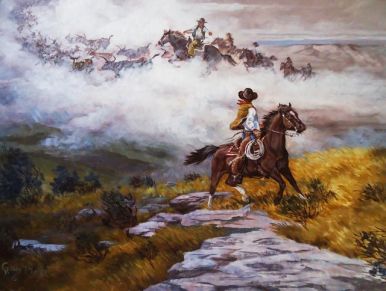
    I have recently read an article about California Gold Rush from my subscribed British history magazine with particular interest as it was somehow relatable to my own experience of being a recent single pioneer woman from the East to the West with new prospects for the future. Although the article was informative in unpicking the social manifest and latent dysfunctions of Gold Rush, there were also new and innovative modes of business as spearheaded by adventurously daring individuals who paved the way to the prosperity of the Wild West in years to come. 

    Wells, Fargo & Company, founded by Henry Wells and William G. Fargo, started and prospered the West’s all-purpose business, consisting of transportation, security, and communication agents, buying gold from prospectors and selling them paper bank drafts and delivering the valuables and mail guarded by a hired detective against outlaws. Pony Express, founded by William Russell, Alexander Majors, and William B. Waddell, was the first express courier service in the U.S., delivering mail from California to New York in fifteen (15) days by dedicated excellent employees on horseback day and night until the transcontinental telegraph was established. And there’s the famed Levi Strauss, the founder of the iconic Strauss & Co., who made the first blue jeans for miners, cowboys, etc. 

    California Gold Rush prompted a huge spike in the demand for changes in various sectors of the American society, which was an inevitable calling of the ethos, Manifest Destiny, and it also begot some of the most interesting and impressive enterprising spirits whose establishments are still among us and whose names are made into the history of the U.S.