Category: Miscellany

  • The Poesie by Titan: poetry in painting


    images
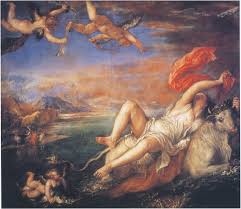
    Europa by Titan

    Although art is territorial, it’s never divisional; it crosses over the branches of art and begets a hybrid of wondrous beauty that spreads through the mind of the beholder and lingers there in alterations, evoking an arch of endless imaginations and a well of inspirations, appealing to our human faculty that is rather physical than metaphysical, sensual than intellectual. It’s a mating of the Senses, a marriage of Reasons perfected in letters or paintings, all in the mastery of stories, colors, and forms begotten by divine madness of artists copulating with a sensation of the flesh in putting a method of expression to its love bed of paper or canvas. Such a love child of arts results in Titan’s riveting masterpiece the ‘Poesie.’

    Titan (1488-1576), one of the most celebrated artists of the Italian Renaissance, created the ‘Poesie,’ a cycle of 6 mythological paintings inspired by Ovid’s ‘the Metamorphoses,’ stories about famous mythological figures in poetry, which was the very reason that Titan chose it as his subjects. Originally commissioned by Phillip II, the life-sized portrait of whose father Emperor Charles V catapulted Titan to stardom in European courts, the ‘Poesie’ gave him the artistic freedom to experiment with different styles of painting incorporating secular subjects that attracted the welcome attention of intellectually ambitious aristocrats. The ‘Poesie,’ meaning poetry in French, is a hexaptych of human emotions expressed in mythological figures that are all too familiar and universal common to all human creatures. It displays the vagaries of human emotions, ranging from euphoria to anguish, passion to regret, and greed to pain, all the artistry in each of the paintings. Titan wanted to create the visual equivalent of the poetry in which Venus burning in passion for her young object of desire Adonis, Europa ravished by Zeus in a bull’s hide, Actaeon chancing upon Diana’s bath and other divine and mortal beings, such as Danae, Perseus, Andromeda, and Calisto intermingled in sensual pursuits were to be translated by strokes of a brush, plays of colors, and dramas of human feelings and emotions. In fact, it is this Titan’s talent both as a storyteller and a painter that sets him apart from his contemporaries and renders the work immortally enshrined in the atrium of universal arts.

    The ‘Poesie’ is currently on display in London’s National Gallery exhibition for the first time in over 4 centuries, following an example of Vatican’s concomitant display of Raphael’s tapestries at the Sistine Chapel. Notwithstanding the thematic and geographic differences, the works of the masters delight the eyes of ours as harbingers of art as artifacts of human civilization consisting of the standard of taste and reason universal in all human creatures as regards the principles of judgment and sentiment common to the eyes and minds of all mankind.

  • thank-you from author Ian Mortimer

    Although Abraham Lincoln said, “Don’t worry when you are not recognized, but strive to be worthy of recognition,” it’s always delightful  to hear when a writer whose work you value highly and like very much appreciates what you have done in connection with the work. For recognition is a great motivator for a dilettante, especially an amateur hobbyist writer, to keep it going in the awareness of her abilities that are in many times smoldered, undervalued, and simply ignored.

    So naturally, I am pleased to find my review of The Time Traveler’s Guide to Elizabethan England by Ian Mortimer gets noted and even quoted on the author’s Twitter today.  Mind you, my dear reader, that I am not an autograph hunter, chasing that usual Thank you- I really- appreciate-your -kind -reviews- on-my-book facade, which I find conceited and empty even, nor do I canvass any such vain cajolery from authors of books like a destitute attention-seeker. Rather, I am glad to know that there are people who appreciate my works however humble they may be, and the happiness becomes twice when such recognition comes from those whose works I like. So it’s a mutual respect between a Reader and a Writer, and vice versa.

    On writing, Stephen King and J.K. Rowling advised in harmony that a good writer requires disciplines and perspiration. True that some of the best writers are natural with their craft bestowed upon them by a supernatural being. But I also believe that many of the great writers work hard by writing continuously and reading copiously. That gives me a ray of hope, and so should you.

  • Raphael’s Tapestries

    Tapestries-in-the-Sistine-Chapel
    The Tapestries by Raphael

    Art can never be old. It is a piece of work that transcends the subjectivity of time in the discovery of the universality of Taste and Reason in the eyes of all human creatures as regards the principles of judgment and sentiment common to all mankind. The beauty of art spreads through the mind of the beholder and stays there in such alterations that it almost feels physical. It is this kind of sensation when we look at Michelangelo’s Sistine Chapel that penetrates deeply into the fortress of Reason surrendering to the force of the Senses. And what if such sensual feast of beauty is doubled by more pleasure that will make it sound sybaritic, and sinful, even? But it is happening now and is happening in the Sistine Chapel in Vatican City.

    To celebrate the 500th anniversary of Raphael’s death, the Vatican has all 12 tapestries designed by the artist hung on the lower walls of the Sistine Chapel. The tapestries were weaved and kept in an art studio in Brussels, and this time they are back in the Sistine Chapel, where they were when Michelangelo, Raphael’s contemporary rival, worked on the frescoes, which eclipsed the silky and shiny tapestries that allude to the affable and delicate nature of the creator. The tapestries are said to have been restored by Vatican Museum conservationists in the last 10 years. It is also said that the last time all of 13 tapestries were on display was in the late 1500s.

    The magnificent display of Raphael’s tapestries was originally Pope Francis’s idea that the beauty of art should be shared and appreciated by all coming from all over the world, the low and the high, the ignored and the admired. Likewise, art should not be a prerogative of a few select or the haves who pride themselves on possessing and knowing a thing about art. Art is not a thing, but a way in life that nourishes our minds, imbuing us with a breath of artistic inspirations to create an art of our own. The Pope knows that through the power of art, the Mysteries of Faith will be understood in manifold ways, which chimes with Shakespeare’s view on art as thus: “The object of art is to give life a shape.” Right on. Rock on.

  • on #ShakespeareSunday

    Great works of geniuses are contemporary with their time and ours; they transcend a great divide of time and space across cultural and racial boundaries and apply the universality of objective truths to any era of our human civilization. That is why William Shakespeare, an Elizabethan workaday dramatist and poet who also acted on stage himself, is a Universal Writer whose works are still widely read, told, re-told, and reenacted that magically resurrect the time he lived that seemed remote yet surprisingly familiar. For Shakespeare is all about humanity that continues to appeal with his rhetorical utility. Hence, I participate in a weekly #ShakespeareSunday on Twitter with different themes as provided by the host. Last Sunday’s theme was ‘ITALY & TRAVEL,’ and this is my tweet that I want to share on my blog with my Readers whom I also encourage to do the same.

  • My essay published on the working class academics conference!

    https://twitter.com/AcademicsClass/status/1228702540130390016?s=20

    My Blog post about Working Class Academics Conference has been published on their website! I was asked to contribute my writing to their wonderful organization promoting the presence of academics with working-class backgrounds on Twitter two weeks ago. Although I am not even in the UK, I was flattered by their invitation. Here is my essay accompanied by the brilliant artwork by Dr. Peter Shukie himself, the founder of Working Class Academics Conference. Thank you very much!

  • Sylvanian troubadours

    Nature is a free luxury spa for all without asking of you any identification card or permits to visit. It is a marvelous Carte Blanche given to us as our birthright gift from the greatest man above.

    Nature is a spectacular cinema of what alchemists considered as the essential components of the Universe, where Fire, Water, Earth, and Air create a symphony of Beauty unsullied by human artfulness. So much so that Lord Byron rhapsodized about this natural beauty thus: “There is pleasure in the pathless woods, there is rapture in the lonely shore, there is a society where none intrudes, by the deep sea, and music in its roar; I love not Man the less, but Nature more.”

    And that is what I and my band of Sylvanian troubadours saw and thought when we went hiking yesterday. We looked at beauty and saw it was purchased by the weight. What a wonderful world it was! Would it be the same feeling God was surged up with when he saw the world after his creation? I bet it was.