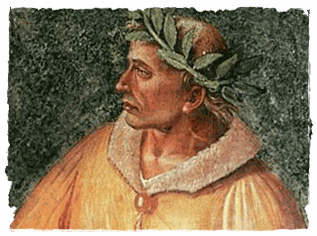
People tend to think that the books of antiquarian authors are far-fetched from the reality of our digital era, whereas our calendar years on the evolutionary scale amount to microseconds on the twenty-four-hour biological clock. Apart from a great divide of time, great writers of all time show us the wounds and mirth at the heart of humankind and stand observant of the anfractuous human lives as though to be seen through opera glasses. In this respect, Ovid, author of Metamorphoses, can be regarded as an ancient trailblazer of popular literature whose subject matters, such as cause and effects of love and devotion, are still appealing to readers.
Ovid first gained popularity with The Ars Amatoris (The Art of Love), a kind of self-help book for men on how to woo women and keep their love with practical tips under the guise of a formal didactic reference to avoid censorship. Heroines, a series of dramatic monologues centering on mythological women, including Penelope, Dido, and Ariadne, lamenting on their mistreatment at the hands of their men, earned him the sobriquet of best-seller writer of his time. However, what Ovid secretly and really craved was a learned readership vis-à-vis the reputations of his peers Horace and Virgil whose works were regarded in high intellectual esteem by the elites. Hence, Metamorphoses, a series of 250 stories of gods and immortals intertwined in a vortex of love, lust, grief, and terror, was his magnum opus, a kind of literary vindication of mass demotic literature. It seemed that Ovid as a man of flowering Roman letters arrived at his pinnacle of literary career until fortune’s malice overthrew his state.
Ovid suddenly fell out of favor of the emperor and exiled to Toms, a city on the Black Sea. Whys and hows of Ovid’s exile are still clandestine to this date as Ovid also never recorded any details about what caused the emperor to banish him to the backwater of the empire. As with many a conspiracy story, there are hypotheses of the cause of this unfortunate event: (1) Ovid had a love affair with Livia, Augustus’s wife, while married with children; (2) Ovid knew of an incestuous affair between the emperor and his daughter Julia; or (3) the error might have been of political nature because Ovid might have gossiped about certain political factions. But then any of the above can be a figment of imagination.
Notwithstanding the above, I like to think that Ovid is a great benefactor of mankind with his dazzling reworking of Latin and Greek myths and entertainingly vibrant guidance of practical love. In fact, he was far more gentlemanly in treating women regardless of their age and looks than any of our contemporary man writers are. To Ovid asking a woman’s age was highly improper and telling a woman of good things about her were a must to keep her love ongoing. In light of the above, none of the aforesaid presumptions rings true to me, and it is my presumption that maybe Ovid’s jealous contemporary despising the well-deserved success of Metamorphoses conspired against him and pushed him to banishment in the outpost of Rome, the city Ovid loved so much.






You must be logged in to post a comment.