Category: prompts

  • Saturday, October 24, 2026 — Reading of Chloë Ashby’s Review of Alone with a Book by Tessa Hadley, Published in The Guardian on October 20,2026 (Saturday Reading Essay)

    One reason I don’t like books by contemporary writers is that many of them seem to come from privileged backgrounds, with prestigious academic credentials and a socioeconomic status that protects them from the burden of working for a living. Poets are not much different: they find meaning in the everyday tasks that the rest of us must perform simply to live. Ashby’s review of Alone with a Book by Tessa Hadley sets a bell ringing in my spirit, instantly piquing my interest in the life of a kindred spirit in stories. What makes Hadley unique among her contemporaries is her delight in the ordinary, the seemingly mundane and trivial.

    My literary heroines are Agnes Grey, Jane Eyre, Prudence in A View of the Harbour, Macabéa in The Hour of the Star, and Renée in The Elegance of the Hedgehog. What do these women have in common? They have no glamorous jobs with PPO health insurance or weeks of paid vacation, nor the kind of intricate intellectual vertigo that places them on a higher pedestal. And if a character is the opposite of these women, she usually rebels against social norms or thrusts her fist toward the sky while chanting for social equality without knowing what it is. Have I forgotten books about ideology and identity, which are so in vogue? Or the confessional memoirs published by celebrities, and so forth? What a medley of public existential angst, clamoring to become bestsellers or national bestsellers.

    Hadley is a woman of letters who draws wisdom and beauty from life through her intellectual curiosity about the three value paths in logotherapy: creative, experiential, and attitudinal, which can be achieved by fulfilling the duties daily life gives us. I am uncertain whether Hadley wrote her essay and her other books with the tenets of logotherapy in mind, but these values seem to match her worldview and her literary world. In Charlotte Brontë’s terms, an author should write what is true to herself and therefore true to life, just as her little sister Anne Brontë did in Agnes Grey. Anne drew on her own experience as a governess, enduring—with the grace of a swan and the attentiveness of a cat—the haughtiness of those who employed her to educate their children. Agnes saw the precarious human emotions in her employers’ flaunting of influence and beauty. I am certain that Hadley would love to write about an Agnes Grey of our time.

    What distinguishes Hadley from others is her view of Christianity as a positive influence that has shaped cultural imagination and our idea of beauty, a way to see beauty in human life. This is remarkable because it is uncommon to find Christianity as a foundation for artistic inspiration in the aesthetic expression of human emotions. She remains in awe of religious paintings, including The Coronation of the Virgin by Jacopo di Cione and The Assassination of Saint Peter Martyr by Giovanni Bellini. Hadley finds Christianity’s magnanimity in life and art rather than in the Church’s catechism.

    I regard myself as a ghost lover, as many of my beloved writers have become stars in literature’s constellation. To me, their work feels more inviting, letting me know more about the characters through whom the writers delineate silhouettes of themselves. But I cannot help but think that writing about someone with no six-figure income, a big house without a mortgage, and/or glittering academic credentials and beauty has become an oddly rare literary subject, at least for now.
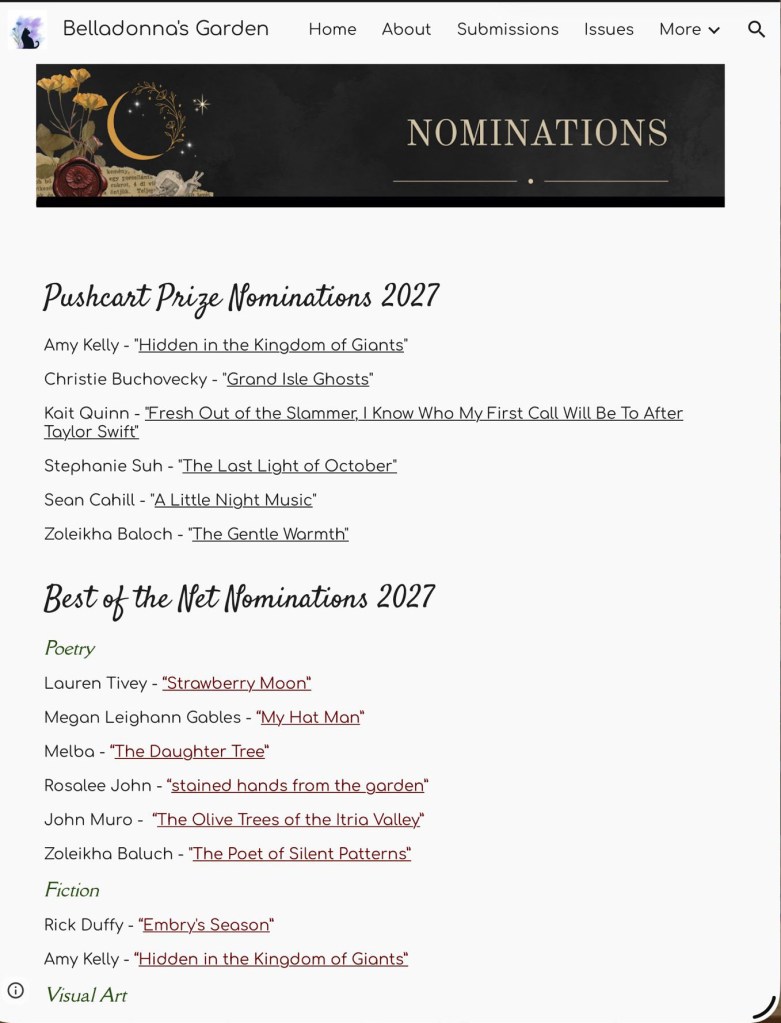
  • 2027 Pushcart Prize Nomination

    I am delighted to share that my poem “The Last Light of October” has been nominated for the 2027 Pushcart Prize by Belladonna’s Garden.

    My heartfelt thanks to Editor-in-Chief Shari Wilder for this honor.

    Announcement image courtesy of https://www.belladonnasgardenlit.com/issues/winter-2026-issue-2/stephanie-suh

  • Sunday Letter – 2

    Sunday, September 6th, 2026

    Hi Freddo,

    It’s September, and fall will arrive soon. In fact, the cooler temperatures are already its harbingers, and I am all for it. How’s the weather in Rome? And how are your projects coming along? Last time I heard, you were working on a translation of a certain book from English into Italian. Are you still working on it? Can you tell me what the book is about?

    I want to show you my prose poem I wrote yesterday. It’s one of my recent experiments with story-like poems. I write poems that read like prose. The best thing about prose poems is that there is no complication of characters with existential dilemmas and metaphysical questions about who they are—questions that not many people care about. But these days, too many poems and stories can read like ideological catalogs, social agendas, or personal traumas that are not easy to read and take to heart. While I get that shared traumatic experiences may help those who find themselves therein, that is not my cup of tea. I don’t want to write about my ethnicity or race in the context of living in America as an Asian immigrant woman. I don’t want to be labeled as an “ethnic” woman writer whose work is shelved outside of the so-called mainstream book sections in bookstores. That is why I admire someone such as Kazuo Ishiguro, who wrote The Remains of the Day. His background does not prescribe the consciousness, subject, or voice he is permitted to inhabit; you would not necessarily know that a Japanese-British man wrote it in posh British English. There are no boundaries of race, gender, or age in the language of the mind and heart. You can be whoever you want to be and show the world the way you are.

    Today’s letter reads like a rant from an anxious woman irritated by a boisterous party of popular or best-selling writers. So be it. I do not want to be restrained in the realm of written words where I can be myself. I do not like being boxed in by what people expect me to be and write, because that is not who I am. You would find it a bit hard to relate to my literary zeal to write the truth about myself because you would not feel the pressure of ink in your own color, but that is okay. I do not expect you to understand my stance. However, I would be incredibly happy to see you on my side when people scoff at my poems and prose.

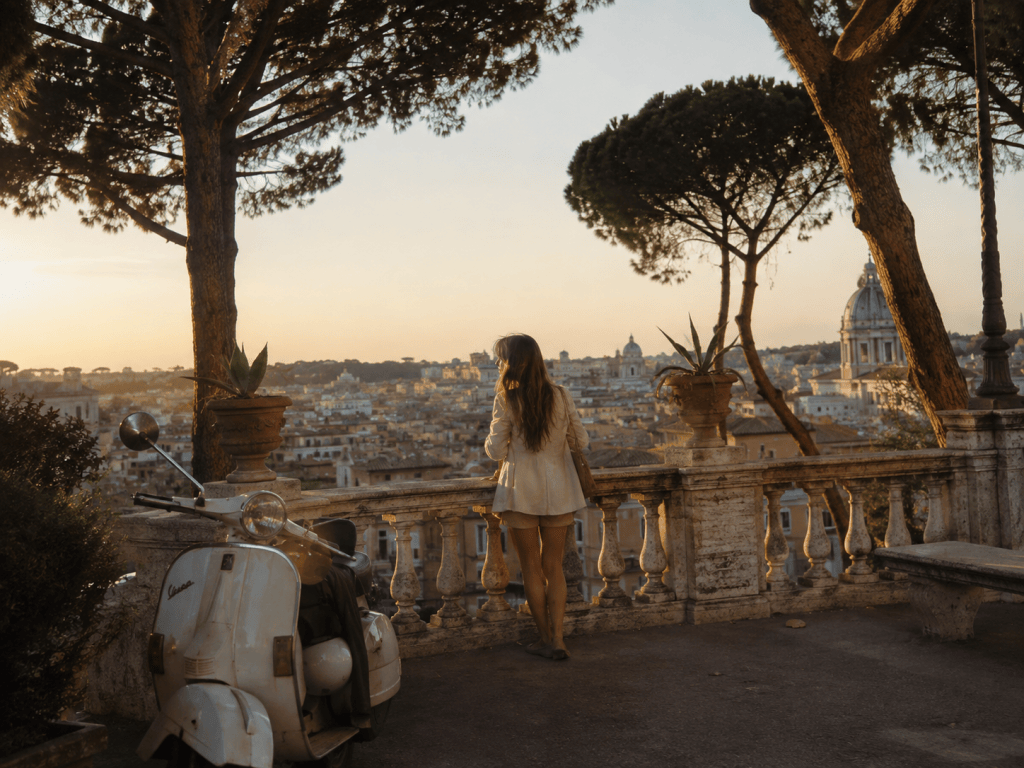
    Dreaming of a dusk on the Aventino Hill looking over Rome with you,

    Stefania

  • Queen’s cats

    Share a photo of your pet and tell us one thing that makes them uniquely them.

    Camile (L) and Toro (R) on their look out from Queen’s Castle

    My cats think they are human. They like Häagen-Dazs ice cream and want to lounge in the living room with me, let alone jump on my bed when I say good night each night. Did I also mention that they’re bilingual?

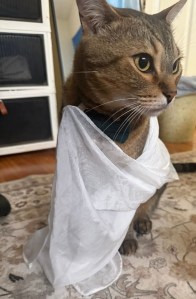
    Toro in Toga channeling into an ancient Roman aristocrat

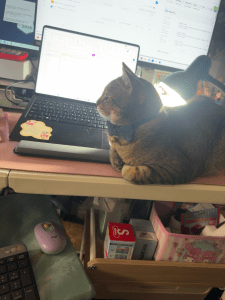
    Toro, the 6-year-old tabby, is a little tiger who wants to help me when I work from home, always insisting on typing emails and notes on my work laptop, which need my spellcheck. He takes breaks and lunch with me, so I am never alone at home. And Toro’s being human doesn’t stop there. He knows when my brother calls because he always sits next to me, his little furry body resting on my side.

    Camille’s magic eyes

    Camille, the 4-year-old black cat, is a little black panther who looks just like Gigi from Kiki’s Delivery Service. Although Camille speaks no Korean, he understands when I tell him my secret wishes and how grateful I am that he lives with me because I am lucky to live with such an adorable black cat.

    Toro as my assistant

    Whoever says cats are naturally independent and feral has not seen Toro and Camille. They are very affectionate and loving. I see their spirits in amber and emerald eyes. I feel their little hearts on my chest and at my feet.

    And they slowly blink their big eyes and bunt their little heads when I say, “I love you so much in every universe.”

  • prompt returns

    Daily writing prompt
    What’s a promise you made to yourself that you’ve actually kept?

    I collect promises like Swarovski jewelry, from necklaces to earrings, to bracelets, and more. I love pretty things, so I change them, but it all comes down to a few select ones that I usually wear to my heart’s liking. So are my promises. There are many, but only a few of them remain, and one of them makes it out to a World Cup final.

    I have always wanted to write a book that I can leave as my legacy, just so to prove I have lived, that I, Stephanie Joori Suh, lived, saw, and wrote. The thought that one day my body will become a speck of dust or ashes gives me a panic attack amounting to losing my eyesight completely. The ancient Greek poetess Sappho also felt the same, as found in one of her surviving fragments. Besides, there is something in me urging me to write as it is my nature. My father once told me that he had the same urge to write poetry, as his mother did too. Maybe it’s in the genes, like a family of practicing ancient secret rites.

    What I have done is to write my first chapbook of poetry this year. It is a collection of poems I wrote from my East Coast years to the present West Coast years. I auto-published a short story before as a Kindle Read, but this is my first time submitting a poetry chapbook to editors of ten presses. Some of them are for chapbook prizes, and some are regular chapbook submissions. And… one of them sent me an email last Wednesday that they wanted to publish my chapbook. I do not want to open a champagne early until I have an actual chapbook of mine in hand. Still, I feel I am in the procession of poets from the misty past and continuing as long as humanity remains.

  • A New Poem on Ko-fi: ‘The Chariot Runs in the Dark

    I’ve posted a new poem on my Ko-fi page — one of the pieces that stayed with me after submission season.

    These poems may not have found their journal home, but they still belong somewhere: in the small literary room I am building, slowly, carefully, and with feeling.

    You can read the poem here:

    https://ko-fi.com/steph79650

    If the work speaks to you, support through Ko-fi is always deeply appreciated. It helps me continue building this quiet salon of poems, fragments, reviews, and literary notes.