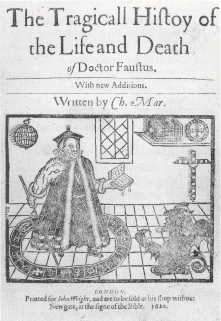
 He was a formidable agent provocateur: a blasphemous rebel, a proud atheist, a counterfeit, and a sybaritic seeker of tobacco and boys and an alleged spy for the government with his literary arsenal and daredevil machismo toward life. It was no less a dramatist, playwright than Christopher Marlowe, who introduced the concepts; a man whose life was staged so mysteriously and controversially that even his death was enveloped in a provocative imbroglio of factoids. In a case of life imitating art, Marlowe’s life was an epic tragedy for a literary enfant terrible struggling to mark his name in the Elizabethan England, where his literary genius and individualism were something of irreligious decadence to be reckoned with. Marlowe’s version of Dr. Faustus was his testimony against conventional absurdities of life in defense of his existential meaning of life, and there’s his outcry of existential dilemma spreading through the mind of the reader and connecting to the world of Marlowe.
Dr. Faustus is a collective model of existential dilemma of Marlowe and his educated poor peers boxed in clerical positions with paltry sustenance in the Church of England. In fact, the strains of daily life of an educated poor is inculcated in the figure of Dr. Faust in retribution of their social confinement unparalleled to the scholarship and academic achievements. Marlowe saw poverty obstructing the progress of gifted minds, and consequently, it became his literary and psychological stratagem of fictional world populated with characters terminated by inner conflicts set in the background against the class divisions and religious dogmas intractably entrenched in Elizabethan England. Thus, Marlowe carried out his poetic justice by making Dr. Faustus able to fulfill his materialistic objectives by the agency of magic from the demonic power, even though it required of him a spiritual as well as physical quid pro quo in this story laden with super abundance of religious tenets and morals that all seemed a pompous, sanctimonious hokum.
Marlowe used Dr. Faustus as his literary artifact, a psychological and spiritual medium through whom he made parallels with his own life, measuring himself against the burgeoning careers of his peers of his time. Dr. Faustus was in a way Marlowe’s mirror image that reflected all things about himself in the peculiar alchemy of literature. It all seems to me that Marlowe was a way ahead of his time because the contextualization of inner conflicts of the characters and the thematic substratum strike the chords of readers of post-enlightenment, post-Second Vatican Council and post-modernism. His behemoth contemporary peer William Shakespeare said, “Some are born great, others achieve greatness.” I like to think that Marlowe was both in the canon of English literature.


 Being a witch can be this fun. She can fly on a broomstick anywhere faster, higher and further and see the world in her own eyes, which takes her to a higher plane of existence. Perish the titular image of a spooky hag with an equally evil-looking black cat flying together on an old broomstick on Witches Sabbath as a medieval invention of a woman laden with sexual and spiritual depravity. For a witch can be young, innocent, good-hearted and hard-working into the bargain who tries to live purposefully and meaningfully with what’s given to her as a result of responding genuinely and humanly to life’s challenges. Such is a growing tale of Kiki’s Delivery Service, aka Witch’s Delivery Service.


You must be logged in to post a comment.