
Fairies, pray come and take me out of this rut
For I want to ride the wind with you in a heartbeat,
Stand on the highest crest of the leviathan tide,
And dance across the meadows and fly with light.
Fairies, pray come and take me out of this rut
For I want to ride the wind with you in a heartbeat,
Stand on the highest crest of the leviathan tide,
And dance across the meadows and fly with light.
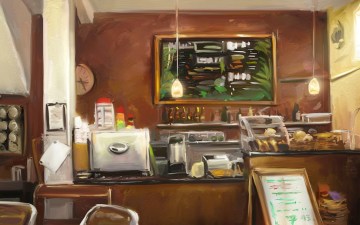
He wanted to talk to her but didn’t know how to begin. He did not want to look overtly anxious, and yet he was obviously anxious. Part of it was his urge to find out if she was the right one that matched his gossamer imago, and more of it was his untamed machismo that even his arete, the harmonious combination of moral integrity and physical discipline, could not surmount. In the age of Amazonian resurgence of matriarchy on the crest of #MeToo campaign, the subject matter of indomitable feat of virility could be highly volatile, incriminating even. But Hector was being none other than a man himself and going against nature would turn him into a closet monster or a spectacular hypocrite. Besides, Hector was an artist who was unafraid of following his heart according to the True North of Nature. He belonged to the race of the untethered, the bold and the beautiful, and he knew it. All of it, all that he had was working toward his wish to speak to her, the mysterious woman sitting three seats away from him.
When it reached the zenith of the urge, Hector couldn’t hold it any longer, and it finally erupted from his lips: “Excuse me, miss. I forgot to bring a pen with me. Do you have a spare one by any chance?” It was the best excuse he could think of because the woman was writing in her notebook. She seemed startled at first by a strange man’s request for a pen, but soon her fear of a stranger relented at his polite manner handsomely juxtaposed with his sonorous voice and beautiful eyes that radiated both warmth of the soul and allure of the flesh. Iris was always sagacious of people’s characters, which was her gift and curse of the Fates, and she saw genuineness in this strange but beautiful man’s eyes in an aura of charisma, a mythological power ascribed to the Olympians and select hybrids of mortals and immortals. In a phantasmagorical display of the Greek heroes and gods, Iris was filled with mysterious confidence that gave her a status that fuses the capricious power of a fairy with the sensuous charge of femininity. She finally fished in a pen from her pencil case and gave it to him. “Thank you, Miss. These days people do not seem to carry around a pencil case.” Hector thought that he talked too much and instantly regretted it. But it was a reflex of his heart that knew better. It was working slowly, the kindling of the amber that was beginning to grow. No, my dear reader, it wasn’t that usual playboy’s antics, that sleek glib of a smooth operator because Hector wasn’t the sort. Nothing namby-pamby about Hector’s sensitive nature, nor the supra-abundance of the embryonic courtship that might not even develop with fanfare. But nothing could be further from the truth – the truth that both Hector and Iris were votaries of aesthetic pleasure, the cult of Psyche and Eros, the seekers of Eleusinian Mysteries in their own rights.
Iris wanted Hector to go on, to take her on, to lead her on. Despite her instant bestowal of confidence, she was still wrapped up in her own clock of anonymity and invisibility like a fairy who was visible to the mortal eyes when she wanted to. A fairy whose sentiments were different from the mortals and who could be both impish and angelic according to her whims and caprice. For a fairy by nature was amoral and could fashion in whatever forms she would prefer. Thenceforth, Iris was lamenting that a fairy at the time of her birth did not bring her a gift of beauty that could captivate a man of her heart. Surely, she was told beautiful, sultry even, but her resemblance to Cassandra was the sine qua non of her solitude, although she would like to insist that it was her voluntary choice. The grace and the harmony of her features would make a beholder think that they were aesthetically proportioned, yet she wasn’t exactly a Helen of Troy for whom Paris, the prince of Troy, left his nymph companion in distress and for whom thousands of ships launched to win her love. Alas, poor Iris! I knew her, my dear reader. I commiserated with her spiritually. I should have cast glamour spells on her so that she could be instantly gorgeous at that time. But would it be a kind of beauty she really wanted?… I wondered. I questioned: then, would Iris- a lesser beauty, a confused fairy, and a distressed Cassandra- make this mysterious man interested in her soul until they became two by two and about what went they to? In this fey meditation, her spirit was pivoting ecstatically from the mind’s castle and swiveling in wonderment. Iris was secretly invoking the power of all the fairies in the limine spheres, the slice of seacoast between low and high tides, deepening foliage between field and forest, and the slope-land between plains and mountains.
I didn’t anticipate her response, let alone her thanks. After all, she’s a celeb in the constellation of high stars, a goddess in the pantheon of divine knowledge, and a grand master in alchemy of literature, Or in recognition of her self-titled epithet, she’s the Comma Queen who will not/does not suffer from the grammatical benightedness of ambitious literary proclivity. But it happened, and she did; Mary Norris, author of Greek to Me about which I wrote a review, responded thereto in the following fashion:
Dear Stephanie,
I thank you and Athena thanks you for a generous and perceptive take on #GreektoMe! Ευχαριστώ!— Mary Norris (@MaryNorrisTNY) July 5, 2019
Well, it’s nice to be complimented for my work by someone who is famous, and I certainly wouldn’t mind being rich and famous if I turned into an overnight sensation in literary firmament. Yet, I do not write to make a living nor to be popular with hundreds of likes. Writing to me is an act of sovereign remedy for the existential ills, of personal treatise on the workings of the mind and of sheer egotism of relieving the creative urge from within. Come what may, a little tweet from the celebrated writer will not turn love of the book into worship of the writer. For it is the work of her intellect manifested in her literary craftsmanship, not the person herself. Whether or not the author liked my review does not/will not/should not affect my reason for and act of writing with a million dollar memento from Kurt Vonnegut: “To practice art, no matter how well or badly, is to make your soul grow. So just do it.”
 Greek to Me: Adventures of the Comma Queen by Mary Norris
My rating: 4 of 5 stars
The ancient Greeks knew what appealed to the senses. The cult of beauty was the caryatid pillars of the culture that sublimated the human body into a divine canvas of the mind. So much so that they codified the value of beauty in their belief system, ranging from mythology to philosophy, in pursuit of kalokagathia , the harmonious combination of physical beauty with spiritual goodness. The perennial upshot of this Greek admiration of kalokagathia is Mary Norris’s charming Greek to Me: Adventures of the Comma Queen, a wonderful cabinet of her infatuations with all things Greek, ranging from awesome Goddess Athena to dashing Sean Connery as Agamemnon, to the whimsical variations of Greek pronunciation, and to her exhilarating skinny-dipping in Aphrodite’s Beach. With her gift of scintillating narrative skills flavored with accessible erudition, Norris warmly invites the reader to her own delightful Greek festival of words, gods, romances, and delicacies.
It is said that when you love, you want to know. An erotic impulse charged from the imposing physical presence of Sean Connery as Agamemnon became a stimuli that galvanized a shy celibate Catholic bluestocking into her never-ending solo odyssey in pursuit of a mystical ambrosia, the food of the Greek gods, for the sensuous delight of the arcane Eleusinean Mysteries. Part memoir, part travelogue, and part reference book, Greek to me is a lovely treatise on Norris’s lasting affairs of the heart with words and adventures in the land of the capricious Olympians, olive trees, and phonetic alphabets with infinite varieties. The scholarly subjects of mythology and language of Greece are never dealt with academic superciliousness or elitist snobbishness that separates them (and the author) from a general reader. Contrariwise, Norris is an intelligently gorgeous writer who wears her erudition lightly and writes in plain language felicitously topped with her artless witticism that makes her a winsome literary troubadour. If Edith Hamilton, author of Mythology and The Greek Way, has an aura of dour-faced platonic conservative teacher of the ancient Greek mythology and the culture, Mary Norris is of a coterie of amiable Socrates, sharing her knowledge with the public – literate, illiterate.
In the exhilarating sensation of naked freedom astride the gushing foams of wild waves in Aphrodite’s Beach, the reader feels connected to the author’s paroxysm of pleasure and transformed into a votary of the goddess of love. Norris’s solipsistic adventure becomes a tour of coterie, traveling beyond the territorial borders into the mythological world of gods and goddesses in search of the Golden Fleece fit to one’s appropriate need. Although the chapters devoted to the lexicons of the Greek language can be taxing to comprehend to whom it all looks Greek, most of the book is invested with the vicarious Eureka pleasure of going there, being there, and seeing there, all made possible by Norris’s goddess Athena-like literary prowess. Besides, if the reader happens to be a quiet solo Catholic woman graduating from Rutgers University in New Brunswick, NJ (more specifically, all-women Douglass College therein), secretly desirous of solitary skinny-dipping in Aphrodite’s Beaches basking in freedom from insecurity, this book will feel like a new friend.

5:15 PM to Florencia. Iris looked at her iPhone clock and felt secured because the time was working nicely with her wish to stay longer until the train departed. The cappuccino was still pleasantly warm in her hands, and she loved the aroma that enveloped her tall slender figure like a shimmering halo of rainbow sunshine. The iridescent mist of instant euphoria was clothing her with a veil of poised status that fused mysterious confidence with graceful humility. Emboldened by this sudden transformation, Iris pulled herself out of her glass castle and lifted her beautiful deep liquid brown eyes to the outside the world of her own. Into the sea of her diamond eyes, the images of love and beauty were cast like magical apparitions, bewitching her senses and sensibilities which were otherwise harnessed like a pair of tamed horses. Iris felt that she could forgive all and love all at that moment of euphoria. It showed that a cup of good coffee could do wonder to anyone as it had done to Johannes Sebastian Bach, Albert Camus, Napoleon Bonaparte, Jonathan Swift, and Ralph Waldo Emerson.
In this caffeine-induced euphoria, Iris did not know she was radiant with her pretty smile. The smile was her most prized jewel. When she smiled, she was sweets to the sweet. It was like a flower blooming around an oasis in a desert, and everyone liked it. It’s as rare as a pearl found in a clam, and it’s this rarity of her smile that kept herself distant from the melee who demanded of her frequent smiles. And who would have known that her pearly smile would have caught the sight of Hector? Yes, it was Hector, the mysterious man with a Byronic face and Olympian physique sitting three seats away from Iris, the smile enchantress. Reader, you should understand that Iris was usually a skillful driver of her Chariot of Mind, keeping a tight rein on the always recalcitrant Horse of Appetites. But at that moment, Iris’s chariot was shaking, and the impudent horse was not responding to her stern command to behave. The harder and more she hit the horse with a goad, the more and harder the horse rebelled against the pain until it became mad with a wild cry of agony. It was the cry of the restrained nature. For the nature of the impudent horse was to act according to its beastly desire, the primal cry of the wild. The ancient Greeks regarded love involving man and woman as the most passionately sensual emotion in which only Eros dominated because it was primarily physical, encompassing carnal pleasure. Was it that Eros and Eros only that reigned in Iris’s entertainment of this rebellious chariot of the mind with the wild cry? Iris did not think so and liked to believe it wasn’t. After all, Iris was chaste, and she believed that she would live as a living goddess like Artemis or Athena, independent of men, of children, flying outside the boundary of marriage and attachment.
Hector was watching this curious woman all along. He did not know why, but something was telling him that she was different from other women whom he had known and lived with. She looked both woman and girl in her tall thin body. She was beautiful with her chiseled face and large dark brown eyes that looked rather serious and dolorous. Her high-bridged straight nose gave her an impression of a patrician woman whom no one could easily be jovial with. The beauty and the grace of her were not in want, and yet she wasn’t exactly the fairest of all the women he had met. Besides, there was a touch of beyondness to her, which was oddly attractive with her rather sophisticated urban demure. The graceful estrangement emanating from this unknown girl/woman reminded him of a deer that lost a track of her kind in a deep forest. Or did she look like a she-wolf voluntarily detached from the pack? Whatever it was, he was hooked on it and wanted to know more about it. It was in her, and she was in it. He wanted to be in it, willingly and madly. Was it an illusion or just a whimsical mood of a bored artist? Hector was all for the adventure, and he’s up for it like Odyssey in preparation for his adventures between the sea and the devil.
 Let Me In by John Ajvide Lindqvist
My rating: 1 of 5 stars
Most of the time, a book made into a film does not fall from the grace of its original literary merit and retains its sovereignty as a textual master over the cinematic adaptation. At least, that’s what I think. It’s really a win-win situation in which both a book and a novel have their own charms with the appropriate bells and whistles. Alas, that’s not the case of Let Me In by John Ajvide Lindqvist. Not an Iota. The book betrayed my anticipation of passing over to the minds of the characters for empathy and disappointed me with its bleak and dreary narrative. It’s like meeting your hero and ending up with a cold, contemptuous shoulder that cut off the thinnest and the highest note of the mind’s strings.
The textual version of the Boy and the Vampire named Oskar and Eli, respectively, were hardly pathetic, not to mention likable, roaming the dark alleys of Scandinavian Dystopia plastered with pornography in all sorts of perversion. IT’s there, it’s here, it’s all over everywhere on the pages like pits pull of filth. The matter-of-fact accounts of child molestation defenestrated my mental equilibrium into catatonia, and I recoiled in diabolic horror in the course of wading through the chapters so as just to get them over with in a heartbeat. Any such disgrace of the subject matter could have been reconciled with a felicity of expressions and literary craftsmanship that would have at least rendered it bearable to read and excusable to merit its genre. Yet, the book continued to go against the grain to grant my wish for even teeny tiny weeny bit of pleasure of reading it – to the end. It all seemed to me that the catastrophe was due to the English translation of the original Swedish version of the book by an anonymous translator trying either too hard or too little to articulate the sentiments that could only be rendered accessible in the author’s mother tongue. The result was an ineffective simulation of a style of writing supposedly associated with Stephen King.
Maybe it’s just me having a difficulty in appreciating the mind of the Swedish writer whom Stephen King generously hailed as one of the top writers of the horror fiction genre. Maybe my adultescent anticipation for the book was precipitately induced by the visual sensation from its film version, which is far better than its textual master in terms of the portrayal of the characters and the interpretation of their minds, capturing the subdued but powerful moments of revelation intelligently played out by Director Matt Reeves, who seems to understand the gist of the book as though it were written by him. Be that as it may, the book was not meant for someone whose heartstrings were prone to be broken if they were to be pulled out perforce. For the book still rings hollow in the valley of bleakness and shrieks in the alley of darkness and nothing more.


You must be logged in to post a comment.