Blog

  • ‘Creators: From Chaucer and Durer to Picasso and Disney’, by Paul Johnson – review

    CreatorsCreators by Paul Johnson

    My rating: 5 of 5 stars

    Kurt Vonnegut encouraged anyone dabbling in the act of creativity: “To practice art, no matter how well or badly, is to make your soul grow. So do it.” Accordingly, the art of creation is a noble act of finding a meaning of life in which man searches for his freedom of will and will to meaning by translating the principles of sentiments and reason that are universal in humankind to various forms of creativity, ranging from writing and painting to music and dance, and to even gardening and making people laugh. Such act of making something out of nothing requires Herculean feats of courage and spirit that serves as a sovereign remedy for the existential ills of everyday life, however ordinary or exceptional. Paul Johnson’s Creators, which looks into the bright side of clever, talented individuals contrary to his previously published Intellectuals in which he recounted the hypocrisy of historically famous intellectuals, presents his thesis: that we all have creative traits in us is our divine prerogative of humanity; and to produce works of the arts involves prodigies of courage as well as talent that is sublimated to the aesthetic expression of intellect and beauty, such as to be in the cases of luminous artists whose oeuvres marked their standing in literature, painting, and music.

    Each chapter on each different artist draws up on the artist’s unyielding courage and creativity, which is a quintessential element of creative originality of outstanding quality. Johnson admits that an artist tends to be egotistical due to his extravagant faculty of creativity into which the artist pours out everything that is in him. An unusual degree of courage that is akin to physical courage of a soldier on the front is demanded of the artist unless he bows to the final enemy of creativity, such as age or increasing debility. Take Beethoven’s struggling against his deafness by using a toothbrush in his mouth to feel the tonality of each piano key while composing his immortal symphonies. Great impressionist painter Toulouse-Lautrec’s inherited disabilities and grotesque deformities as a result of hereditary inbreeding could not stop him from producing beautiful paintings with his triumphant willpower and courage until his death at the age of thirty-seven. Robert Louis Stevenson wrote incessantly despite his chronic illness due to his weak and unreliable lungs that eventually killed him in his early forties. Emily Dickinson wrote poetry without encouragement and public response, while David Hume failed to receive public recognition upon publishing Human Understanding. So did Anthony Trollope of The Macdermots of Bally Cloran that was neither reviewed nor sold of a single copy.

    The life of an artist is full of peculiar aspects and strange satisfaction often spurred on by personal weaknesses, such as in the cases of Jane Austen and George Eliot whose real name was Mary Ann Evans. Both of the women led lonely and lugubrious lives without experiencing felicities of love and adulation by men despite their brilliant spirits and ingenious minds. Surely beauty was in their time and still is only skin-deep, but their plainness left them in spinsterhood and forced themselves to spur loneliness on writing that was the solace in which they could fall in love with the men they desired. In effect, the reader will learn that it was the courage to express their spirits and feminine aspiration to be loved that fed on their creativity. Also, self-awareness, careful nursing, and restricting of the talents and subject matters, rather than audacious rampant criticism of society in general in undisciplined tempest of words, were added to the wings of their creative spirits.

    In light of the above, art is not genius but a work born of love and labor of its creator whose Herculean degree of courage and desire of expressing imaginations and intellect perform a painful but delightful feat of ingeniousness. Johnson avows that rational and professional methods of using skills, experiences, creative industriousness, and self-confidence are the ingredients to create the work of art. Also, he affirms the reader that there is no need to make a pact with the devil or perform a magical ceremony to invoke a creative spirit because inspiration comes from within. It is how to find it and reveal it like a hidden diamond in its most radiant luminescence. Written in common words devoid of academic locutions and once again his usual consummate narrative skills, this is Johnson’s another scintillating book to be acquainted with the human face of geniuses whose works have produced pleasure in our senses and minds.
  • Song About Her

    young_woman_washing_plates_580x
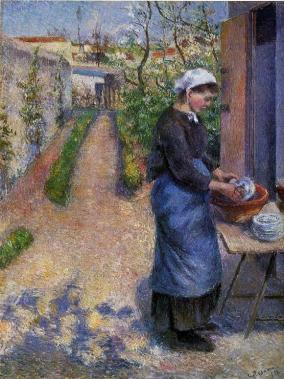
    A Young Woman Washing Dishes by Camille Pissaro

    Her beauty is invisible to untamed view
    As that of many maidens be;
    Her charm he never knew
    Until she smiled on him;
    Then he found her diamond eyes,
    A jewel of passion, a well of grace!

    Alas! Her reply is shy and silent,
    To him it is a cold recrimination;
    But his secret passion is not misspent
    For the secret passion in her bastion;

    Her infelicities are even muliebral, more
    Than the felicities of other maidens are.

  • Italy Dreamin’

    Amalfi Coast photo book, Italy (60 photos) : Europe series 4Amalfi Coast photo book, Italy (60 photos) : Europe series 4 by Akira Okubo

    My rating: 5 of 5 stars


    When my spirit feels weary of existential dealings of daily life and whets a desire of carefree escapade from the reality I am anchored in, I tend to daydream about places I want to travel alone. John Steinbeck once admitted that oftentimes, reading magazines and books full of colorful pictures of foreign countries would be more satisfying than actually going there, save all the hustling and bustling, flotsam and jetsam related to traveling. Hence my choice was this beautiful pictorial read of Amalfi Coast in Italy on my Kindle Fire. The delightful pix of southern Italy will take you out of your humdrum life while looking at them; they bring vibrancy of the ambience of the region to your eyes and allure your heart to the romance with the beauty in a heartbeat, alone with yourself.  The rustic and restive sensuousness of the scenery as vividly illustrated in the pictures will dazzle the reader’s eye like a beautiful paramour secretly pleading with you not to leave.

    저장

    저장

  • Beloved

    392a83649da242c04a8a50d374e6a8cf
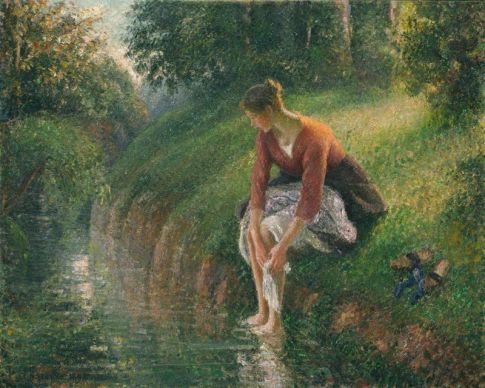
    Woman Bathing Her Feet in a Brook by Camille Pissarro

    Is it too foolish then, without hope?
    Your soul was pure and true,
    Your spirit was fire and dew,
    The high stars shined in your horoscope.
    And because I was very young, invisible,
    And our fates were a great divide so wide,
    Each was nothing to each, each to end; must it be told?
    We were never to cross the paths – Impossible!
    We were mortals strutting our hours; nothing beside?

  • Star-crossed

    9688f7e8198aa7e0542344aa79ef3818ae4a2bf0
    from google

    She kept all her love to herself alone, all alone,
    But let her concealment, like a pearl in the clam,
    Feed on her rosy cheek: she pined in thought,
    And with a blue and even bluer melancholy,
    She stood there like Dido by the River of Lethe,
    Smiling gently at the last shadow of memory.

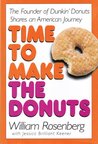
  • Time to Make the Donuts by William Rosenberg

    Time to Make the DonutsTime to Make the Donuts by William Rosenberg

    My rating: 4 of 5 stars

    Before Starbucks claimed a monopoly on franchised coffee-houses around the world, Dunkin Donuts had been arguably one of the most popular American food service franchises in the States as well as other countries. With its signatory Munchkins and famous slogan of “American runs on Dunkin” presented by Super Mario-look alike Fred the Baker (although he retired from the public in the late 90s), the famous coffeehouse brand has made its mark on the American urban culture thanks to its straight-talking, no-nonsense founder William Rosenberg who drew up his case history of being a successful entrepreneur against personal all odds in this simple but admirable memoir written during his last days of life while succumbed to a cancer.

    Rosenberg’s business philosophy of what works and what does not in business to share with the public forms the basis of this book whose inception was first conceived by encouragement of Mario Puzo, the author of The Godfather in the 60s. Straightforward and enterprising he was, Rosenberg’s sharing of his own experiences with the reader for altruistic motive without a sense of entrepreneurial machismo is traceable in every chapter. What he lacked in formal educational background because he had dropped out of school at age fourteen in the height of the Great Depression in 1930, was compensated by the simple but timeless tenets of achievements: diligence, persistence, determination, risk-taking, diligence, innovation, vision, and passion. Surely, all of the aforesaid seems bromidic, but oftentimes, it is these simple elements of life that we oversee as trifle and insignificant without pondering over Leonardo Da Vinci’s truthful adage: “Simplicity is the ultimate sophistication”

    In fact, there are parallels that the reader can make between Rosenberg’s elements of success and the three values for meaningful life in Logotherapy, the third Viennese school of psychotherapy established by the great Viktor E. Frankl whose experience in Auschwitz was a testament to its veracity and validity of Logotherapy, which is to help us find a meaning of life by freedom of will and will to meaning. Throughout the book, Rosenberg emphasizes that it is what we do with the challenges that determine our failure of success because learning from errors is the sine qua non of success. Whatever the circumstances may be, a person can find a way to succeed, and it is attitude that makes it possible. Having a good-hearted but violent-tempered father did not stop him from going out of his way and establishing world famous Dunkin Donuts. This forthright attitude links to attitudinal value of Logotherapy signifying our triumph over biological, social, and cultural inhibitions during difficult times with a discovery of meaning of suffering by the way in which we respond to. That is, how we respond to challenges will make a heaven out of hell, a hell out of heaven.

    Also, a sense of humor is a must-have for taking us a long way to succeed in life. “Work hard, play hard,” was Rosenberg’s mantra. Yet to put it lightly is to miss the gist of the meaning; humor is a prerogative of human that can help us take on a different view of life in a light-hearted way, so that we can be soundly assured that unpleasant things we may be going through are not everlasting and that they are occurring because there is a meaning to them. This, in fact, also relates to humor as a vehicle to turn our backs against emotional distress in life that may hamper our continuation of searching for a meaning of life. Whether or not Rosenberg might have been aware of Logotherapy in his lifetime, the reader will find at every turn analogy between Rosenberg’s business philosophy and Dr. Frankl’s Logotherapy.

    Philosophy aside, there is plenty of interesting information on how the brand name came up with, the origin of Munchkins, and revolutionary way of operating the stores . To illustrate, the catchy name of “Dunkin’ Donuts” came from “You dunk a donut,” Munchkins, previously called Dunkin Donuts Donut Holes sold for 19 cents per set, got the name of a character from “The Wizard of Oz” with the right to utilize the name exclusively in the food service business. After all, the famous Munchkins have become a household name throughout the States and achieved a unique status in the food firmament.

    This is an interesting read that the reader will find both practically helpful in applying Rosenberg’s elements of success to his own set of principles for betterment in life and entertaining to discover the history of the franchise in pastime. The reader will also find that the narrative will reflect the author’s artlessness, cleverness, and forwardness in this engaging book that matches its topic worth the writing.