Blog

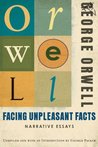
  • Facing Unpleasant Facts by George Orwell

    Facing Unpleasant Facts: Narrative Essays (Before Orwell)Facing Unpleasant Facts: Narrative Essays by George Orwell

    My rating: 5 of 5 stars

    Eric Arthur Blair, better preferably known as George Orwell, wrote a series of essays that dealt with the subject matters close to the human life in the manner of a journalist with heart. This book is a definitive anthology of Orwell’s essays contributed to various magazines and newspaper that will invite the readers to the Orwellian world of reality as he saw and he liked.

    Orwell was capable of perceiving the absurdities of reality and truths masqueraded by ornamented political euphemism to obfuscate the masses for unscrupulous intentions. Of all his essays, “Why I write” is a paragon of his fineness as a great essayist. In the essay, Orwell provides the readers with sage guidelines for a writer, one of which is a choice of the subject matter that should be determined by the age a writer lives in. Such advice links with Leo Tolstoy’s view on great work of art to be closely related to the ethos of the time it is made. That is, a writer is unavoidably influenced by the ethos of the time he lives against his willful struggle to escape from solid reality.

    Orwell asserts that a writer should discipline his temperament lest he should be stuck at immature stage or depressive mood. A writer should think straight so that he can write clearly. This shows Orwell’s belief in writing not as a platform for babbling about his egoistically driven existential dilemma of daily life, for consuming his energy into such self-induced woes and pains will kill the creative spirit in him, the very impulse to express himself as he truly is. To my delight, Orwell further expounds 4 motives for writing as follows:

    (1) Sheer egoism: desire to be regarded as clever and much to be talked about. Writers are vain in the fact that they do want to be individuals, not compromising with the social conditions of reality. Writers can be egotistical and vain because of their elitist attitude toward the opinions of others and general opinions of the public, but are less interested in monetary reward.

    (2) Aesthetic enthusiasm: desire to beautify arrangements of words in pleasing manner by using a plethora of flowery words and rhythmical rhymes.

    (3) Historical impulse : desire to record historical facts of the time to pass the written records for the use of posterity.

    (4) Political purpose: desire to direct the world in a specific direction in order to influence people’s views on society in such direction as it should be

    The readers may find Orwell’s credo in writing rather anachronistic and dogmatic in consideration of the time the essay was written (1946). However, what rings the bell is the recognition of impulse to write as a sublime human act of expressing himself in connection with the time and society he lives in because as Aristotle put, “Man is a political animal.” This collection of Orwell’s poignant, honest, and witty essays will guide the readers into the mind garden of Orwell where moral obligation and the psychological facts are differentiated as pointed out in “Such, Such Were the Joys” and  where there is a pleasant, family-friendly pub called “The Moon Under the Water” with a privilege to appreciate Orwell’s brilliant display of language facility and power of facing unpleasant facts in his own words.

  • Waiting for Gotto

    rain.jpg

    Beneath the grey curtains of rain, there she was solo,
    Standing at a bus stop all alone where no one could find
    With her eyes gazing upon the road far away with eager mind
    Without a soul to join her solitary waiting for Gotto.

    But Gotto would not come in any minute soon to her,
    not coming forthwith, for she would have to wait longer,
    until her faith in him became flickering out and would disappear
    so that he would finally come and manifest her wishes so dear.

    And when Gotto came at his appointed time however uncertain,
    he would come incognito to make his adored presence certain
    by the conspicuous obscurity of the ordinary facade ever discreet,
    and her wishes to meet him would be fulfilled in secret.

    저장

  • How to Be Your Dog’s Best Friend by Monks of New Skete

    How to Be Your Dog's Best Friend: The Classic Manual for Dog OwnersHow to Be Your Dog’s Best Friend: The Classic Manual for Dog Owners by Monks of New Skete

    My rating: 4 of 5 stars

    One of my favorite saints of the Church is St. Francis of Assisi because of his humanity, compassion, sweet nature, and his love of animals with whom he is believed to communicate based upon the story of his converting the Wolf of Gubbio to a tamed animal. The story goes that while living in the city of Gubbio around 1220, St Francis volunteered to take leave and meet a ferocious wolf who devastated the country by attacking people and livestock. When St. Francis finally met the wolf, instead of punishing him for the offenses, he gently admonished the wolf to cause no more plight to the people and the livestock and promised him that he would be fed daily by the people of the city. The wolf was grateful for the compassionate promise and put his front paw on the saint’s hand as a gesture of accepting the advice. Thereafter, the Wolf of Gubbio kept his promise with the saint and became a tamed pet animal of the city.

    With this evocative image in mind of the gentle saint and the tamed wolf I had once seen on a prayer card, I selected to read this book by Monks of Skete of the Eastern Orthodox Church. In this regard, I was piqued by the facts that (1) these monks were reputable German Shepherd breeders and acclaimed canine-human relationship teachers; and that (2) the monks lived with the dogs in accordance with the teachings of the Gospel manifested in their healthy relationship with the dogs. However, the monks of Skete carefully avoid religious jargon in the book lest the book should be interpreted as a promotion of their faith. Instead, their faith is carefully incorporated into the belief of fostering their ideas about dogs with a philosophical and spiritual foundation for personal change because dogs mirror who we are by responding to the way we treat them without deception.

    The gem of this book is the monks’ views on salubrious human-canine relationship as appreciation of truths of the two worlds: one world of our own human prowess as a caretaker and one world of their own pristine nature as a guide to the wondrous natural world from which we have gradually distanced. While we provide them with food, shelter, and veterinarian care, dogs enable us to appreciate the beauty, the warmth, and the compassion that are deeply rooted in our humanity we often overlook or even try to suppress in the face of existential dilemma. In consideration of the aforesaid, I believe that the story of St. Francis of Assisi and the Wolf of Gubbio is not a myth but a truth.

  • Lists of Note by Shaun Usher

    Lists of Note: An Eclectic Collection Deserving of a Wider AudienceLists of Note: An Eclectic Collection Deserving of a Wider Audience by Shaun Usher

    My rating: 3 of 5 stars

    The act of note-taking is the prerogative of humans throughout the history of civilization; impromptu, interesting, and important, the nature of notetaking is to capture a train of thoughts that comes to one’s mind. This book by Shaun Usher is a pleasant compilation of such notes flooding vicissitudes of humankind. It is a sequence to his bestseller Letters of Note, which is a riveting compendium of letters of all kinds throughout the history of the world. Mr. Usher, who is very keen on collecting personal correspondence of people, has indeed again exerted great effort and time to make this project possible through the support of his fans via Unbound com, an organization which has helped writers publish their works since the 18th century in England.

    The book contains some very intriguing notes as follows: (1) Bill of Mortality which tells of the kinds of ailment English people of the 17th century died of, (and the reader will be surprised to find that one of the common causes of death was abscess); (2) an ancient Egyptian worker’s note on his absences recorded on a limestone; (3) Leonardo Da Vinci’s notes on what he would need to research for the anatomy of a man; (4) Michaelangelo’s list of food he wanted to eat with adorable pictures accompanied during his travel to and from Pietrasanta to extract marble used for the Basilica of San Lorenzo; (5) Sir Isaac Newton’s list of note revealing his peevishness with his mother and father, striking his sister and servant and neglecting to listen to a Sunday sermon in church; (6) Mark Twain’s list of note showing all the food he wanted to eat at home upon his returning from a long European trip; (7) Marilyn Monroe’s resolution to attend her new acting class without fail and to enroll in an English Literature class; and (8) Jack Kerouac’s note to his friend for writing tips in which he asserted the importance of free writing without grammatical, syntactical, and literary inhibition. These are just a few notable excerpts from the book, and the reader will have no time for boredom in reading this book.

    This is a quick read which one can enjoy without having to analyze the contents of the notes. The only foible about this read in Kindle version is that the original scripts of some of the notes are not clearly shown due to a mechanical aspect of the device. For this reason, it will be better to own a hard copy of the book as the notes are pictured in their entirety, so that the reader can see clearly the writing styles and discern the personalities and characters of the notetakers to a certain extent. The reader will realize that the act of note-taking, however simplistic and insignificant it may seem, is in fact a way of sketching the flow of thought from a world full of things assorted and flowing without a sense of purpose for composite significance.

  • Who am I?

    photoaaaaa

    Dear Readers:

    Hi there. Thank you for stopping by my blog. It’s always a pleasure communicating with people through writing, which I believe is the most authentic vehicle of expression of a self. My love of reading and writing inspires me to publish my thinkings in this blog. So Welcome All with my Whole Heart.

    My name is Stephanie Joori Suh, living in a suburban New Jersey town in the vicinity of the New York City. I work in the City for livelihood and write at home (or sometimes on the Second Floor in a Dunkin’ Donuts’ shop nearby my workplace) for selfhood. The great psychologist and thinker Viktor E. Frankl, who is also the founder of Logotherapy, has urged us that we strive for realizing our values that are: Creative Value, Experiential Values, and Attitudinal Values in order to arrive at meanings of our lives. How true it is! I believe those who write are united spiritually in fulfilling such noble deeds. We are kindred spirits.

    I may not write perfect English prose due to English being my second language. I may not sound ordinary in the sense that my writing speaks with certain streaks of foreignness. Nevertheless, it is my quest for actualizing what I possess inside by means of literary expression. And I have to purge it out, unravel the mystery in me that is dying for the discovery of the truth in me.

    Hence this little blog has come into being; it is the birth of my brain child, or rather the manifested ego qua meaningfulness as in terms of Logotherapy. So many thanks again for your readership, which is also meaningful to me.

    All the Best,

    Stephanie S.

  • The Diary of a Mad Legal Secretary by Eve Halliburton

    The Diary of a Mad Legal SecretaryThe Diary of a Mad Legal Secretary by Eve Halliburton

    My rating: 4 of 5 stars

    Stephen King said that people love reading about what others do for a living because it’s so entertaining and thrilling at the same time with subject matters being closed to the real world. It gives readers a sense of realism or verity in which we all are rooted because work is what ties to us in reality where we face existential absurdities in dealing with human imperfections in conjunction with performing demands imposed on our daily tasks at work.

    Hence a story of a neurotic legal secretary who has good heart but is driven to a borderline madness by witnessing the idiosyncratic characters she encounters in the office: The bumptious boss, the snobbish lawyers and their ilk, the ingratiating and ruthless HR personnel, the pitiful and sometimes cunning co-workers. Reading this story is like watching a black comedy which induces both pathos and satirical comedic relief.  In fact, this diary seems to be more of a therapy journal in which the narrator purges out her hidden innermost feelings and emotions about her work and the people at it; it’s a Punch-like compendium of caricatures in word format.

    Ms. Halliburton could have written this hilarious book as her memoir of a seasoned legal secretary in a prestigious Manhattan law firm. Or more likely than not, the author might have written this diary as a way of releasing her own stress and distress. For whatever reason it might be, Stephen King was right in saying that we enjoy stories of others in relation to their jobs because this book is easy to read and enjoyable, providing the reader with the kind of pleasure a Peeping Tom indulges in by peeking at what others do and feel about their work  with a telescope.