Blog

  • Lord of the Flies by William Golding

    Lord of the FliesLord of the Flies by William Golding

    My rating: 4 of 5 stars

    Lord of the Flies, which is derived from Beelzebub in Greek, by William Golding is a mind-boggling story about a band of English young boys aged between 7 years and 12 years marooned on an island after a plane crash during an atomic world war. Written in 1950s, the book questions the defects of human society in respect of the defects of human nature as symbolized by the stranded boys who have once civilized under the parental/societal guidance descending into savagery, which is operated by Id alone. And it only takes about 2 weeks or so to return to the primitive stage of mankind. Which is all the more terrifying to acknowledge.

    There are two extreme characters in the story: Ralph, a headstrong, sophisticated boy whose father is a naval officer. His primary goal is to be rescued by a ship, to return to the the world of civilization where all will be normal. Therefore, his main concern is to keep fire ablaze to signal his existence, the last remnant of civilization, the surviving Ego that “wills” his societal existence struggling for existential meaning that a civil community confers upon his singularity and uniqueness for recognition. Ralph’s lifeline for returning to civilized human society is fire as he keeps invoking the mantra of “No fire, No smoke, No rescue.” To him fire is Hope that will save him from falling into savagery. Other boys blindly and almost unconsciously have become animalistic, acting on instincts to satisfy their most basic desire only: Eating by Hunting.

    The Hunters are led by obstreperous, belligerent choir leader Jack. In fact, the figure of Jack represents many interesting aspects of psychotherapy. In the respect of psychoanalysis by Fraud, he symbolizes Id that “drives” all his acts and governs his modus operandi. To him fire does not seem to matter. He does not even want to be rescued. What he excites him is a process of hunting a pig – especially a female one – for provisional entertainment and survival on an island. In the view of individual psychology by Adler, gaining power over his “tribe” of the boys and becoming a chieftain by forcefully and unjustly abdicating the legitimate leader Ralph takes precedence over anything, such as keeping fire and going back to the cradle of civilization. The limit of ego qua responsibility does not apply to Jack, who lets his Id dominate his being. According to logotheraphy by Viktor E. Frankl, Jack has ceased to fulfill his responsibilities as a cooperative cohort of Ralph to work together to protect themselves, to guard fire, and to abide by orders and rules of their own until a rescue comes their way.

    And there is pitiful Piggy. We don’t know the real name of Piggy. But we know that he does not want to be called such. But the boys, including the civilized Ralph, who has learned how to blow a conch by the help of Piggy, insists calling him the name. The narrative tells us that it’s not that the accents or fumbling that makes him a buffoon of the boys; it’s his corpulent appearance that loses him respect among the boys. Besides, he’s the only one that wears a pair of spectacles, which are used as a magnifying glass to gather sunlight to make fire. In fact, I view the figure of Piggy as a voice of the intelligentsia. Ralph laments over the tragic death of Piggy because he’s the one who “talks sense.” In fact, his spectacles, which is cruelly damaged by the sneak ambush led by Jack and his savage tribe, symbolize the perspectives of the intellectual that view the state of human nature in danger of retrogression and decay to Zero, the raw, primitive nature devoid of existential meanings and values that define human. And the boys ridicule him, deriding his attempts to call their attention to reality of their situations. Piggy betokens a Thinker, a voice of Rationality that loses its footing between provisional needs of survival and existential ennui at the time of abject crisis.

    Lord of The Flies by William Golding attests to loss of humanity as a result of catastrophic event in which a survival of the fittest seems only true. This may include a case of war in consideration of the year the book was written; it’s 1954, only 9 years after WWII. Golding saw the evils of the war – the countless deaths, the famine, the ruins of houses and building and nature – the Wholesale Destruction of Humanity. What had once been a great civilization fell into a great catastrophe by the hands of Humankind. It’s a paradoxical truth that ascertains civilized human society debased into brute savageness operated on ferocious instincts for survival… The theme of the book bespeaks a collapse of human conscience governed by our Ego that prevents us from being thoughtless, self-destructive entities solely acting on our raw, dangerously ferocious impulses, our Id. And it is this Id that the devil as symbolized by the fly manipulates such instincts to fall into moral decadence for our ultimate destruction from within. In light of the aforesaid, Lord of the Flies is a modern day fable of the demoralization of human nature laid bare in the limelight.

  • Down and Out in Paris and London by George Orwell

    Down and Out in Paris and LondonDown and Out in Paris and London by George Orwell

    My rating: 5 of 5 stars

    Based upon his real-life experience as a scullery worker in a Paris hotel and a tramp in London, George Orwell’s recounting of the stories of the impecunious stands alone in its authenticity of the content and veracity of the experiences. The substantiality of poverty was boredom and inconvenience, because poverty freed people from standards of ordinary behaviors. Nevertheless, this book is not a book of socialist manifesto that urges the impecunious to revolt against the establishment, nor a pamphlet for advocating the welfare of the poor. It’s an investigative report on the people on the lowest and lower rungs of a social ladder. Orwell hoped that his readers would at least change their acerbic views on the low and the lowest because their situations were created through no fault of their own or voluntarily. And I hope there will be more like this book in our time.

  • Travel with Charley in search of America by John Steinbeck

    Travels with Charley: In Search of AmericaTravels with Charley: In Search of America by John Steinbeck

    My rating: 5 of 5 stars

    Mr. Steinbeck’s intention of his travel with Charley, his old poodle, in Rocinante, a noble camping truck named after Don Quixote’s horse, was two folds: first, his innate wanderlust had grown bigger as his age advanced. He defied the senility of mind and body as a man who could still be a manly husband to his wife and function as an able-bodied man in society; second, Mr. Steinbeck wanted to see America as he had known on a personal level and to ascertain what could define true American identity and character. What he experienced in his own eyes across the land was part rhapsody of begone days he used to remember and part treatise on American national characteristics. Mr. Steinbeck was indeed a Don Quixote in his pursuit of finding America as portrayed in his novels and as remembered in his memory. But most of all, Mr. Steinbeck was a quintessential American writer in his tough-guy demeanor tinged in the narrative who had a deep affection for his country despite its foibles and imperfections.

  • By Ox Team to California by Lavinia Honeyman Porter

    By Ox Team to California: A Narrative of Crossing the Plains in 1860By Ox Team to California: A Narrative of Crossing the Plains in 1860 by Lavinia Honeyman Porter

    My rating: 5 of 5 stars

    I like reading historical and social accounts of writers both famous and ordinary, such as travelogue, diary, and letter because they reveal something about the authors’ personalities and the social milieus of the times that look to be beguilingly fictitious with frankness and stupendousness that reality brings about.  In this regard, this book is an informative and enjoyable read.  It’s a story of an intelligent and brave woman’s narrative of her six month journey with her husband, younger brother (although he later decided to stay in Colorado instead of venturing to California), and their little son overland to Sacramento, California by an ox-driven wagon. The story is read as if the author were telling her tale of pioneer adventure to West for a fresh new start. In the course of her narrative, readers can also peep into the general outlook on the Native Americans whom the author shows sympathy toward and the panoramic view of immigration trail usually congested with ox or mule driven wagons. This is a valuable record of an enterprising and educated woman unafraid of the perils of long journey overland with a “go-aheaditiveness” attitude which is still so uniquely part of the American character.

    저장

  • Eichmann in Jerusalem by Hannah Arendt

    Eichmann in Jerusalem: A Report on the Banality of EvilEichmann in Jerusalem: A Report on the Banality of Evil by Hannah Arendt

    My rating: 5 of 5 stars

    This book is about a famous trial of Adolf Eichmann, a former German Nazi SS lieutenant colonel who was in charge of collecting and deporting the Jews from all over Europe to concentration camps, written by Hannah Arendt, one of the most brilliant thinkers and intellectuals of the modern time. Originally written as a trial report for the New Yorker, Arendt described the scenes of the trial held in the court of Jerusalem, the characteristics and physiognomy of Eichmann, and the general ambiance of the trial without sentiments or belle lettres. Her narration style is more of journalism than of storytelling in evident consideration of the fact that she wrote it as a series of report for The New Yorker. And the languages she used to portray the whole trial and Eichmann were so highly academic and philosophically intricate that the reader might find this book abstruse to completely absorb the content in one sitting. And yet, it is worth finish reading it because the author provides the reader with her stoic and disinterested opinions on the nature of the trial and on the accused as what she observed during the trial based on facts and reason.

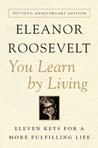
  • You Learn by Living by Eleanor Roosevelt

    You Learn by LivingYou Learn by Living by Eleanor Roosevelt

    My rating: 5 of 5 stars

    This book is not a feminist manifesto as most women would like it to be. The subject matter is not exclusive to women only. Rather than polarizing the class/gender stratifications, Mrs. Roosevelt speaks to all of her readers who feel less about themselves based upon their falsely limited views on representations of the reality. She was a Mother Figure to all Americans in  her time and still speaks to us through this book of the importance of human dignity and positive attitudinal values to appreciate what we already possess in us regardless of things that we cannot change beyond our control as by telling us “No one can make you feel inferior without your consent.” Of all the towering glittering famous women, it’s the mind of Mrs. Roosevelt that scintillates with brilliance because of her compassion toward humanity combined with her intelligence, which has become a rarity in our time.