Blog
-
prompt 35
If you didn’t need sleep, what would you do with all the extra time?
A deprivation of sleep would be a nightmare to me. Sleep is the most natural and safest palliative to forget worries, however temporarily it is. But if there should be any other props for this natural medication, I could keep my promises.
I want to read and write as much as I should after returning home from work and generally at home. I used to work in an office where I could write during the lull, but for this year, the cognitive processing activities have been reduced to about 10 percent of my daily life because I have been feeling mentally exhausted. It has become psychosomatic by preventing me from sitting at the desk when I am home. My best regular place has become a sofa bed, watching YouTube continuously. I don’t even play with my cats as much as I should because of this sense of powerlessness combined with the weight of existential despair. When writing – which I am doing now during my one-hour lunch at my workplace – I feel so much better with the fogginess of the mind cleared and the heaviness of the spirit relieved.
Therefore, engaging in activities that use the body and the mind would be the best thing I should do during the extra time because, as the ancient Greeks called it, Mans Sana in coporore Sano. (“Sound Mind, Healthy Body”)
-
prompt 34
Name your top three pet peeves.
Pet peeves are subjective, and they say something about the personalities of the narrator. I have mine, and here they are:
1. Poor listening skills – I hate when people fidget with their bodies or smartphones when I talk to them. To see them behaving in such ways is downright disheartening. It shows they are not interested in what I am talking about or who I am. Or even if they seem to listen to what I am taking, when I check what I have told them, they don’t remember any of it.
2. Discrimination of expressing greeting – I see it very often that when you smile, the world will not smile unless you are within their cliques or type of favor. It plunges my spirit to a dismal low. For instance, in stores, you see store associates greeting and helping customers with their likes. I mean it in the context of appearance. If you are attractive, you will be treated nicely. This meritocratic tendency extends to workplaces. Most readers may disagree with this statement, but the dissenters may be of the Attractive Club.
3. Loud people – They are absolutely a disgrace of community life. From my apartment to workplace, people who disregard the quite peace of mind of others by opstrepeously bellowing, hooraying, and laughing as if they were a center of the universe should be put in a stone-made castle kept by a malicious witch in a deep forest until they cry for Mercy.
I wonder why people who have contributed to my pet peeves and thus galvanized me into writing this during my lunchtime at work continue to behave as they do. Do they think such behaviors are cool and an expression of freedom? Indeed, they are not educated well enough to learn that freedom and responsibility go hand in hand. Hence, these are my three pet peeves, and I hope you will understand me.
-
Prompt 33 – why cats are women’s best friends
What are your favorite animals?

One and a half years old Camille Rudyard Kipling described the nature of a cat as a creature that walked alone. The graceful pose, the noble demeanor, and the aristocratic solitude make the feline kind all the more mysterious and charming. Cats are so loving and, at the same time, so selfish, which makes them exuberantly human. It is no wonder the ancient Egyptians turned them into goddesses Bastet for womenkind. To make the long story short, the association of cats with women is natural and inseparable as if the two kinds are supra-natural companions.

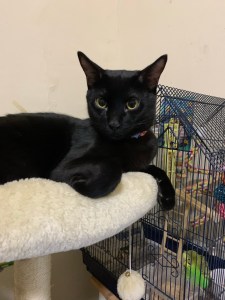
Three years old Toro The feline imagery has been complimentary and cautionary depending on the purpose of its application to societal conventions. For example, black cats are typically associated with devious single women practicing witchcraft (or, for God’s sake, cantankerous spinsters) because of their formidable ambiance of darkness, which significantly contrasts with their wonderfully fierce eyes and quiet solitude. While feminists would disagree with the application of such feline imagery to femininity (“How could you use such a demeaning word?!”), one can’t eradicate the visible traits that are so unlike their counterparts, including the canine. The coquettishness of feline characters and the capriciousness of behavior conjures the images of Cleopatra charming Julius Caesar, Mark Anthony, and the like. And what about Michelle Pilfer’s Cattleman? Then there were Charlotte Bronte and Lucy Maud Montgomery, whose feminine sensibilities were replete with fiercely independent creative spirits, and the fascinating power of words still mesmerized the readers of her times and ours. They were lovers of cats, and their best friends were cats who could share secrets because cats were the only true secret keepers.

Tori and Camille Some people seem to take pride in publicly announcing their dislike of cats as if there were some virtue in doing it. They say cats are treacherous and capricious. But that is precisely why I like cats because, like us, when they are good, they are very, very good. Yet when they are bad, they are horrid. I never get bored with my two cats, Toro and Camille, because they are very responsive to my talking by vocalizing their needs when they want to play, go out to the living room, and eat. But you know what? They are also my best friends who always stay with me, even when I am blue and gray under dark spells.
-
Tabby Toro

Of all the cats that alone walked
There’s none like Tabby Toro;
He is the sweet of my heart
And he likes to sleep at my feet.
There’s no cat in the world
is half so sweet as Tabby Toro;
He is the sweet of my heart
And he likes to sleep at my feet.The soft furs are like a great fluffy pillow
his little heart pounding at my feet
with the brilliant eyes riveting billow
bright sparkles of emerald secret
he keeps from the faraway star
where he was once a little prince;
He is the sweet of my heart
And he likes to sleep at my feet.My mother tells me all the time
that I love Tabby Toro too much,
And, but for him, silent I am
Smiling at the taunts and sighs such;
But pity not, for I am fine as long as
I feel the little heart at my feet,
And I know there’s Tabby Toro
He is the sweet of my heart -
Prompt 32
If you could meet a historical figure, who would it be and why?
I would like to meet Jane Austen, George Eliot, Mary Seacole, and Francis Barber, whose backgrounds and personal aspects interest me not as celebrities but as persons from my knowledge of their extraordinary lives birthing from the ordinary milieu.
1. Jane Austen – Today, Austen is one of the most revered writers of world literature worldwide. But her novels were not regarded as a lofty tome of literature in terms of academic value in her days. Austen was not of blue stockings, but a woman attending the household cares that feminists call drudgery. She took care of her elderly father, and writing was a means of her creative outlet to express herself. Also, she was weak at spelling, just as Leo Tolstoy was. (What a relief that perfect grammarians are not necessarily great authors!) She was also unmarried, so she and I would have many things to discuss as a single woman taking care of her family with a love of writing.
2. George Eliot – a great intellectual writer, Eliot used to churn butter out of milking the cows on her family farm. But her family denied it because it would mar her image of an intellectual as if doing chores were considered unfit for a woman of her literary status. She was a strong-minded, independent-willed woman with the power of words to compensate for her lack of physical beauty.
3. Mary Seacole – I want to ask her how she upheld her confidence and determination to care for the wounded soldiers during the Crimean War after Florence Nightingale rejected her application to volunteer for her Nurse Corps. Her love of humanity and keen observation of societal norms and behaviors have impressed me, and I want to ask her for a word of advice.
4. Francis Barber – Born into slavery in Jamaica, Barber was a loyal servant of English essayist and author of A Dictionary of the English Language, who took him under his protection against racial injustice and mistreatment. Johnson even bequeathed him a small fortune after his death, so Barber set up his small business and started a family with an English woman. His descendants still live in Lichfield, England. I want to meet him and ask him about what Johnson was really like – as it is the best way to know the character of one’s boss – and how his life became after the death of his master in the time when the blacks on the British Isles were conspicuously existent in small numbers. Was he treated like his counterpart in the U.S.?
It would be best never to meet your heroes or idols in real life because you will be disappointed with their actual characters. But my list of people will not be a disappointment because they were not from the highest estate of the ether and seem approachable and relatable. Or so I should think.

You must be logged in to post a comment.