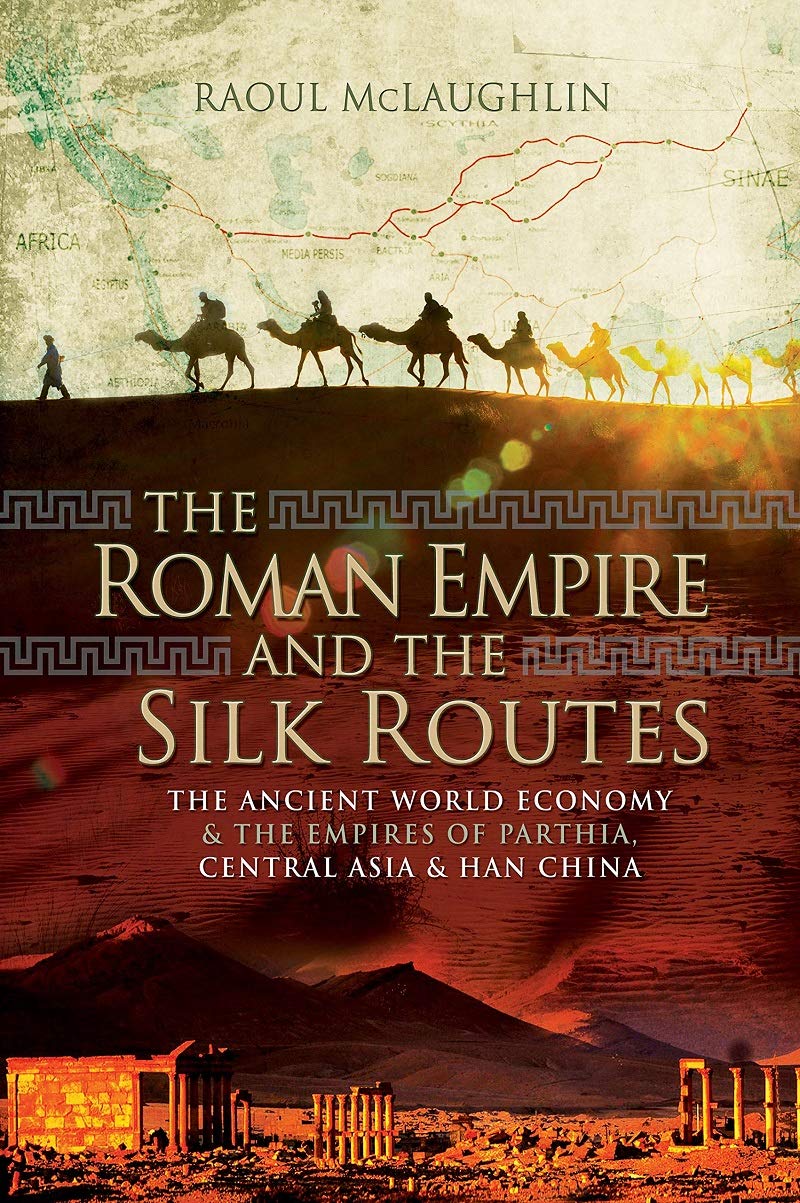
The Roman Empire and the Silk Routes: The Ancient World Economy & the Empires of Parthia, Central Asia & Han China by Raoul McLaughlin
My rating: 4 of 5 stars
We are easily apt to presume that what we can do was an impossibility for those of different eras and places. Yet, what is happening now has happened before, although in various modes of Operandi. Global trade was also part of the ancient world’s economy that affected civilization’s fortune just as it is today in our time. This book shows the reader how ancient commerce happened thousands of years ago across a great distance of continents from the Far East to the West to propagate the prospects and prosperity of Europe and Asia’s far-flung regimes via silk routes through Central Asia.
The book is a fine organization of roads, resources, and governments involved in the ancient business world that surprise the modern reader that without airplanes, cars, and computers even, our forefathers of humankind found ways to travel a great distance for profits with flares for adventure. First, the term “Silk Roads” became famous by the 19th Century German geographer/explorer Baron Ferdinand von Richthofen, who surveyed the land routes crossing Central Asia from Afghanistan to China as used in the ancient Chinese and Roman texts. His ambitious plan was to construct a railway line across Central Asia that would have linked the German economy to Chinese markets. In ancient times, the Romans imported Chinese silk that came to Roman Syria from Iranian caravan routes crossing the Parthian Empire from Uzbekistan to Mesopotamia. The Romans’ Eastern business also included Indian valuables via the Persian Gulf that reached Parthian markets in Babylonia. An ancient text reveals that one Indian sailor from the wreckage of a trade ship from India around the Red Sea rescued by a Greek patrol ship from the Ptolemaic kingdom of Egypt around the Arabian Peninsula told the Greeks how to sail from India via season Monsoon winds.
The Romans had already known about India but not the Far East until 1 B.C., when silk began to reach the Mediterranean Sea through the Parthian Empire ruling in ancient Iran via caravan routes, aka the silk roads. It appears that commerce contacts and cultural interactions indeed existed. Modern archeologists discovered the graves of slave workers of textile production during the first century A.D. at Vagnari in southern Italy; one of them had a DNA of Far Eastern ancestry inherited from his mother. From Julius Caesar to Caligula, silk both ornamental and devotional in the panoply of magnificent Roman authority. The Romans made ceremonial silk curtains dyed in royal Tyrian purple as awnings in public ceremonies to protect spectators’ eyes from the fiery Mediterranean Sun’s glare. Silk also made beautiful garments and garlands presented to classical gods’ images and offered to the protective household deities. The reader would be pretty surprised to learn that the end of Cleopatra VIII and her paramour Mark Anthony was a purple augury of lucrative Roman trade from the eastern world. The accumulated Roman economy from Ptolemaic Egypt’s annexation and control over the eastern legions made the distribution of the Roman citizens’ funds possible. The empire gained direct sovereignty over the Red Sea shipping lanes into the Indian Ocean.
Reading this book confirmed my conviction that people would find the way to do what they needed. However, the younger generations of our time often make the anachronistic mistake of judging the previous generations as culturally retrogressed and hemmed in insular thoughts. It is only a different way of doing business, however slow or primitive it may seem. The ancient commerce contacts show that a country cannot stand alone and survive alone in the world if it refuses to measure the truth with the desire based on ethnocentrism growing into xenophobia. Human cultural progress is a collective enterprise. We live not in isolated islands but a global village.
View all my reviews


You must be logged in to post a comment.