Thursday, September 10, 2026
I often wonder why God allows the ills of society to persist and their victims to suffer violence for no reason. What are the sins of children who suffer such violence? Why can’t he care more about changing the fates of these children? The same question arises through Aeneas in Book II when he sees his beloved Troy burning and, with a yearning heart, seems to demand an answer. If fate requires suffering, what is fate? Is God truly omnipotent and omniscient?
Book II is Aeneas’s ballad of burning Troy—the story of his fate, which does not allow him to enjoy the ordinary life of a married man. His life doesn’t seem to be protected by the gods, even by his divine mother, who appears to her son as Venus, not as a mother. They force him to fulfill sacred pietas by carrying Troy’s future to foreign soil, where his descendants will build Rome. He tries to resist their gambit on the chessboard, where he is their number-one knight, moved around at their pleasure. Even his mother Venus is part of the divine ilk and hurries him out of Troy like a mom sending her son to school before it’s too late. In Aeneas’s mortal eyes, the idea of becoming the forefather of Rome appeals to him less than being a husband, a father, and a son at home. Can even his divine mother protect him from this fate?
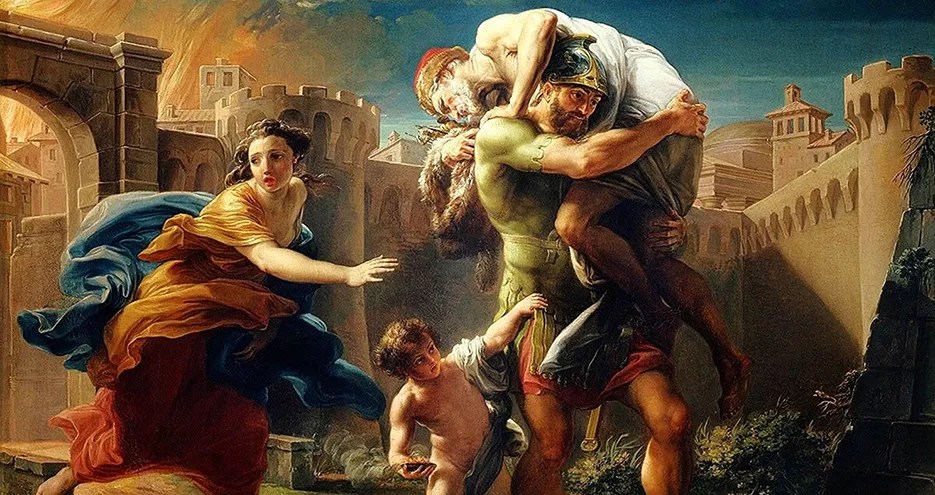
Gods are cruel just as God is cruel. They make his life easy only when he acts according to their will. Without the gods’ command, Aeneas would not have thought of fleeing the burning city with his elderly father Anchises on his back, his little son Ascanius at his right hand, and his wife Creusa following behind. But then Creusa must stay away from her husband, who has a duty far greater than his personal life. Her ghost appears and tells Aeneas that he must leave; as she vanishes into the folds of mist, all his chances of escaping his fate and its burdens vanish with her. He has no reason to stay but must move forward against his will.
The Trojan Horse, Laocoön and his two sons engulfed by the sea serpents, and the cries of Priam and his wife Hecuba all signify the great labor of birth in the process of dying, all within the fate of a man who must act out his assigned role in the divine chess game.


You must be logged in to post a comment.