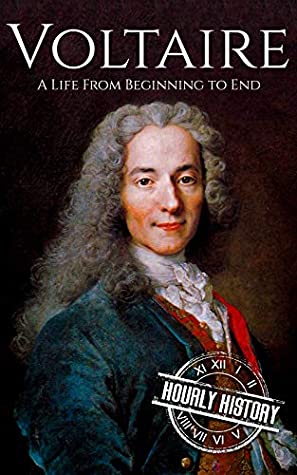
Voltaire: A Life from Beginning to End by Hourly History
My rating: 5 of 5 stars
The role of intellectuals is to see the corrupt at the heart of society and stand furious with the mass and constantly monitor the conditions of ill-effects and actively work on the improvement of living conditions. For books can never teach the use of books. Otherwise, they are no more than armchair academics complacent with their impressive scholastic achievements and high social esteem as elites of society, proudly distanced themselves from the general. But Voltaire wasn’t, nor was he a demagogic writer grandstanding with the ire of the have-nots.
Born as Francois-Marie Arouet on November 21, 1694, when the discovery of the New World and religious turmoil swept Europe, Voltaire was destined to become a cavalier of new thoughts, the Enlightenment of Thoughts, which the Catholic Church regarded as a dangerous school of ideas to the mass. Yet, Voltaire wasn’t hell-bent on destroying the Catholic Church as a freemason but pilloried the corruption of the ecclesiastical members and the duplicities of their teachings and acts in practice. Religion is also a social institution made and governed by people and therefore subject to corruption and dysfunction. Before the French Revolution, the Catholic Church controlled people’s ways of thinking and exerted its authority over political and cultural spheres. That was why Voltaire’s lifelong resistance against the Catholic Church arose, not from blindly malicious intention to sabotage belief of the religion.
Voltaire was very human with his volatile temper but also with passionate munificence. He was fluent in English and his years of stay in England, the country he regarded as a model country of liberty of thoughts and religions. During his visit, he met John Locke, Jonathan Swift, and Alexander Pope, to whom Voltaire was said to be very rude for reasons clandestine. Methinks that for a person as at once passionate and sensitive as Voltaire, the anecdotal vignette sounds true, but who can blame him for his temper and let it eclipse his wholesale brilliance as an unbridled thinker and writer unafraid of speaking against the social injustice against the unprivileged? Rousseau, a fellow freethinker, abandoned his child at an orphanage and berated the illiterate. Isaac Newton, whom Voltaire respected for his scientific findings and logical mind, mistreated his servants with whacks and beatings. But, on the contrary, Voltaire paid off all the tax debts of his tenants on his properties. Also, he published ‘Candide,’ which is an allegorical book about the absurdities of the teachings of the Church and a man’s search for a God in this world, in 1759 at a meager price accessible to poor readers yearning for a taste of Enlightenment.
The absence of God’s presence in the deeds of the clergy and religious people and the presence of injustice in the name of elusive God were the questions Voltaire had in mind, and yet he wasn’t blasphemous about the God they believed. On the contrary, Voltaire’s belief was ecumenical in the principle of syncretism founded on a universal belief system according to Natural Law, a conscience. He was liberal in ideas but responsible in acts by accommodating his knowledge to practice for ordinary life. Samuel Johnson’s definition of an imperiously sullen scholar who loses his days in unsocial silence and lives in the crowd of life without a companion was the opposite of Voltaire. Indeed, Voltaire had no morals, yet he was a very moral person for sure.
View all my reviews
Tag: biography
-
Voltaire, the moral rebel – book review
-
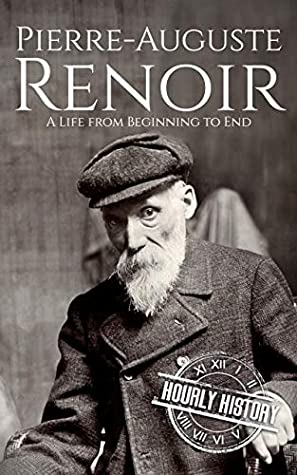
Renoir Forever – Book Review
I remember the first time I saw Renoir’s painting, “Girls at the Piano,” hung on a restaurant wall when I was a first-grader in elementary school. I loved the vibrant warmth of the colors and the softness of the girls’ expressions. Since then, Pierre-Auguste Renoir (1841-1919) has become one of my favorite painters. Given that preference, my reading of this book about the master was long overdue. Still, I am pleased to learn that Renoir was what I had imagined him to be – a creator of art whose eyes are set on the stars and foot grounded on earth.
Renoir was a master of the French Impressionism troika led by Claude Monet and Camille Pissarro, pioneering a new painting style as the epoch needed a new cultural ethos for the upcoming new century. Although the masters of French Impressionism were on the same musical note, their timbres were various. While Monet and Pissarro were idiosyncratic and liberal in techniques and subject figures of their artistic creations, Renoir was a conservative in keeping a tradition of Paul Rubens in his celebration of feminine beauty surrounded by the realism of nature and life.
A pursuer of the natural and ideal beauty existing in the physical world, not the spheres of the heavens, Renoir used the ideal to perfect the real, adapting traditional techniques to his visions of the worlds conjured in his mind’s eye. Renoir’s fascination with sensuous beauty in the expression of vivid but soft hues of vibrant colors and rounded, smooth figures of models in his paintings show his unintentional application of Aristotelian aesthetic theory: beauty inherent in itself and beauty by its use. Renoir’s paintings are replete with the beautiful colors, the warmth of the ambiance, pleasantness of the moment, and equilibrium of the backgrounds, all the mastery of using the ordinary with a profound sense to elevate it to art, giving art its true meaning. That might be a reason why German composer Richard Wagner, the creator of “Nibelungen’s Ring,” chose Renoir among other famous painters of the time to produce his portraiture. Or perhaps it was why Americans first found Renoir’s paintings so appealing that the goring sales in America brought Renoir fame and wealth.
After reading this elegant biography of Renoir, I liked him even more because he was an artist who had an artistic vein of genius and a practical sense of responsibility. He was a devoted father who even took care of his illegitimate daughter from his first girlfriend before marrying his model wife Aline Chariot, from whom he kept it a secret for life. Renoir might have had preconceptions about specific beliefs and people, but who would not have them secretly hidden in their mind’s closet? I believe that art serves its purpose when it gives the beholder a delightful sensation, not a dangerous illusion of distorted reality drawn from an artist’s disillusioned mind. Now I have a replica of Renoir’s “Two Girls at the Piano” from Amazon posted on my bedroom wall. It still has the first impression of the painting that has stayed in my heart with delightful nostalgia, enveloping me in the longing for the bidding the time’s return, which only Renoir could do the magic.
-
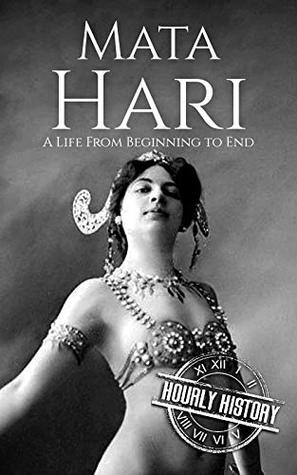
‘Mata Hari’: la madame butterfly – book review
Mata Hari: A Life From Beginning to End by Hourly History
My rating: 4 of 5 stars
A paragon of femme fatale with a name meaning Eye of Dawn in Indonesian, Mata Hari has become an unlikely figure of feminism that elevates a famous courtesan into a tragic martyr against male chauvinism. Some even have turned Europe’s first-class exotic dancer into an innovative artist, surpassing the great French-American creative dancer Isadora Duncan. Although Mata Hari expressed her unbridled erotic charge on the influential men in an era when the ideal victorian femininity still reigned in the social consciousness, she was hardly any more creative to the art of dance than Isadora Duncan and less manipulative than Delilah. This concise bioptic narrative about Mata Hari leaves the image of her open to creation on the reader’s perception of her.
Before her rebirth as Mata Hari, Margaretha Geertruida MacLeod was a divorcee from a Scottish-born dutch army officer. Her divorce from her husband was a ticket to her freedom from conventional womanhood whose place was home, tending her family and domestic affairs. Mata Hari used her womanly prowess tinkered with an exotically alluring atmosphere surrounding the sultry appearance that she used for the glamorous life. While reading the book, I found Mata Hari hard to sympathize with her, commiserate with her when she was hoodwinked by the men she fluttered with, and she believed to fall in love with. A life of courtesan she was leading was dangerous and ephemeral, and she didn’t seem to bother making her livelihood without toiling her hands into specks of dirt, as most of the poor women in her time had to earn a living.
It is not to say that her wayward lifestyle was meted with her unjust execution, which conspired to use her as a political and diplomatic scapegoat during World War One. She was an easy target to put all the misdeeds of the men involved with her and the faux-pas they wanted to conceal in consideration of her reputation as a persona non-grata with a questionable reputation. The trial of Mata Hari was nothing but a Kangaroo court procedure that only showcased the famed woman under an international spotlight behind which the real culprits of the espionage were hiding. However, her trust in beauty as a sexual prowess over men should not be confused with a woman’s symbol of an unyielding independent spirit under the pretext of being a divorcee without long-term financial security. The spirit of womanhood that evokes a feeling of camaraderie lacks in the figure of Mata Hari.
View all my reviews -
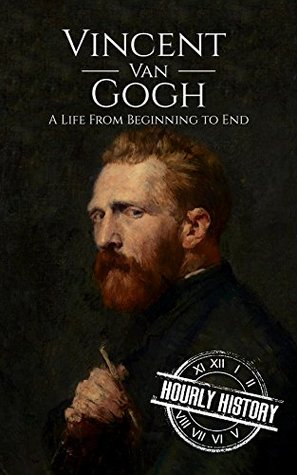
Portrait of Vincent Van Gogh
Vincent van Gogh: A Life From Beginning to End by Hourly History
My rating: 5 of 5 stars
Here’s a portrait of a man who hated being alone yet found freedom when alone. Austere yet bohemian, religious yet autonomous, he was a paradox himself like the faces of Janus. It was no other than the painter Vincent Van Gogh himself in his well-known portrait looking more in disappointment with the world than in madness against it.
As the late eminent Australian biographer of Ben Jonson Ian Donaldson once put, good biography is anything but a bland, chronological summation of a man’s life, and I am not intent on reciting the dates of from Gogh’s birth to death and in-betweens. Instead, I am all mind in positing what I think he was, other than the man with a bandaged self-mutilated ear because our sensory perception often betrays the truthfulness of what we see when stimulated to the external sensation. Indeed, Gogh was a disturbed man whose sensitivity found no elbow room in the world with which he so endeavored to have a long-lasting content relationship. It is not to say that Gogh was an archetypal self-imposed exiled artist who voluntarily distanced himself from ordinary life scenes. Hardly so. As shown in his letter to his beloved little brother Theo, who helped his misunderstood forlorn artist brother as ever, Gogh tried to be as good-humored and cheerful as he wanted. Still, it was the world that seemed to betray him with blows that bludgeoned his unalloyed wishes and noble aspirations.
Gogh’s paintings reflect his love of realism and reject artificial romanticism without the ideal romantic ambiance in vogue with the time. He was interested in all that existed as they were because discovering beauty in the coarseness of reality was his objective in achieving creative and experiential values. In this regard, Gogh was in the same artistic vein as Francoise Millet, whose paintings Gogh admired because Millet believed that treating the commonplace with the feeling of the sublime was what gave art its true power. The only difference between the masters of art was how to portray it with individual flairs of colors, techniques, and perspectives based on their tastes and judgments. Gogh’s ‘Potato Eaters” might not have that romantic dignity surrounding the hardscrabble peasants. Still, they were unforgettably expressive in the nuanced struggles and strife they had to bear and live with. Perhaps the uneasy cohabitation of the independent spirit and the loving heart distinguished Gogh from his famous peers who had the practical sense to reconcile their creative souls to social needs.Moreover, Gogh lost a sense of direction when he realized that a man of the cloth wasn’t his cloth. The existential frustrations from the confliction of the will then added to his already innate fragile sensitivity, a hereditary mental trait running in his maternal family. Nevertheless, Gogh continuously endeavored to fend it off and conquer it, even when the citizens of Arles, where he dreamed of building a haven for his kindred spirits, united to expel him from the city he once cherished. However, one good-hearted postman continued to give him a touch of kindness till he voluntarily admitted himself into a mental asylum for the peace of his mind and others’.
To me, Gogh tried to live up to his conviction of good, fulfilled life with exquisite sensibilities, and unalloyed humanity too great for the realities of the world he was born into. His life was life imitating art, and art was not imitating but expressing life as he saw. Yet, be it ever the play of the fate, the more he tried to be good-humored, the more estranged he became because he was an extraordinary artist constantly breaking away from confinement prejudicial to his ever sensitive and creative spirit. Upon reading this elegantly narrated life of Vincent Van Gogh, I realized the truth of the genius only took some time for its brilliance to shine, no matter how long it would take. Who would have thought Vincent Van Gogh, who once sold only one of his works out of hundreds, would be looking at his admirers in the constellation of brilliant painters in heaven? For those who are creators of arts in all genres, famous or hidden, amateur or professional, the story of Vincent Van Gogh will be a consolation to the heart and hope to the spirit that never knows the end.
View all my reviews -
The Masques of Ben Jonson
He was Man of Infinite Varieties
In the Craft of Words with Masques:
A High Priest of Poetry of Delphi,
A Prefect of the Ancient Knowledge,
A Thespian of Comedy and Tragedy,
A Hercules whose Might was Pen,
An Odysseus in Search of Truth,
A Pretorian of Classical Precepts
With the elevated Heart of Passion
And the exalted satisfaction of Reason
Whose Brilliance of Star Outlasts
The Celebrity of Instant Comets.


You must be logged in to post a comment.