Tag: book analysis

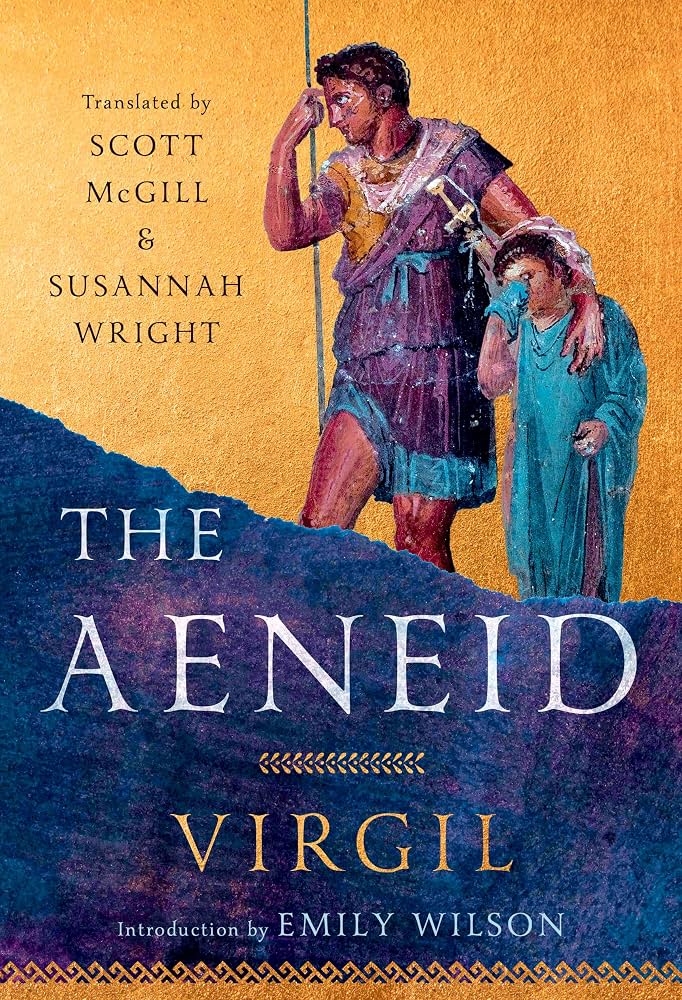
  • Reading on A Review of the Aeneid, Translated by Scott McGill and Susannah Wright, by Deborah Warren

    First, let me confess that I have not yet read the translation of The Aeneid by McGill and Wright. Maybe I will after I finish reading Robert Fagles’s translation. So, while it would be unfair for me to judge which translation better serves readers of the twenty-first century, I can say that Fagles’s translation of Virgil’s epic narrative of Aeneas reads like a prose poem to me, simply because its language and arrangement suit my taste.

    This essay is not for general readers but for readers with an academic background in Latin. Therefore, for general readers such as myself, its comparison of the original Latin with the English translations—in terms of metrical structures, the choice of words, and their juxtaposition—may not ring a bell. My interest in reading The Aeneid comes from a purely personal curiosity: I want to understand why Aeneas is the way he is, breaking the hearts of the women who loved him dearly. In that regard, Fagles’s translation chimes the bell of my heart and soul because his words are poetic and, at the same time, go straight to the heart. Take a look at these translations:

    Fagles:

    “Wars and a man I sing—an exile driven on by Fate,
    he was the first to flee the coast of Troy,
    destined to reach Lavinian shores and Italian soil.”

    Robert Fitzgerald:

    “I sing of warfare and a man at war.
    From the sea-coast of Troy in early days
    He came to Italy by destiny
    To our Lavinian shores,
    A fugitive, this captain . . .”

    McGill and Wright:

    “I sing of arms and of a man displaced
    by Fate, the first to leave the coast of Troy
    for Italy and its Lavinian shores.”

    Fagles’s version of “Wars and a man I sing . . .” clearly expresses Virgil’s intention to sing about a man destined to put duty before feeling. By placing the mainstay of The Aeneid—the fate of the man—at the beginning, Fagles conveys to his readers that Aeneas was not born to be a romantic figure, or even a heroic star, but to be a man torn between what he wants and what he must do.

    Through Fagles, we hear Virgil sing of Aeneas, a demigod and an excellent soldier: the embodiment of the Roman ideal, whose pietas and gravitas signify personal virtue as well as martial prowess. But Virgil was not a soldier; he was a poet. Bernard Knox, however—the classicist who wrote the introduction to Fagles’s translation—brings the crack of a horsewhip to it. A former U.S. Army captain and World War II veteran, Knox had literally followed in the footsteps of Antony and Octavian during the Italian campaign. He must have carried Euterpe and Calliope with him—the Muses who had also stood behind Virgil thousands of moons before.

  • Bartleby, the Scrivener A Story Of Wall-Street by Herman Melville

    Bartleby, the Scrivener A Story Of Wall-StreetBartleby, the Scrivener A Story Of Wall-Street by Herman Melville

    My rating: 5 of 5 stars

    It was more than 10 years ago when I first read Herman Melville’s Bartleby, a short story about an unwonted young man employed as a scrivener by a Wall Street lawyer. At that time, Bartleby struck me as a plain eccentric, imprudent worker who had the temerity to reject his boss’s orders. He was just a mentally deranged man with only a few words, other than the monumental diction of “I would prefer not to do …“

    But now I think of him differently. Maybe it’s because I have more experiences in a journey/sailing of life than I had when I first encountered the Bartleby character. Whatever it may be, my perspective of the character has been changed in a humane way. Since I re-read the story this afternoon, I have felt bottomless sympathy for Bartleby. Mixed with pathos and sprinkles of humor in the narrative of his benevolent former employer, the figure of Bartleby evokes springs of human compassion and humanity itself. And my feelings for this tragic scrivener amount to what the narrator felt about his former employee.

    I am not hereby intent on “analyzing” the psychological aspects of Bartleby and his former Wall Street lawyer boss. And I don’t think that even the writer Melville himself ascribed such psychoanalytical theory to these characters in mind when he wrote the story. To me the story itself tells what drove a sensitive man like Bartleby to such demise in the eyes of a compassionate man – and a decent employer seldom found these days. Loneliness, Hopelessness, Sorrow, and Reality of Death all packaged in letters to be burned in flames deprived the humanness of the forlorn scrivener. The Death of Humanity, that is. Having worked in the Office of Dead Letters at Washington must have been a traumatic experience to someone like Bartleby with eggshell sensitivity. Surely, there is no doubt that Bartleby was mentally disturbed, but who would hate or even despise him for his malaise?…

    Readers will conclude that it’s only a fictional story in which no such characters will/would exist in reality. But I don’t think so. As a matter of fact, I have always believed that fictions are always built upon factual elements of human life to a certain degree. Dismissing stories as creations of imaginativeness seems to miss the fundamental truths laid behind the subject matters of stories. That the multitudes of change and choice of our human life with a bit of creative imaginations is a substance of any story. Ditto Stephen King, who has once said that the stories are artifacts that are not really made up, but that are based upon preexisting objects we discover. Ditto Shakespeare who once said we are all actors and actress on a stage called a “Life.”

    The tall, lean, pallid and lugubrious image of Bartleby the Scrivener still lingers in my mind… All those returned/erturning letters flooded into the office every single day might have come from those who died in despair, those who died hopeless, and those who died suffocated by insurmountable sufferings; Bartleby had lost his own sense of existence, feeling utterly dispirited, pessimistic, and lethargic in performing demands of his duty. It was the loss of meaning of life that made him passively resistant to all the ordinary functions of daily life which all seemed insignificant to him. The life itself was nihilistic and hence non-existential to Bartleby. Humanity in the expressions of feelings and emotions meant nothing to him; it had ceased to exist in the form of dead letter attesting to existential horrors, which had led the authors to death, which had taken the poor Bartleby as the witness thereof.

    Thus the lamentable outcry of the narrator still deeply reverberates in my mind even after I closed the book: “Ah, Bartleby! Ah, Humanity!”

  • Lord of the Flies by William Golding

    Lord of the FliesLord of the Flies by William Golding

    My rating: 4 of 5 stars

    Lord of the Flies, which is derived from Beelzebub in Greek, by William Golding is a mind-boggling story about a band of English young boys aged between 7 years and 12 years marooned on an island after a plane crash during an atomic world war. Written in 1950s, the book questions the defects of human society in respect of the defects of human nature as symbolized by the stranded boys who have once civilized under the parental/societal guidance descending into savagery, which is operated by Id alone. And it only takes about 2 weeks or so to return to the primitive stage of mankind. Which is all the more terrifying to acknowledge.

    There are two extreme characters in the story: Ralph, a headstrong, sophisticated boy whose father is a naval officer. His primary goal is to be rescued by a ship, to return to the the world of civilization where all will be normal. Therefore, his main concern is to keep fire ablaze to signal his existence, the last remnant of civilization, the surviving Ego that “wills” his societal existence struggling for existential meaning that a civil community confers upon his singularity and uniqueness for recognition. Ralph’s lifeline for returning to civilized human society is fire as he keeps invoking the mantra of “No fire, No smoke, No rescue.” To him fire is Hope that will save him from falling into savagery. Other boys blindly and almost unconsciously have become animalistic, acting on instincts to satisfy their most basic desire only: Eating by Hunting.

    The Hunters are led by obstreperous, belligerent choir leader Jack. In fact, the figure of Jack represents many interesting aspects of psychotherapy. In the respect of psychoanalysis by Fraud, he symbolizes Id that “drives” all his acts and governs his modus operandi. To him fire does not seem to matter. He does not even want to be rescued. What he excites him is a process of hunting a pig – especially a female one – for provisional entertainment and survival on an island. In the view of individual psychology by Adler, gaining power over his “tribe” of the boys and becoming a chieftain by forcefully and unjustly abdicating the legitimate leader Ralph takes precedence over anything, such as keeping fire and going back to the cradle of civilization. The limit of ego qua responsibility does not apply to Jack, who lets his Id dominate his being. According to logotheraphy by Viktor E. Frankl, Jack has ceased to fulfill his responsibilities as a cooperative cohort of Ralph to work together to protect themselves, to guard fire, and to abide by orders and rules of their own until a rescue comes their way.

    And there is pitiful Piggy. We don’t know the real name of Piggy. But we know that he does not want to be called such. But the boys, including the civilized Ralph, who has learned how to blow a conch by the help of Piggy, insists calling him the name. The narrative tells us that it’s not that the accents or fumbling that makes him a buffoon of the boys; it’s his corpulent appearance that loses him respect among the boys. Besides, he’s the only one that wears a pair of spectacles, which are used as a magnifying glass to gather sunlight to make fire. In fact, I view the figure of Piggy as a voice of the intelligentsia. Ralph laments over the tragic death of Piggy because he’s the one who “talks sense.” In fact, his spectacles, which is cruelly damaged by the sneak ambush led by Jack and his savage tribe, symbolize the perspectives of the intellectual that view the state of human nature in danger of retrogression and decay to Zero, the raw, primitive nature devoid of existential meanings and values that define human. And the boys ridicule him, deriding his attempts to call their attention to reality of their situations. Piggy betokens a Thinker, a voice of Rationality that loses its footing between provisional needs of survival and existential ennui at the time of abject crisis.

    Lord of The Flies by William Golding attests to loss of humanity as a result of catastrophic event in which a survival of the fittest seems only true. This may include a case of war in consideration of the year the book was written; it’s 1954, only 9 years after WWII. Golding saw the evils of the war – the countless deaths, the famine, the ruins of houses and building and nature – the Wholesale Destruction of Humanity. What had once been a great civilization fell into a great catastrophe by the hands of Humankind. It’s a paradoxical truth that ascertains civilized human society debased into brute savageness operated on ferocious instincts for survival… The theme of the book bespeaks a collapse of human conscience governed by our Ego that prevents us from being thoughtless, self-destructive entities solely acting on our raw, dangerously ferocious impulses, our Id. And it is this Id that the devil as symbolized by the fly manipulates such instincts to fall into moral decadence for our ultimate destruction from within. In light of the aforesaid, Lord of the Flies is a modern day fable of the demoralization of human nature laid bare in the limelight.