Tag: book review

  • The Timeless Art of Jean Francois Millet: Book Review on Jean Francois Millet by Estelle M. Hurll

    Jean Francois MilletJean Francois Millet by Estelle M. Hurll

    My rating: 5 of 5 stars

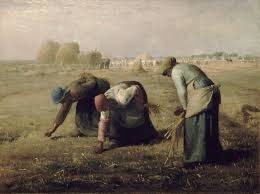
    I was 13 years old when I first saw “The Gleaners” reprinted on a small tin plate as a complementary bonus to a carton of vanilla ice cream my mom had bought for me and my little brother. The painting had a peculiar charm that diverted me from the love of my favorite ice cream; its serene but picturesque impression of the three working women and the pastoral scene produced in me a peace of mind and a sense of comfort. Since that time, the painter of “The Gleaners, ” Jean Francois Millet, has become my favorite painters of all. So when I came upon this book by Hurll published in 1900 on Kindle Bookstand, I was already downloading it on my kindle with a kind of same delight I felt when I was 13 years old.

    x
    “The Gleaners” By Jean Francois Millet courtesy of wikipedia

    Jean Francois Millet (1814-1875) was born into a hardworking and caring peasant family who had been residing in the old province of Normandy, France through the generations. The rustic, chaste beauty of the pastoral scenery and the coarse but artless and diligent village people who toiled to grow life out of land and tended flocks of livestock for living were imprinted on the senses and sensibilities of Millet. His subject matters were already indelibly marked in his nature. It is in fact, this natural beauty that became his muse and the epitome of his aesthetic beliefs. He spurned the artificial beauty of the forced setting. He believed, “The beauty is the fitting,” which links to what Saint Augustine explained in his “De Pulchra et Apte,” meaning “The Beauty and The Fitting,” in which two kinds of beauty: beauty inherent in the thing itself, and beauty by virtue of thing’s use were explained. In this regard, Millet’s tranquil beauty pertains to the latter as shown in his paintings of the pastoral life and its inhabitants.

    What’s special about Millet’s paintings are distinctive features of his art. To illustrates, in “The Angulus,” “The Gleaners,” and “The Shepherdess,” the landscapes cease to be a mere setting or background in figure pictures and become “organic” parts of the compositions, focusing on the human sides in the expressiveness of the figures, and thus make both figures and the landscapes interdependent, fitting together in a perfect unity. Millet also mastered in the effects of changing the light during different hours of the day, which creates the ambience of the normal and the quiet in the paintings.

    cropped-g1mllt010_5_1862-1864-bergere-gardant-ses-moutons.jpg
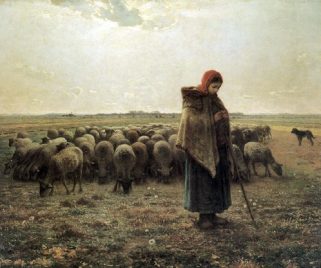
    “The Shepherdess” by Jean Francois Millet courtesy of 1000 museums.com

    Although it was “The Gleaners” that allured me into the world of Millet’s paintings, my favorite is “The Shepherdess” completed in 1862. There is a young shepherdess knitting like she is transfixed, while her flock of sheep and her assistant black little dog are following slowly their pensive guardian. The expression of her face begets many thoughts on the sacredness of work and its worker that strikes into your heart with a sense of respectfulness, which is stretched to the far distance in the scene where men working on piles of hay and their carts to carry them over. This painting gives an impression of a suspended action captured in the eyes of the painter as if it were photographed that would proceed to move in any moment soon. Also, it renders the 3rd dimension of space with the figure of the shepherdess having a solid, tangible appearance and the space that seems so infinite, so boundless, and so eternal with the quality of surrounding light of space composition evocative of religious serenity.

    This book does not contain a biography of Millet but rather serves as a reference book of his paintings to get readers acquainted with the artistic world of Millet in a short period of time. One of the reasons I chose this book is its year of publication. It was published in 1900, only 25 years after the death of Millet. Therefore, Hurll could glean information on Millet’s life from surviving friends of his, which is all the more authentic and factual, devoid of myths, legends, and fables that are so prevalent in the books on the famous who were long gone.

    For these reasons, Millet is one of the fine artists whose intense love of human nature and expression thereof is the chief element of beauty. In his paintings, nothing is ignored in the landscapes as well as the figures. He was indeed a master of the arts who could use the seemingly commonplace with the feeling of sublime that gave to art its true meanings. Many years might have passed since the first time I saw “The Gleaners,” but the kind of mysterious delight of peaceful awe I felt at that time still remains with me after all those years. Millet was right: the true beauty knows no boundary of time and place.

  • Why We Get Fat: And What to Do About It by Gary Taubes

    Why We Get Fat: And What to Do About ItWhy We Get Fat: And What to Do About It by Gary Taubes

    My rating: 4 of 5 stars

    We all have read about books about dieting and exercising. We all have tried most or some of the methods as provided, but the bottom lines are all the same: that eating less, exercising more is the sine qua non of getting thin and staying healthy. Does this res ipsa loquitur (a thing that speaks for itself) model really work wonders to all? Then why doesn’t everyone following this principle get the uniformed result?

    Gary Taubes does not believe so. In fact, he subverts all such received ideas of what we have so far known as norms of dieting rules and regulations because they are scientifically fallacious and commercially expedient based upon his years of punctilious research on this subject matter. In this book, Taubes goes back to the primordial question of what makes us fat despite our efforts and offers head-turning advice which “stands the the received ideas of dieting and exercising on its head”.

    He criticizes such faulty knowledge on calorie intake/outtake as a result of insufficiently conducted experiments of nutritional science of the 20th century. (He calls it the product of “bad” nutritional science”) This belief of less “calorie take-in” and more “calorie-out” contradicts the science of physiology – i.e., how it works as regards to how our body digests food, where it is stored,  and how it influences our body.

    Furthermore, he looks into a role of genetics playing in metabolism. Which one is more influencing in making us thin? Exercising or your genetic composition? Besides, does meat really make us fat? Should we become vegetarians to lose weight and stay gracefully thin? Taubes answers these questions in detail and enlightens us from the mass hypnotic mantras of the calorie intake/outtake that have been permeated in our society for more than a century. If you are on the verge of abandoning your will to lose weight, or tired of listening to the fad dieting, or want to try something new and really effectual just as I did, this book will make a breakthrough guidance book for your healthy life.

    저장

  • Albert Speer: Hitler’s Architect

    Spandau: The Secret DiariesSpandau: The Secret Diaries by Albert Speer

    My rating: 5 of 5 stars

    Albert Speer was a very clever man; he managed to survive a death sentence at the Nuremberg trials and lived to tell his story of the Third Reich, Hitler, and himself as Minister of Armaments and War Production during WWII. Furthermore, Speer made a brilliant career of writing memoirs with many a television interview following his release from West Berlin’s Spandau prison in 1966 after having completed his 20-year sentence. This book, written between 1946 and 1966 in Spandau, is a collection of his diaries and letters to his family secretly kept against the prison regulations.

    The reason that Speer had written his diaries was to keep his mind disciplined and alert by using his mental faculties while serving his time at Spandau. He was afraid of undergoing mental and physical atrophy because the prison life to him was nothing but a repeated series of monotonous routines that would lead to mental stagnation and physical lethargy. Whether Speer had written diaries and other correspondence to his family with the thought of publishing them in mind is hardly probable because it was for the sake of his own ego arrested by a lack of social refinements and intellectual engagements during his confinements as well expressed in the diaries.

    There are many interesting anecdotes about his fellow prisoners who formed their own social cliques even inside the prison: Albert Speer and Rudolph Hess did not socialize with the other prisoners but spent most of their time alone. In fact, Speer was disliked by the other prisoners for his admission of guilt and repudiation of Hitler at the Nuremberg trials. So was Rudolf Hess for his reputed antisocial personality and conspicuous mental instability. The two former Grand Admirals, Erich Raeder and Karl Dönitz stayed together. Baldur von Schirach, the German Nazi Party’s national youth leader and head of the Hitler Youth, and Walther Funk, Reich Minister for Economic Affairs, were described as “inseparable”. It was Konstantin von Neurath whom Speer seemed to have a good opinion on for his amiability and amenability to all until his release in 1954.

    The book is not a history book or a testament to Speer’s apologetic gesture of doing public penance for his involvement in the Nazi regime. As Freud once said, “Sometimes, a cigar is just a cigar,” this memoir is a memoir, Speer’s personal journal, encompassing his intellectual capacities to observe and analyze what he saw and read in addition to his desire of being with his family, especially the sons who seemed to feel uncomfortable with their father when visiting him in prison. Upon reading this heavy volume of memoir, I am convinced that it was his sagacity and intelligence that saved him from death and that enabled him to launch a successful writing career afterwards.

    저장

  • Billy Budd by Herman Melville

    Billy Budd, SailorBilly Budd, Sailor by Herman Melville

    My rating: 4 of 5 stars

    The ageless question of human nature pertains to the paradoxical mysteries of human personality shaped by our perception of the world, as reflected in ancient mythologies. Herman Melville saw this intricate irony in this representation of reality in connection with the development of complex human personality in the characters of Billy Budd, John Claggart, and Captain Vere in this nautical novella.

    (1) Psychoanalytic perspective: The characters are emblematic of Freudian elements of personality. They are id represented by Billy (intuitive mind), ego (conscious mind) by Claggart, and superego by captain Vere (ethical consciousness). Billy’s ingenuousness, unalloyed beauty both in physical appearance and inner qualities, and young age symbolize the earliest phase of development of human personality. Hence the name “Budd” seems to betoken this emerging state of metamorphosis into early adulthood. When Dansker warns him of Claggart’s malicious intention to do harm on him, Billy dismisses the advice and insists on Claggart’s friendly treatment of him. In Billy’s representation of reality, Claggart exists as what he sees: a kind officer who does not give him a hard time. In fact, it is this innocent child-man like quality that becomes Billy’s fatal flaw.

    Billy Budd is doomed to be ruthlessly crushed when he is transferred as a foretopman to the naval ship HMS Indomitable. Here he meets his Valkyrie John Claggart, Master-at-Arms equivalent of Chief Police Office or discipline officer, who is always down upon Billy, for a reason indicated none other than his being divinely beautiful and angelically kind. It is the old veteran sailor named Dansker who regards Billy as his little child and informs him of Claggart’s devious motive. All these characters are at the helm of Captain Vere (whose name is derived from the Latin word Verite, meaning truth. Here the vessel is a model of representation of reality surrounded by seas, which is the world it anchors in.

    Claggart’s reason for his hatred of Billy is clandestine. He appears to act according to his ego, the conscious mind which Socrates considers as spirit. It seems that Claggart’s loathing of Billy becomes inflamed when Billy accidentally spills pea soup on his feet because he believes it to be Billy’s intentional effrontery. Claggart seems to act by his emotions based on the purely abstract reasoning of the mind. Therefore, Claggart’s model of reality is a result of his own way of interpreting the situation with his faulty assessment of the character that defiles his mind with dangerous antipathy toward the youth.

    Captain Vere, a figure of authority that convenes both Billy and Claggart on the subject of alleged mutiny as instigated by Billy, represents the ethical mind, the superego, the reason. He acts as an executor of justice to gird up the loins of discipline among his crew amid the revolutionary wars on the sea. Vere feels that Billy is innocent; however, when Billy hits Claggart to death at his false accusation of him as a mutiny leader, Vere is convinced of Billy’s alleged guilt and orders his execution by hanging. In a way, Vere represents an amoral authority figure dealing with individual citizens or subjects according to law and order minus spirits and appetites.

    (2) Mythological perspective: It is also interesting to look at this story of Billy Budd as folklore tinged with a mythological undertone of heroism akin to Norse mythology. The figure of Billy Budd reminds the reader of an ideal hero dying young; the hero can prove his nobility of character by death because often heroism depends on lost causes. The young welkin-eyed Billy Budd’s death gives rise to the high concept of this Nordic hero because the real power of good is shown by continuing to resist evil while facing certain death as the legacy of Billy Budd is immortalized in the seaman’s ballad. In my opinion, this story of the welkin-eyed young hero reflects Melville’s model of a heroic individual whom he once envisioned in his sailing days. Or perhaps, Billy Bud could be what Melville wished his two sons lost in unfortunate occasions (Malcolm, the eldest, who died of a self-inflicted gunshot wound in 1867 and another Stanwix, who died in 1886 in San Francisco) to be like. It would have been Melville’s mournful tribute to the deaths of his sons as enshrined in the mythological figure of Billy Budd.

    The book is written in an intricate prose style with the literary vocabulary used in the 19th century and historical allusions to the revolutionary wars and the great Admiral Nelson’s naval wars to give to the story a more realistic setting. Melville, who was a seaman himself in his youth and later settled as a customs inspector in New York City, wrote this novella in 1891, the time of his death. It was actually his postmortem work, published in 1924, 33 years after this death. And it was this work that kindled widespread interest in Melville’s works.

    Reading this tale of an angelic sailor will give the reader a sense of reading a Norse mythological tale because the protagonist of the story is evocative of pathos flowing from the complex human nature that is sublimated into heroic triumph over the face of the harsh reality of the world.

  • It’s a Strange Place, England by Jack Strange

    It's A Strange Place, EnglandIt’s A Strange Place, England by Jack Strange

    My rating: 5 of 5 stars

    Jack Strange’s England is never a bore; it is a mystifying country with its tempestuous history and colorful characters populated by the ever undead of the bygone eras still roaming their past abodes or workplaces among the quick. It is a quaint country where history meets myth and legend. This book will guide the reader to Strange England where fanciful folklores and historical facts are anchored in the traditions and customs.

    The author admits that England is perhaps arguably one of the most haunted countries in the world, thanks to its religiously and politically tempestuous pasts spanning the wheel of time from the Roman colonial period to the present. To illustrate, in Derbyshire a spectral Roman sentinel is often seen leading a parade of a circus comprising gladiators, chariots, and slaves, then all of them disappear into the mist. Another lovelorn Roman soldier is witnessed alongside Hadrian’s Wall in Northumberland, wandering in despair of his betrayed love for a fair English maiden. The phantom English residents also encompass the Benedictine monks led by St, Cuthbert in Lindisfarne, which was a target for frequent raiding by Norsemen who also threatened the cradle of English Christianity. It is said that the best time to see the saint or the monks is when the tides are high and a full moon lights the shore as a natural lantern.

    England is also a home of many interesting sports that are historically – and sometimes by happenstance – originated. The World Gurning Championship in Egremont in Cumbria was originated in 1267 when the Lord of the manor gave out crabapples to the locals. One can imagine without difficulty the consequence of tasting the apple, and thus can master the art of making as ugly face as possible. Hence this hilarious tournament comes to exist to this day. It’s open to everyone – yes, even to the fairest of all – , and it’s all about fun and participation. Also, there is Black Pudding Throwing Championship in Ridge, Lancashire. Originated in 1455, this tournament shows English humor mixed with historical irony, which makes it all the more convincing. It was during the period of “War of the Roses” elegantly referred by Sir Walter Scott (who was a Scot) to the feud between the House of York whose symbol was a white rose and the House of Lancashire a red rose. At the Battle of Stubbins in Lancashire in 1455, both forces decided to throw puddings at one another instead of lances. Believe it or not, the descendents still commemorate the incident by holding a championship every year with mirthful popularity.

    Subsequent to Strange Tales of the Sea, the author Jack Strange has done a marvelous job gleaning the extensive historical documents and cultural artifacts from his tireless research to provide his reader with interesting facts about his England. Strange is a gifted artificer who digs artifacts buried in the depths of forgotten times and lost folklores. Strange is also a mysteriously reclusive figure himself because there’s no personal information about him. Maybe that’s why his writings are so hauntingly attractive and oddly addictive. Strange is an excellent storyteller who weaves a tapestry  of legends and folklores imbued with his impressive knowledge of the history of England and his English humor permeated in his writings. This book is Strange’s winking invitation to his beloved England that spins a general image of the country with enchanting oddity and wide-eyed wonder that the readers will not tire of.

    저장

    저장

  • A License to Heal by Steven Bentley

    A License to Heal: Random Memories of an ER DoctorA License to Heal: Random Memories of an ER Doctor by Steven Bentley

    My rating: 5 of 5 stars

    Steven Bentley, M.D., an American Board of Emergency Medicine certified ED doctor and also the author of this book with a fabulously fitting title, began his medical vocation in the mid-1970s with a naive but noble cause to heal the wounded and save human lives. His reason for choice of the ER Medicine was that it consisted of Minor Surgery and Emergency Medicine and thus gave him opportunities to practice a wider scope of medical knowledge and administer it to a wider range of patients.

    Over 30 years until his retirement in 2000s, Dr. Bentley was a commendable doctor equipped with an arsenal of immense medical knowledge combined with a sea of compassion and kindness to treat all the patients he encountered in the ER of a hospital in North Carolina regardless of their social and economic statuses. Unlike most impersonal, officious doctors, Dr. Betley “listened” to his patients and oftentime went out of his way to help a patient whose medical need was repeatedly and cruelly rejected beyond a reasonable measure.

    Welcome an old veteran man whose doctor was out of town, so he had to get his prescription for blood pressure control refilled at a VA hospital. However, it was such a painful ordeal for the old man, for he had encountered frustrating runaround from one hospital to another because they did not want to take a responsibility for refilling his prescription without his primary care doctor’s consent. So when the man finally came to Dr. Bentley, he burst out crying saying, “All I need is to get my usual prescription refilled…” Thereupon, Dr. Bentley wrote him a refill prescription and told him not to come back to the hospital. And off the man went out of the hospital with a relieved mind.

    The world of the emergency medicine as experienced by the ER doctor himself was a variety of fragmented views of human frailty, both physically and mentally, but it was also the world of the most human medical practice where compassion, kindness, and charity were witnessed to the hopeful eyes and shared by the staff and the doctors in the name of humanity.