
I remember when they were happy,
I remember when they were lonely.
When only two of them left, there
I saw the light glowing and growing
in the silence of darkness of night
Frolicking in the twinkling starlight
Becoming two fireflies on the grave.
I remember when they were happy,
I remember when they were lonely.
When only two of them left, there
I saw the light glowing and growing
in the silence of darkness of night
Frolicking in the twinkling starlight
Becoming two fireflies on the grave.

She wished her dreams secretly
Sitting on the rock by the shore
Lest the spirits tear them anon
And keep her a hostage to fortune
Until her spirit left her in surrender
To the mercenaries of death in the pact.
Luck was a stranger, so was Faith.
But Hope always stayed with her
On the rock against winds and waves
As a Friend like Pellas and Athena
giving the light of Hope to Despondence
reviving Breath of Reason to wait still.
One day Hope told her to write a letter
To Heaven about her Seven Wishes
So that the West Wind would carry it
On his feathered wings like Pegasus’
To the Palace of King direct and express
And He would open and read it at once.
So she wrote her letter to King
Of Seven Wishes sealed in secret
Stood and flew a lithe kite carrying
The wishes in words fluttering in the breeze
And waited for the West Wind to come
And deliver them upward further higher
Alas! The Wishes sent to the skies
Fell from the wings of the wind,
As her heart’s whispers were wafted
Downward, leeward, seaward
Until mermaids caught in their outing
And treasured them in the shells.

The congress of professed faithfuls gather
Under a great kiosk of memorial Agnes Dei
Wearing their best masks misfitted altogether
Sitting on the paws as pious sinners to pray
Reciting verses that become meaningless
Abracadabra that no pagans would know!
The Feast of Life resurrected in Pascal Mysteries
Is the feast of absurdities in deceived fallacies,
And the heart among the entranced worshippers
Pounds in great beats of passion and faints in weeps.
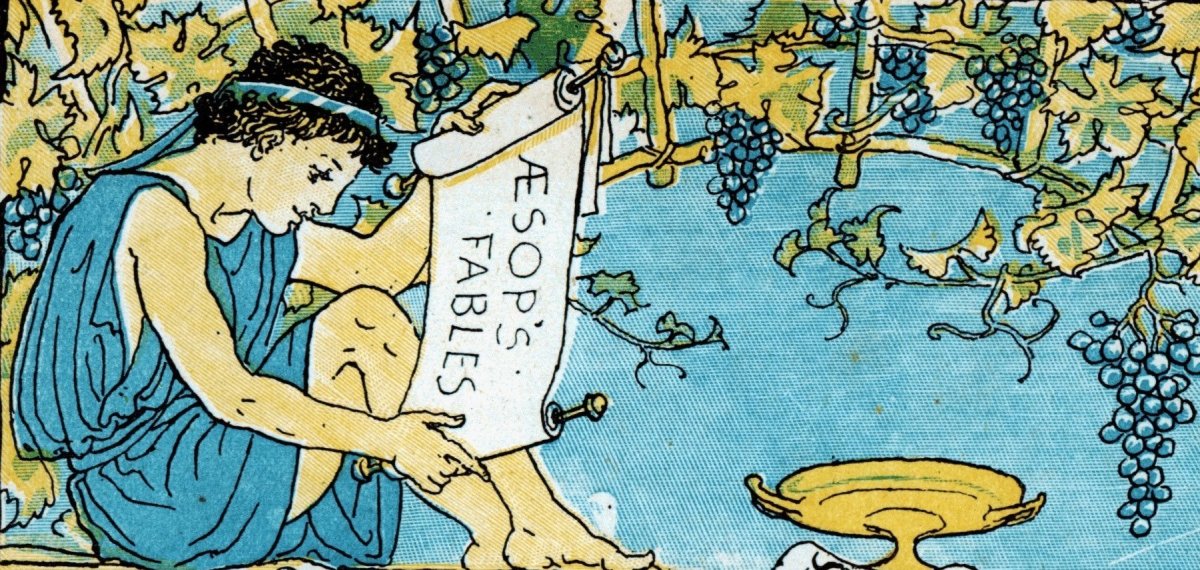
Aesop’s Fables by Aesop
My rating: 5 of 5 stars
Last week, I reread Aesop’s Fables as an adult (that is, in terms of the ages on an evolutionary scale) in the 21st century and found them just as attractive as the first time reading it as a child. What a feeling! A freed slave once, Aesop’s natural wit combined with protean imagination made him able to investigate the essence of things, the nature of things, and attribute it to human nature’s characteristics, which ultimately brought him mortal death and immortal life. He was, in a way, a lot like Hephaestus, the god of fire, blacksmith, presider of the arts, and the only legal husband of the goddess of love and beauty Aphrodite who found him unbearably unromantically ugly.
Aesop’s Fables still scintillates in the brilliance of affabulation and humor that nicely relates to Nietzsche’s concept of immanence, the understanding of nature of all things; the Natural Law called conscience the supreme ruler of the universe has inculcated in us. The Fables are full of lessons that are akin to Jesus’s parables employed in his teaching of ethical codes for Christians in daily life. Of course, Aesop was of the Pre-Jesus era. Still, his stories bespeak something of human nature that had already existed, which is ongoing and will continue as long as humanity exists. The cardinal virtues of prudence, justice, temperance, fortitude, and Christian values of faith, hope, and charity are all embroidered on the elliptical, imaginative, and impressive episodes of and among humans, animals, and even gods in this immemorial anthology of ancient wits. “The North Wind and the Sun” teaches about the force of gentility over the fear of intimidation. “The Woman and Her Hen” resonates with the timeless adage of everything in moderation. “The Milkmaid and her Milk Pail” corroborates the famous proverb that you should keep a bird in your hand than catch two in a bush. Treating others in a way you want in reciprocity illustrates the dinner scenes in “The Fox and the Stork.” And yes, I believe President Ted Roosevelt must have gotten inspiration from “The Astronomer” that you should look at the stars while keeping your foot firmly on the ground. And there are more stories to wow modern readers.
Aesop’s Fables are so practical and amusing that all of them collapse millenniums between his telling and our reading it. Besides, all of them read like Book of Proverbs or Psalms in free verse or prose version, which makes the reader unburdened with textual analysis to decipher meanings intentionally obfuscated by the high intellect the academic writers of the sort. The Fables are comprehensive to all, serving a purpose of providing tenets of reading; to bestow pleasure of the sense and satisfaction of reason in a way you do not consult a help of a dictionary or other lexical or literary reference. Reading the Fables gives a feeling of watching a TV cartoon, say Woody Woodpecker, which tells something about man’s nature wrapped in an animal hide. So do not fear reading Aesop’s Fables now. It is well worth spending your free time discovering the universality of the truth with that “A-Ha!” moment regardless of the subjectivity of time.
View all my reviews

The 3 gods preside over the Arts.
Pallas Athena sends out the rays
of visions into the memory temple;
Vulcan grasps the beams of light
and grows them into red hot fires;
Mars receives the divine artifices
and perfects them into treasures.

The chariot of the sun reaches
At the end of the day’s race,
And the eyes follow the trace
Of the sun god’s declination
And stay on the golden palace
In the dazzling adumbration
By the waterfalls of Elysium.


You must be logged in to post a comment.