Tag: charlotte bronte

  • Writers of Extraordinary Hearts

    Saturday Reading of Kerry Clare’s “Beyond ‘Women’s Fiction…’ On the Quiet Brilliance of Barbara Pym,”

    published by Literary Hub on March 16, 2026

    October 10, 2026

    Muriel Barbery, Clarice Lispector, and Elizabeth Taylor (not the actress) could give voices to women whose quiet presences belied the flame within. They could see the stories in what others dismissed as insignificant and draw readers’ attention to their lives. Renée from Barbery’s The Elegance of the Hedgehog was a sophisticated, erudite woman with an unacknowledged sultriness. Macabéa from Lispector’s The Hour of the Star might have been a shy typist but was an undercover beauty with her red lipstick. Prudence from Taylor’s A View of the Harbour was a lonely, beautiful girl who was never popular. Now Barbara Pym joins these writers of extraordinary hearts.

    I haven’t yet landed on Barbara Pym’s universe, and I’m happy to read Clare’s essay on her work and characters who sound a lot like the aforesaid characters. Her characters revolve around the daily tasks of ordinary life. Other writers often avoid such lives because the material is either (1) too unglamorous to attract readers from a milieu similar to that of the authors and their characters, or (2) too mundane to accommodate the fashionable existential dilemmas so prevalently narrated within elite literary circles. Some of today’s women writers also fall into this pattern, creating expensively educated women—or scholarship winners risen from rags—who are beautiful, independent, and supplied with lovers for passionate nights and days anywhere. Okay, I get it. I may be too biased, or too inaccurately accusatory, toward writers who don’t write like writers with extraordinary hearts. But if you know my point, I am sure you get it—don’t you?

    Writing about something you do every day can bore you and your readers. But if you find a story in how you do it, why you do it, and what you do—or will do—about it, that is the gem of the story; it makes the simple powerful. I remember reading a book about a legal secretary at a large New York City law firm, written by an author who drew on her own working life. Her narrative shows readers what routine work can conceal, giving them a reason to understand why people are the way they are.

    When I look at some of those who advocate for the rights of the oppressed and underprivileged, I notice that they do not always acknowledge the people around them in daily life. At times, ideology comes before humanity because writing about diaspora, social injustice, and identity crises is now presumed to be intellectual, just, and conscientious. Charlotte Brontë, who wrote about women compelled to work—usually under less-than-gracious employers—said that an author’s first duty was “a faithful allegiance to Truth and Nature.” What could be truer than telling a story of a woman ignored and invisible?

  • Prompt 18

    What job would you do for free?

    I would work for something attending to the welfare of cats pro bono. With All My Soul, All My Might, and All My Spirit. The best place for me to do this is probably in a shelter or a rescue center where I can devote myself to cats needing help with my undivided love for man’s best consort.

    Being a cat person not made of the crude materials of this world, I feel most comfortable with my two cats, Toro and Nero, at home. Who says that cats are aloof and egoistic? Hardly so. Cats are so affectionate and kind and beautiful both externally and internally. Lucy Maud Montgomery, the author of Anne of Green Gables, was a cat lover who averred the beauty of the feline folk: “I love them. They are so nice and selfish. Dogs are TOO good and unselfish. They make me feel uncomfortable. But cats are gloriously human.” Indeed so, for when I am crestfallen because of the woes of daily life in this world, my cats come next to me and nestle their little furry body and soft head under my arms, purring, consoling, and allaying my fury and disappointment and sadness. Unlike my fellow human species, my cats know me well and accept me for who I am. They say animals can see the true colors of our characters. True, especially in the case of cats who can see spirits.

    I have noticed that people dislike cats with a sense of pride as if there were some peculiar virtue in expressing such shameless disapproval of cats. So be it because cat people are a particular tribe whose sensitive nature and delicate sensibility fit those of cats. Edgar Allen Poe and the Brontë Sisters would ditto in the constellation of literary stars excellently bright in heaven with their cats in their arms, purring and meowing. Therefore, in light of those mentioned above, why wouldn’t I willingly work tending cats free of charge?

  • law of inertia

    According to Newton’s law of motion, inertia refers to a condition when a mass of an object determines a resistance to change. The bigger a thing is, the harder it is to be moved. What a splendid discovery when such truth has always existed! That is a difference between someone like Newton and other mortals who have seen it but cared more or less about it. The gist of my proposition is that inertia fits the state of my mind at present; the more I exert my cognitive facilities on articulating my thoughts, the harder they seem to operate the abilities with all their souls, with all their hearts, and with all their might.

    Today I looked into the statistics of my blog posts, realizing my literary fruits were turning sour with the leaves of the knowledge of tree desiccated in the arid land of pitiful ignorance. T.S. Eliot must have felt the same when he yeared for a benevolent pool of knowledge on the barren land of his mind, which is hardly likely to think about because – well, for what he is. No matter how much I try to use a craft of writing that I used to possess until three months ago, I realize the powers are gone with the wind to the ether and then to the blackest black hole in the universe. The words become weightless, and the images are as bleak as the Persian night. It’s like being in the middle of an adumbrating labyrinth with Ariadne’s ball thread missing or forfeited by whimsical divinity. Nothing scintillates, nothing promises, not even with a bluebird that used to guide me into avenues of hope. So whereas I still delve into reading voraciously, the words are flushed into a great abyss of darkness, a slough of despond, leaving me weeping and then crying alone. I wonder if this state of inertia can also be related to the dark night of the soul that St. John of the Cross experienced before his spiritual epiphany. Or I can identify the feeling to the sudden listlessness of Albert Speer, the mild-mannered, brilliant Hitler’s architect friend, during his long-term incarceration in the Spandau prison after the fall of the Third Reich.

    I have always professed to write for the sake of my sanity, the justice to myself with a tenacious grasp on a sense of purpose that I am not going to disappear without a trace of my existence on earth. Laura Ingalls Wilder, Jane Austen, Charlotte Bronte, and Lucy Maud Montgomery all endured the vicissitudes of life in dealing with the demands of daily life while cherishing their literary ambition and endeavoring to prove themselves as gorgeous writers whose credo was allegiance to truth and nature, using the ideal to make the real perfect and kind that God forgot to bestow upon them. They are my spiritual sisters whom I daresay can relate to due to my circumstances and kindred disposition.

    I write not to canvass celebrities for being a top-rated blogger. But then I want people to know that I write however imperfectly or abstrusely. I write because I like it, just as people like to take their selfies and post them on Instagram or make vlogs on YouTube. So while the cold receptions still vex me to my publishing of writing in my blog, my spirit resists giving it all up, which rebels against the law of inertia. Come to think of it, the witch in training Kiki in ‘Kiki’s Delivery Service’ laments about her suddenly losing the ability to fly her broomstick as she stumbled into a vertigo of existentialist distress, part of growing pain before blossoming into a wonderful full-pledged witch. Maybe I am going through the same thing, too. I like to think that way.

  • ‘Plain Girl’, by Arthur Miller – review

    Plain GirlPlain Girl by Arthur Miller

    My rating: 5 of 5 stars

    When I first came across this book while looking for my next read on the train, I was immediately hooked on by the simple no-nonsense title of Plain Girl and incredulously surprised by the famous name of Arthur Miller, a celebrity playwright who had once married Marylin Monroe in his prime. Such an incongruous admixture of the images sprang in my mind like phantasms from a presumed association between the Dolorous and the Gorgeous, the Lonely and the Lovely, the Unlucky and the Lucky, all compactness in this beautifully elliptical and deeply heartfelt story about a plain girl whose jewel of beauty was wrapped in a dull, grey, crude titular epithet.

    Janice Sessions, an intelligent young Jewish woman living in New York City, seems to share the sentiments of the introverts whose quiet modes of behaviors and shyness often make them unnoticed, if not obscure, among vociferous, glamorous crowds. Think Maupassant, who at the hour of his death confides in his close friend, “I coveted everything and enjoyed nothing.” And Charlotte Bronte, who always thinks she is deprived of beauty and fortune, which prevents her from a delight of love as a prerogative of beautiful fortunate women. And then the Monster created by Dr. Frankenstein whose deformity puts him in a cruel shackle of absolute loneliness with an outcry of “I see inside but dare not to go inside!” They are the concerted echoes of estrangement – whether voluntarily or involuntarily imagined or devised – from lonely souls roaming around, wandering about in a search of happiness in life that can culminate in the union of loves, both Eros and Psyche, the spiritualization of sensuality in totality. This Janice is in want of, this is the source of her existential distress, noogenic frustration that keeps her away from anything miraculous and wonderful every happening to her.

    In fact, I wonder if Miller writes this story of a plain girl on the thematics of existential frustration in which his protagonist is made to believe what she really isn’t, whereas her extraordinariness of resilient spirit against endless disappointment and distress renders her all the more distinguished from her peers whose ordinary femininity looks banal and trifle without stories to tell. Such emotional distress may arise from an existential vacuum caused by a collective value, such as in this story the disillusioned tenets of political and social ideologies ultimately culminating in World War II and the aftermath thereof. And Miller so elegantly and dexterously accounts for a woman’s solitary quest for the meaning of life, a sense of purpose in life as a woman of true value against epochal tides of world crisis. The apex of Miller’s literary finesse manifests in every sentence delicately nuanced sentiment wrapped in his elliptical expressions and laconic use of plain words, defying every streak of intricately baroque literature that does not communicate straightforwardly to the hearts of readers.

    This book is not to discuss woman’s liberation or to lecture about the superiority of spiritual beauty over physical beauty that so many of you would quickly respond with stock answers. Janice’s doubt about her value of being loved and her preoccupied consciousness to her appearance makes her all the more palpable and realistic to those of you who find a kindred spirit in her and feel that you are not alone in loneliness and that what you think you are may not be the truth. Janice doesn’t need the glamour spell to transform herself into beauty because Janice is not a plain girl, nor has been, and will never be. The same goes for you.

    View all my reviews

  • To readers

    additional_7a1d79197752605194d5b4ab7d9c394967566b14-8
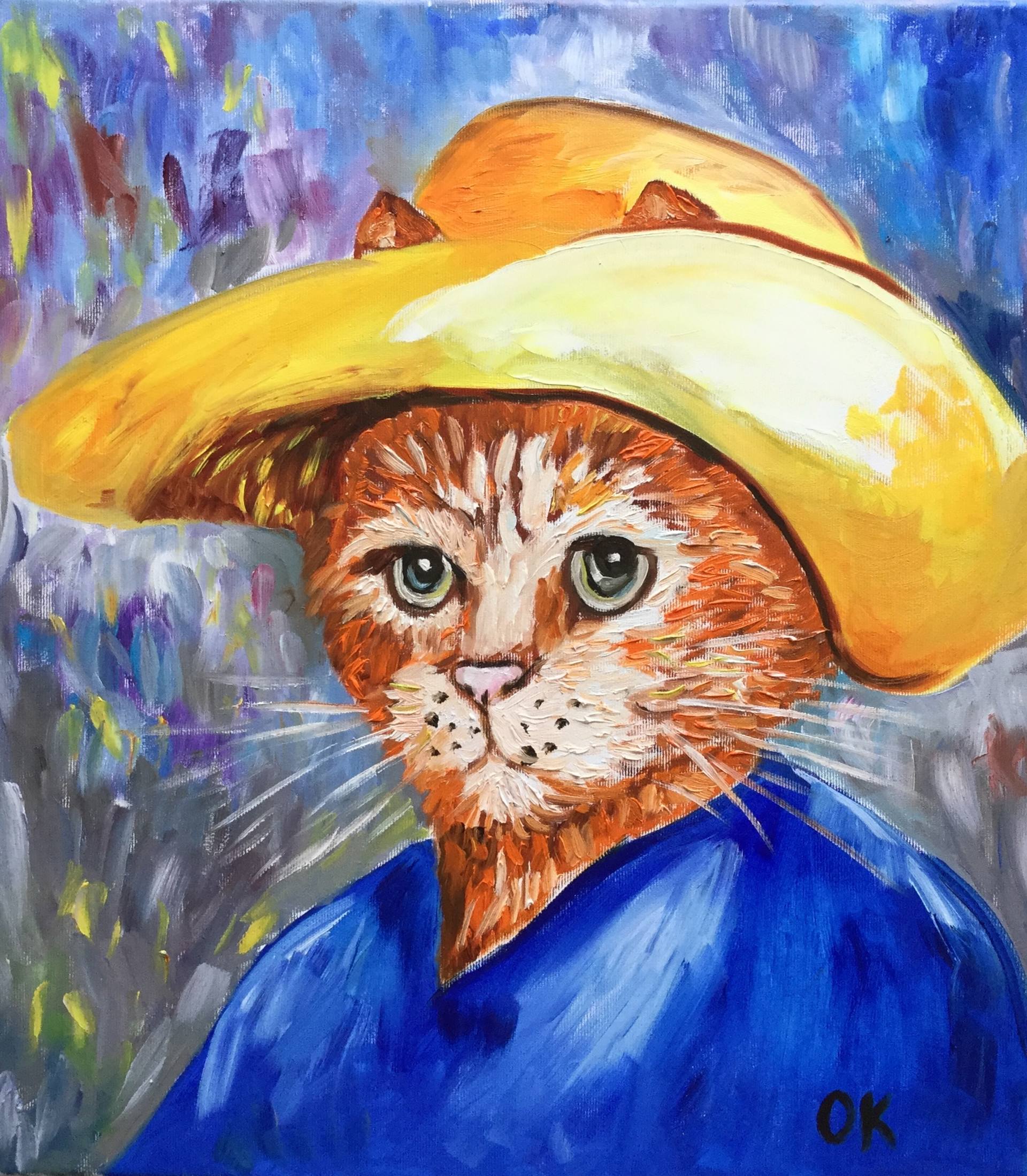
    Cat in a hat La Vincent Van Gogh by Olga Koval

    Normally, I don’t post a crude litany of woes or untamed outcry of malaise because that’s not what I want my blog to be filled with. However, today is an exception to the rule because for the last couple of days the receptions to which my published posts have been particularly detrimental to my disposition and averse to my sensitivity. Well, I don’t think it really matters to any of you out there who happens to stumble into my hermit blog, but then I don’t really care what you think about it because it’s my sovereign blog, which is my only safe niche, an elbow room amidst this crazy existential daily life constantly threatening my sanity, bullying my sensitivity, knowing that I am distinct for that “Positive Thinking in Thick Skin” facade.

    First of all, I don’t understand how people can follow a blog without liking any of my posts. Are they fishing in for their potential followers? I have noticed so many of them out there without liking any of my posts and following my blog, which I find it very insulting and odd. I am not here to foster an online relationship with anyone out there but to practice my writing skills as well as to use it as my creative, intellectual outlets yearning to surface from within because I can’t just will out what I feel and think without letting it out. Besides, I don’t want my existence to disappear into oblivion, which is a great injustice to my sovereign freedom of expression. That said, I don’t want to build up popularity by getting mindless followers either haughtily not bothering to like my writing or stopping to like it for whatever reasons. That breaks my heart to the extent to which it can’t be sawed up or replaced by a steel heart. It’s imbecility to have followers who are unappreciative of what I write.

    Secondly, to pour hot lead into my already wide-open gap of the wounded heart and soul, I saw the stats that although people read my last post about 6 movies from the 60s celebration of National Classic Movie Day yesterday and today, only four people voted for likes! Such disastrous comeuppance made me so disappointed and disheartened that I could not but think that writing could also be a Modus Operandi of detecting all about yourself from the way you looked to where you were from. This betrayed my primal idea about being capable of metamorphosis and travel to become all that I want to be, to do, and to go under the protection of faceless stealth. Faceless because your face could be a hindrance to expressing your self in a true glass of the mind. In order to ascertain the cause of such an outrageously heartbreaking result of the last post, I have read my post over and over again, but there appears to be no sophomorically pesky solecism whatsoever.  Further to the attempts, I visited the blogs of others about the same subject, but none of them is hard to regard it as a magnum opus! Do they think my post is inaptly conceived and professionally benighted or just plain average? And they even had comments from their members of the coterie eulogizing how great their picks were! Seeing all of this in my very eyes, I could not help agreeing with Edgar Allan Poe criticizing a clique formed among the New York Literati that excluded any writer outside the league of their own. I don’t think any of them appreciates my writing, and it makes me feel like such a fool that from now onwards, I vow that I will NOT volunteer to do any contributory writing unless I am asked to.

    Thus I have reorganized a list of followers because I think it necessary for me to do so for the love of my broken heart and wounded soul. I see writings of others, which are not tours de force but filled with a rhapsody of why their inane posts are great. Jealousy? What hokum! It’s such amusement to see even writings can become a tool for attracting strangers as a social get-together platform. Here I am, a hobbyist amateur writer working 9 to 6 to pay bills and rents but whose literary ambition is as great as Ben Jonson and Charlotte Bronte. Charlotte Bronte had been rejected to have her work published many times and was of the same disposition as I am. (Yes, I am closer to her in temperament and sensitivity than any of you out there who likes to think you are or wants to think you are when you are not!). She and I are in agreement in thinking that any appreciation from a considerate and intelligent reader for our writings is highly appropriate and proper as decorum to the author. You know what I mean?

  • ‘The Secret Diaries of Charlotte Brontë’, by Syrie James- review

    The Secret Diaries of Charlotte BrontëThe Secret Diaries of Charlotte Brontë by Syrie James

    My rating: 5 of 5 stars

    Who would have thought that the woman with a calm and dainty exterior wrapped in an air of impeccable propriety was inwardly a passionate Dido, a willing Ariadne, and a beguiling Cleopatra?  Such a popularly conceived false shadow – by default of nature against her will – might have conveniently belied Truth and Nature of her substances to the eyes of the public, but her labors of love in the form of literary works bear the witness to the person of the Author. She is no less a person than Charlotte Bronte herself who created one of the most unforgettably iconic romantic characters of Jane Eyre, and who tells to readers of the millennium the stories of her own life in this beautiful and truthful The Secret Diaries of Charlotte Bronte by Syrie James.

    The Secret Diaries of Charlotte Bronte is neither nonfiction nor fiction eulogizing the greatness of the literary Titaness in the English literature. In fact, it is this mysterious ambit of the genre that gives to the book the status fused with the whimsicality of cross-over nonfiction in the likeness of fiction that reads like an enchanting novel. Drawn on the original diaries, miscellany, and poems written by Charlotte Bronte in frequent collaboration with her equally gifted sisters Emily and Anne, James does a superb job of weaving a tale of her admired literary muse as an admiring votary into one fascinating tribute narrated by Bronte herself as though to render her poetic justice on the truth and beauty of her person which had been largely unrecognized, if not ignored, in the discourse of the tale. In fact, reading this book, you will find yourself reading a posthumously published work of Charlotte Bronte with the style of writing, the tone of the narrative, and the sequence of the story, all of which superbly resurrect the atmospheric ambiance of the 19th Century English province. In this magical craft of writing, you will see Charlotte in the humble personage write in an expense of will and emotions, pages after pages filling them with heartfelt words, producing beautiful melodies of her heart and the soul.

    The beauty of this book collapses three centuries, five oceans and seven continents between Charlotte’s lifetime and our reading it, making us intimately acquainted with one of the most celebrated writers in the world. James is excellent in portraying Charlotte Bronte based on the extensive research on the original manuscripts and visitation to the places where she had trodden and lived as authentically as possible, with her immense admiration for the author delicately nuanced in the narrative, thus rendering the story the power of reality and authenticity of truth in the likeness of contemporary memoirs. That said, I am certain that Charlotte Bronte would have given the book the imprimatur willingly and wholeheartedly had she read it for review. And I also believe that her spirit would also love this book and bring it to the world beyond in all and mirth and merriment.

    View all my reviews