Tag: english

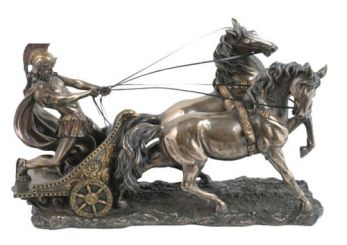
  • Chariot and two horses

    6561-roman-charioteer-wit

    The soul of man has his own chariot

    With a driver and two winged horses:

    The one eager for honorable praises;

    The other intent on becoming corrupt

    That only flogging and bawling can quell.

    With the driver’s free rein on the mares,

    The noble horse goes AWOL,

    The ignoble heads dominance,

    The chariot loses control,

    All fall from the fantastic race

    To the parched land of ignorance,

    Then begins the rebirth of the race

    Again, and again forever and ever.

    Author’s Note: I remember reading about Plato’s Chariot Allegory that illustrates our journey to the end of enlightenment with its vividly dynamic images of the aerial chariot race too compelling to reserve for a silent appreciation in my mind’s reservoir. I wonder what my chariot race has been like thus far…

  • Sunday Dreamin’

    When the Chariot of Apollo started racing at full speed thru the aerial hippodrome in the early morning, she decided to go out and watch the splendor of the golden racing that brightened up the earth after several Sundays’ absence of the spectacle.

    So, she first sauntered at the park where K-9 school students were taking classes. Then she went to an arts and craft store to buy stuff to decorate her next year’s traveler’s notebooks in which she will write her reading notes and all sundry things. Thereafter, her ceremony of beautiful Sunday was served with delicious refreshments at a donut shop that she didn’t expect to find in the Wild West.

    Apollo’s racing has long been finished with his twin sister Artemis taking over the celestial domain with stars and the Moon. She looks out the windows and realizes that this Sunday is fast approaching Monday tomorrow like a fashionable host. “Live a little, comfort a little, cheer thyself a little,” said the Bard. She thinks that life shouldn’t be complicated indeed.

  • Thereby lies the Devil’s Bible

    missedinhistory-98-2015-03-codex-gigas-600x350
    The Codex Gigas, courtesy of google

    A monk to be welled up alive

    After breaking his sacred vows

    Bet his life on a magnum opus

    In one night with all the knowledge

    Deep and wide of heaven and earth

    to appease the communal fury

    in the glory of the holy community

    Forever famed in an earthly shrine.

    So, the monk made a special prayer

    To Lucifer, Prince of Darkness fallen

    From heaven in exchange for his soul

    For helping him complete the opus.

    The Devil answered the prayer thus

    And possessed the monk with feats

    of supernatural erudition and swiftness.

    The monk then paid his dues in twofold:

    The portrait of his satanic master in the opus

    And the offering of his life to Lord of Hell

    In the likeness of the life of one Dr. Faustus

    According to the gospel of Marlowe.

    Thereby lies the Codex Gigas immortal

    Author’s Note: This poem is based on my reading of an article about “The Devil’s Bible” that survived the infernal fire in a Swedish castle. It’s arguably the largest medieval manuscript in the world originated in 13th century Bohemia. The scribe who penned this formidable book is said to have made a Faustian pact with the devil for completion thereof in just one day. What’s more, the book escaped the inferno by being defenestrated outside the window despite its being of 8.7 inches thick and 75 kilograms (approximately 165 pounds). The story is so remarkable that it has been registered in my mind’s book since I read it. The Devil’s Bible is now preserved at the National Library of Sweden in Stockholm.

  • Dear editor

    0d380ebe-dcf9-11e8-9f04-38d397e6661c

    On reading Mr. _______________ ‘s article on the instapoets, I was appalled at his dyspeptic raillery on the poems of the known poets and incandescent snark on the literary merit of the works by playing a role of agent provocateur following the instapoets just to mock their works with malice.

    Just because one does not like another’s work doesn’t ipso facto endow the person with right to desecrate the work and to insult the author by putting him/her in the pillory and, thus dispiriting the mind and the heart that are indeed “noble” and respectful. As a hobbyist writer of my blog in English, I am now indeed in more sorrow than in anger that there might be agents provocateur or double agents in hides of followers intent upon deriding my amateurish but sincere writings.

    The instapoets, bloggers, and anyone dabbling in the craft of writing are the cult of Knut Vonnegut’s maxim: “To practice any art, how well or badly, is to make your sol grow. So do it.” I hope the author and his likes will understand it with magnanimity of the learned literati who will not use their learning to reason against these noble spirits.

    Author’s Note: This is my letter to the editor of a certain magazine that I subscribe. I couldn’t believe that such a historically famed magazine with reputation featured such an article publicly deriding the merits of poets on social media just because the style of writing and the subject matters do not meet the subjective standards of the journalist, who even became a follower of the poets to make fun of them behind the curtains… To think that he’s pleased with himself as a guardian of the English literature with a cruel intention! That’s why I had to send a letter to the editor even if it will not be featured in the magazine. Mind you that practicing art is not a prerogative of the privileged. 

  • ‘Thirty Seals & The Seal of Seals’ by Giordano Bruno – review

    Thirty Seals & The Seal Of Seals (Giordano Bruno Collected Works Book 4)Thirty Seals & The Seal Of Seals by Giordano Bruno
    My rating: 3 of 5 stars

    The art of memory has been a popular subject for occultism and academicism throughout the centuries. The subject deals with our incredibly flexible human intelligence with its general multipurpose learning strategies that can work wonders if the doors of imagination are opened to the mystery of the knowledge without constraints of religiosity and fears of the unknown territories of human possibilities. Of the intellectual trailblazers of the craft of memory, none other than the figure of Giordano Bruno stood out blazingly even at the burning stake as an accused wizard. For it was akin to a witchcraft of perfect knowledge as expounded in his Thirty Seals & the Seal of Seals, the book banned by the Church in fear of losing the faithful to the Power of Knowledge.

    The book illustrates a set of “basic” rules that reads more like Euclid’s Elements or Pythagorean Theorem, which means it is not written for general readers. This is because the book was part of a job application for a teaching post at the Oxford in the Elizabethan England, demonstrating his admirable erudition, superb command of the English language as a foreigner, and naked flattery to the academics at the university. Bruno got a few lecturing opportunities at the Oxford, but his cerebral mind devoid of wit in addition to his short, unprepossessing appearance was regarded as far-fetched and unfavorable to the attainment of the sought-after position at the Oxford. In fact, this book does not provide the reader with special spells for obtaining perfect memory but gives the method of encoding letters or syllables of the name of the thing into a set of predetermined images. It is magic in the sense that if this method is perfected, it works wonders. It’s a psychological mind game, the magic of psychology per se.

    This magical book, this banned book will betray anyone who expects it to be something of magical Rosetta Stone for obtaining the secrets of perfect or better memorization. But that doesn’t mean the book is entirely abstruse to enjoy; the idea of the intellectual trinity comprised of Pallas Athena (The Senses), Vulcan (Imaginations), and Mars (Judgment/Reason), all of whom are overseen by Jove (the Soul) is quite intriguing and related to Socrates’s idea of reasoning. As a matter of fact, this book is not so much an esoteric book as deeply psychological literature that boasts Bruno’s indomitable intelligence and recalcitrant individualism that stigmatized him as a renegade. Maybe that’s the reason this illustrious intellect was burned at the stake as a dangerous pagan.

    View all my reviews

  • farewell to sunday

    26070674702_bddc1eea69_o

    The day is gone, and the sun
    disappears into the West,
    As the chariot of Apollo is done
    with its quest for the day’s zest.
    And leisure and laughter make
    the hours seem too short.
    As this day is nearing to end,
    so do my minutes hasten to the end.
    Farewell sighs and sings a ballad.