Celestial streams of Independence, Intelligence, Trustfulness
Became the Stars of Your Destiny constellated across the northern skies
Shining thru the cold wintry night as the radiant meteor diamonds,
Crowning you with the magical powers of mystic Aquarius.
Author’s Note: It’s a poem dedicated to all whose astrological sign is Aquarius 🙂
According to Greek historian Herodotus, there was the Egyptian pharaoh Psamtik I ruling in the 7th century B.C., who was keen on finding humanity’s primal language. Ergo, the inquisitive Pharaoh gave 2 infants to a shepherd to raise and told him not to speak to them because he believed that the first words the children spoke would reveal the Mother Tongue of all of the Human Race. Quite creative, even feasible, but highly abstract; the hypothesis resulted in one of the children’s utterance of the word “bread” in what sounded Phrygian, the language older than Egyptian. Nevertheless, the Pharaoh’s the Up series-like experimentation on human linguistic origin tells us something of a human desire to find anthropological aspects of languages in their origins even before the proverbial Tower of Babel was set about to begin forming.
Here in the States, one does not get bored with a mono language: English (American English, to be precise), Spanish with continental and regional variances, Hindustani, Pakistani, Mandarin, Cantonese, Japanese, Korean, French (mostly of former French colonies in Africa), Tagalog, and etc. So the story of Psamtik I’s ambitious experimentation to parse the root of all languages chimes with the cosmopolitan landscape of everyday life. Apropos of a diverse group of languages, Benjamin Franklin, however, seemed not to be in favor of multilingualism in the States in fear of the country’s being disseminated into a variety of different language communities. To Franklin, the importance of English as a unified official language of the States meant a national sovereignty and cultural identity that would bind people living in the States into one cohesive cultural group. In this respect, the English language as an official national language of the U.S. is the sine qua non for a lingual and social unity of a country as much heterogeneous as the States. That said, it is beneficial to know of the lingual root of the English language as well as of the other related language.
One of the most popular Indo-European languages in terms of active speakers, English belongs to the Germanic along with German and Norwegian under the Indo-European lingual branch, which also includes the following groups of language:
Indo-Iranian: Persian, Urdu, Bengali, and Romani
Greek: belongs to its own family
The Italic: Latin and the Romance
Sir William Jones (1746-1794)
The reader may be surprised by the fact that Persian, Urdu, and Bengali spoken in the Near East Asia and Asia are also a lingual family with English, but according to British jurist and amazing polyglot William Jones in Calcutta, India, Sanskrit, an ancient Indic language, had common ancestry with Greek and Latin because many of the words were similar to those in Greek and Latin. For instance, take the word “Fathera”. The Indo-Eurpean term is pater. Sanskrit is Pitar; in German, Vater; in Latin, Pater; in French, Pere, and in Spanish, Padre. In fact, Jones’s elation of the ancient Indic language in his industrious study of its deep cultural influence as well as lingual traits on the Germanic paved a way to modern comparative linguistics. In terms of the cultural theme of Indo-European cultures, the idea of trinity in aspects of life that are sacred, social, and economic can be traced in the old caste system of India comprised of Brahmans (the Priest), Kshartyas (The noble and the King), and Vaishyas (the Commoner). Likewise, in Greek myth the 3 Fates who are the beginning, the middle, and the end of each mortal’s life and the Holy Trinity of Christianity adumbrate a cultural connection between the continents that look remotely different at a first sight and yet interestingly alike with deeper insight.
To encapsulate, the relationship between language and culture is the sine qua non of human civilization, the inseparable archeological, anthropological, historical, and linguistic artifacts to study the origin of humanity and its misty pasts. The development of languages also relates to an expansion of its influence by means of trade, war, and migration that are still in progress in our time. It is a product of collective enterprise in the form of textual artifact. Otherwise, who would have thought that English, an obscure west Germanic language, would become a modern day lingua franca spoken across the five continents and six oceans? For what it’s worth, T.S. Eliot elegantly summed it all thus: “For last year’s words belong to last year’s language and next year’s words await another voice.”
I see them almost every day with carts chockablock with their haggard belongings at a coffeeshop in the morning. They come in disheveled, reeking of abandonment of hygiene, but they seem past caring of it, let alone resigned to unwelcome glances of strangers. They are no less than Mendicants, Vagabonds, Tramps, Panhandlers, Beggars, or the Homeless themselves, defying the laws of social evolution and Marxist dialectic changes. You see, they have withstood epochal changes.
It was one Monday morning while I was perking up my spirit still under the spell of weekend reverie with a cup of coffee in my regular Starbucks shop nearby my workplace when a homeless woman approached me and cadged for money to buy coffee. I conceded her plea because her forlorn spirit manifesting in her once beautiful face evoked pathos, which would have stung me with a pang of conscience if I had let it foregone. Besides, the fact that she was a woman living in the street, where all foreseeable and unforeseeable risks were lurking to violate her dignity as a fair sex, vexed my mind and heart. It was all too a fortiori opportune to read the article with the lethargic face of the homeless woman still fresh on my mind.
Never mind piousness, didacticism, and self-righteousness. It goes against the grain to decry poverty at the door of the poor themselves, which is always easy and convenient to pin down based on personal faults, but that would attest superciliousness of being not one of the unfortunate kinds. That is to say, the homeless is the result of addiction to substances, laziness, and careless ways of modus vivendi; therefore, the homeless are unworthy of sympathy nor empathy.
As a matter of fact, the liberals wade in with their de rigueur weary blaming of the heartless conservatives for their preferential treatment of the given, the fortunate, the haves, while the conservatives lambast the cry babies’ importuning their sorry states as a tendency of the cossetted dependency substratum. Both of the parties do nothing but grandstanding against one another for their voting rights that exclude these “marginals” of society they could not care less. However, the causes of homelessness are one collective social evil comprising many a factor; it’s a complex one involving mental health issues for sure, skyrocketing rent fees as a result of rampant trend of gentrification, prevalent lay-offs and unresolved unemployment rates, low wages, integration of families, and a variety of personal elements that are oftentimes looked on with insignificance as trifles. George Orwell, whose brief period of impecuniousness upon returning from Paris to London forced him to live as a tramp as plainly narrated in his empirical Down and out in Paris and London, conceded: “… if they [the homeless] are worse than other people, it is the result and not the cause of their way of life.” That is to say, no one wants to be homeless with a will.
Come to think of it, our human conditions are precarious and many times operated outside the boundary of planned stratagem, for human life is woven by unexpected variables and vicissitudes that befall any one like you never know. Aeneas, a royal Trojan hero in Virgil’s Aeneid, became homeless in the wake of the fall of Troy and found himself and his homeless followers dependent upon the kindness of Dido, the queen of Carthage and her people. The great Russian writer Maxim Gorki and the American Jack London were once homeless. And there is J.K Rowling, who lived a life of near-homelessness with her infant daughter without a job before the first book of the Harry Potter series was published. Woe betides anyone who patronized them for the want of the gumption before they became somebody.
Whether or not we like it, the caste of the homeless will most likely to proliferate unless political leaders stop pontificating about their party ideologies that lose touch with the realistic world of everyday life of the ordinary people. They say the extravagant lifestyles of the aristocracy and their haughty treatment of the poor were the sine qua non of the French Revolution, which was the radical reconstruction of the class system that excluded the welfare of the poor. Then why do I yoke the images of the haughty aristocrats to those of the present-day politicians who seem to thrust the issues of rising homelessness into the bottom of a filing bin and to keep pointing fingers at the homeless for their misfortune? Maybe in an irony of fates, if these politicians wake up one morning and find themselves in the shoes of the unfortunate, they might understand it, but I hope it will not be too late then.
“Our doubts are traitors and make us lose the good we oft might win, by fearing to attempt. – W. Shakespeare
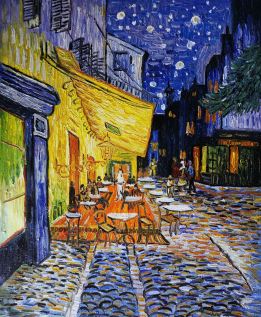
Cafe terrace at night by vincent van gogh
We all have our best registers, our natural octaves, and Judy’s was a flow of unsteady streams of flotsam and jetsam of peripatetic life that cut her adrift from the safe mooring in the orderliness of life. The detritus of contemporary life seemed to be piled up in her own Aegean stable, and she felt like Hercules to clear it all away just as he had been assigned to wash away the ancient filth of his Aegean stable. And she was at the moment of decision to figure out how to start it off. And it was at that moment when she was also befuddled with yet another indecision. Would she do it, or did she really want to do it? Or could she do it?
Judy was preparing for her initiation to the rite of conjuring up a fairy that was to serve her wishes and aspirations which she believed to be forfeited by her divisory lot. Whatever it was, whoever the perpetrator of such turpitude, Julie wanted to get things sorted out by encountering it face to face, even if that meant a risky business. She did not feel like a weird nor a devious satanist to get into the esoteric world of magic on the grounds of her knowledge about the history of religion and magic during the medieval and Elizabethan periods of England as well as the story of Dr. Faust. That those who were caught up in the existential vertigo of livelihood, literate or illiterate, rich or poor, man or woman, Christian or pagan, had often turned to the Other Side was a legitimate tendency, a sort of catch -22 attempt to grasp at a straw adrift on a life sea.
In fact, there was a veritable historical account of a Cambridge medical student in Elizabethan England who made a pact with the devil to procure money to repay his student loans. Whether or not he was dragged into hell upon his death was clandestine, but that was a fact of the matter. So why not? That was Julie’s self-rationalization. That was the proximate cause of her premeditated action. That was her own defense against the sordid fact of life that pushed her into where she was.
But here was Judy’s dilemma: what would a spirit be like? Would it be a female or male? What would it look like? Would I face an abominably hideous creature? Enveloped in a cloud of morbid speculations, Julie began to hesitate nervously, her spirit suddenly trapped in the intricate labyrinth of Anomie. Yes, the labyrinth, the one prodigiously built by the legendary architect Daedaius at the behest of King Minos of Crete named Knossos to lock up Minotaur, the half-bull and half-man creature born out of an unholy consummation between the Cretan Bull and Pasiphae, Minos’s beautiful wife, because Poseidon, the god of the Waters and the formidable brother of Mighty Zeus into the bargain made her madly in love with the Bull, which her husband had dared rescind the sacrifice of it to Poseidon and kept it to himself because of its magnificent beauty.
To tell you the truth, Judy felt sorry for the deformed hybrid of the bewitched union despite its bestial ferociousness calling for human sacrifice. The brutality in behavior was often a manifest result of violent upbringing in conjunction with a denial of love and absence of trust at an infant stage. The security net woven by a loving and caring relationship between a mother and a child was sine qua non of a well-being in both soma and psyche. That was the reason Julie had a sneaking, sympathetic opinion on the Ancient Monster. But she kept her sentiment toward the mythological beast to herself, lest she should be lampooned by others whose idea of justice was a draconian, Jacobean execution of justice that would take no prisoners. Or those whose minds were desiccated by a drought of humanities would declaim against Judy’s altruism. Nevertheless, Judy had no wish to simulate such sternness or gruffness to join the melee.
The whirlwind of thoughts was spinning like a potter’s wheel in her, and Julie was entranced into it rapturously. She let her mind dwell in it however long it would be. She loved the sensation of being drifted away into the world of fantasy, the world of dream, and fiction, as it was her a sanctuary amid the demands of everyday life. Was this the same kind of feeling E. B. White was feeling while he was looking at the beautiful young circus woman rider on a horse running around a grand circle during her performance? The Circle of Youth, the Circle of Beauty, that was. It was what enchanted White to follow her into the World of Magic, and it was what he felt the ecstasy of the sensuousness of Beauty.
It was synchronicity, a mental realignment to the mind of another sharing the same or similar intellectual or psychical formations by which Judy could connect with others readily and efficiently. As a matter of fact, it was one of her gifts of mind she possessed, but which was unrecognized. No, it was suppressed by the possessor. To acknowledge her uncanny ability would upend the course of her life. It would be a radical reconstruction of everything she had been grasping at, knowing that it would be a seismic turnaround of her insecure but sedentary life. And it was giving her a hard time all the more. And she knew it, but she resisted it, and that was her problem – a classic case of circulus in probondo
Our post-modernist culture is nuanced with anti-establishment of anything traditional and proper, such as decorum, mores, and codes of chivalry. The result of degradation of the values under the pretext of establishing a New Brave World is illustrated in the following cases of Manifest Grand Irony of Liberalism that is supposed to be synonymous with altruism and niceness.
A Nazi sympathizer? Are you kidding?
According to this week’s edition of The Spectator, an anonymous former British Prime Minister revealed his hatred toward Theresa May by saying that she should be stabbed or done harmed in the most despicably atrocious fashion that reminds me of the gruesome murder of women by the Reaper of Whitechapel in the late Victorian period. Then there is a British conservative party leader named Esther McVey, who was maliciously excoriated by John McDonnell, a British Labor party politician instigating the mass in public to “lynch” her. Also, the First Lady of the U.S. Melania Trump was criticized for her supposedly apocryphal colonial fashion in Egypt by the media which also prompted the subsequent rebukes from the public. And this does not stop in the West. The first female president of Republic of Korea, Keun Hae Park was preposterously ousted by her radical left-wing contender Jae in Moon on the count of accepting bribery from a prominent business conglomerate based on unfounded grounds. Besides, Moon’s myrmidons maligned her reputation with indecent computer-generated photo-ops of her to destroy her political career as well as her personal life in prison because she was a leader of a conservative party.
What the aforesaid ladies have in common is not only their conservative affiliations but also their social defenestration from their societies that show neither sympathy nor solidarity among the members of the parties and of the humanity in general. But then, woe betides anyone declaiming against the faults of the demagogues! Criticism of a political rival on different stances with courtesy is countenanced and actually encouraged in democracy, but contextualizing it in the egregiously violent words toward the women amounts to terrorism and therefore should be publicly deplored in full force and effect. Besides, however strong-willed and imperturbable the aforesaid women might seem in public, they are “ladies” deserving being treated with courtesy, for none other than being women because they are women. Where has all the honorable, respectful chivalry gone? It’s a code of honor, civility, respect toward womanhood that is transcendent of geographical, cultural, and racial boundaries. Just because they are conservative does not give anyone a license to harass them with malicious verbal remarks or gestures marshaling a mass prompting for the behoof of their political hegemony.
To top it all off, the aforesaid betrays the usual faux-pas of declining against their contenders ad hominem, not on the ground of substantive factors or evidence, as Shakespeare corroborated thus: “Condemn the fault, and not the actor of it?” So it’s not altogether based on the standard of Reason but the manifestation of appetites, the raw emotions, the unbridled egos. Sounds antiquated, abstract, or even priggish? – Maybe so, but the men speaking about the women in the aforesaid manner are beyond the pale because it IS a violence of men in power against their women peers in a form of sordid verbal harassment. And it makes me wonder why #MeToo tweeters seem to connive at it, doing nothing to mobilize the supporters for pillorying the guilty men as usual.
The essay as a respectful literary genre has not yet established its firm meritorious footing in American intellectual society where the novel, poetry, and journals featuring de rigueur social/political issues with gravitas, surrealistic individualism, or puritanical heroism that has recently morphed into a rags-to-riches memoir are the only select legitimate royalties worth being decorated with a laurel. Perhaps it has something to do with the level of American intellectualism being at its still developing stage in consideration of its relatively “youthful” history. For what is worth, despite its general cold reception from the literary hierarchy, E.B. White is nonetheless a quintessential American English writer and a very fine essayist of the twentieth century in the English language into the bargain. In this collection of his essays published in various magazines over the years (from 1920s to 1970s), Whites recorded the overtones of humanity, democracy, and social concerns in ordinary things and experiences described in elegant and crisp prose style that resembles none other than his, thus making him one of the central figures in the canon of American literature without dispute.
Being an essayist means something of a modern day literary troubadour, an independently-minded man with childlike streaks of artless interest in all things worldly and unworldly and innocent belief that everything he thinks about and everything that befalls him is of general interest. In a way, he’s a likable egoist with venturesome effrontery and verve to write a very egoistic essay on his whims and caprice. However, Whites gently rebukes us for our general perception of the essay as an expression of exalted rootlessness without self-discipline and an intellectual basis; rather, it is a panoply of sensibilities, senses, and intelligence, all broken loose from the hidden private closet of the essayist. For this reason of being egoistically concerned in a panorama of contemporary daily that many serious writers of the other literary genres tend to downplay, an essayist should accept his self-imposed role of small-fry writing gentry in the class of scribe, advised White with a kind of avuncular manner. However, it is this estate of an essayist Whites feels exhilarated about; it provides him with a valve of the emotional influx and outflow, so that he can wield his pen across a page in an expense of his curiosity, conviction, observation, and self-discipline, producing a dazzling delight of literary pleasure in its simplicity of language and subject.
To illustrate, White’s subjects of his essays vary from his experience of moving from New York City to Maine as in “Goodbye to forty-eighth street,” to the humorous political essay of “Bedfellow,” featuring his canine family member Fred, and from his keen and humane observation of a circus girl rehearsing her show in “The Ring of Time” to his youthful poetic experience of working as a waiter on a ship to Alaska in “The Years of Wonder.”All of the aforesaid deal with a cast of everyday character and contemporary daily life written in simple but perspicacious words to contextualize the inner realm of White. There’s no priggishness or pomposity in his prose style, which I find very appealing and endearing. For someone who’s as erudite and intelligent as White, such simplicity of writing betokens that he wears his knowledge lightly with a general reader in mind. In fact, White thinks it his duty as a writing man to record all items as though he would be held personally responsible if it were to be omitted. This idea of a writer as general secretary of humanity parallels the reasons of writing as posited by George Orwell: It serves as a platform of expressing our sheer egotism, aesthetic pleasure, political evidence, or historical record. A priori, both of the great essayist of the English languages strike the mutual writing chords in their hearts.
At the heart of the essays lies White’s love of the world where he collected the flotsams and jetsam of what our contemporary human life could bring to us, which were washed up by the waves of time and memories. This collection of essay by White, I think, bestows in spades its sovereign royal heritage of its own on the American essay that merits its own section in nonfiction aisles across the country. That is, in a wide stretch of literary imaginations imbued with historical evidence, the book has made itself the founder of new royal blood in a way that reminds me of William the Conqueror’s becoming the first Norman king of England by establishing a new royal bloodline in 1066. With a variety of topics, and the practicality of language, this book is a gem that holds the reader’s attention throughout the pages including the unforgettable cover featuring Fred and the author himself, which so fittingly and wittingly demonstrates the Element and Style of Essays of E.B. White. It’s a lovely read that warms your heart and piques your curiosity of the inner world of the writer whose thoughts and feelings chime the bells of ours own in one way or another because White is ageless in his writing and his writing timeless in his essays.







You must be logged in to post a comment.