Looks can be deceiving, for sure. It can yield an ill-judged misapprehension of the true person and therefore, form a certain prejudice about the person. A person’s appearance is a false shadow for the substance, but our faculty of mind based on a sensory perception with the works of imagination often falls into fallacy. That said, this charming little book comprised of lovely missives to her beloved husband Almanzo back home in Mansfield, Missouri comes surprisingly pleasant twist of the image of Laura Ingalls Wilder, the creator of Little House on the Prairie, whom I always considered to be stoic and imperturbable, a kind of austere and puritanical mid-west matriarch, who turns out to be one sweetheart with the untainted sensibility of feminity.
In these letters written to her batter half she called ‘Manly Dear’ during her travel to San Francisco and her stay there too in 1915 following an invitation from her only child Rose, you will read the words of her heart and soul enveloped in tenderness, colored in vivaciousness, and sealed with love, all the marks upon pages in the felicity of vivid descriptions wonderfully mixed with the perspicacity of reflective introspection, so jolly that reading them makes you feel like reading love letters from a smitten maiden to her smashing beau.
It’s one of the reads that require no practical analysis of the psyche of the author or of the social, political climates to make revisionist commentaries. It’s a pure mental delight of peeping into the inner world of the author that puts a smile on your face. Also, it’s a great read to while away your time at one sitting. On a personal note, if you have read Prairie Fires: The American Dreams of Laura Ingalls Wilder by Caroline Fraser, the magisterial biography of Ingalls, this book is a lovely accompaniment to feel this great American writer of all generations closer to you as none other than her true person, talking about her journey to you as a great story-teller.
The Babylonian Marriage Market by Edwin Long, 1875
There she stands like a nameless flower
Alone, away from a heap of roses in the garden
of the temple of Ishtar, Goddess of love in armor
and looks not with pride seen but with pain unseen
Days have left, Years have passed;
But the girl still roams around the temple
Alone, apart from the beauty selected
And consummated to a sacred couple.
Alas, what is it not the thing called Pity
When the wallflower unwanted, unsought
Alone, as always, waits a cruel eternity
Till she meets a beholder besotted sought?
P.S. Ishtar is the Mesopotamian goddess of love, war, and fertility. It is said that in ancient Babylonia, every young female when reaching a certain age should go to the temple of Ishta and wait for a man who will approach and take her as a wife to home. The temple was used as an open market for marriage, which was considered a sacred means of attaining divine union between mortals in the presence of the goddess. However, as the unfortunate ones in love have always been the figures of lamentation throughout human civilization, the shy, unpopular girls had to wait in the temple for years to be selected. This poem is to feel the feeling of being unwanted and ignored in the meritocracy of beauty…
If you feel why life can’t be lived at the same pitch
Of your mind’s notes written in the heart’s chamber;
If you find the utter cry of your heart without a hitch
In a solitary sea of words rolling and heaving under
A rainbow of vivid imaginations and fleeting emotions;
And your spirit often rebels and refuges in the ether
From the detritus of broken promises and shattered dreams,
You were born of the mystic race of the Highly Sensitive
Of Fire, Spirit, and Dew in the wondrous alchemy of beauty,
So beautiful, so pleasing, so delightful that your eyes are lit
With twinkles of sparkling waters, sparkles of diamonds
That which adonize you with the Supreme One of Mystery.
Concealed in its untrodden paths of dazzling mysteries:
Light and dark, birth and death, mastery and terror
All curled in wreaths of coiled bewilderment in alterations
Encircled in the visceral entrails of great serpentine
Paths that allure you with a riveting promise of delights
From erotic games of licentious pursuits of pleasure hunts.
Lo! Somewhere in the corners of paths hides a blue marble
That promises you magical power of all that you want to be
Immersed in the deepest bottom of your secret bleeding heart
Wrapped up in the divine power of the magical beauty,
Which is the messier, the prettier, the madder, the better.
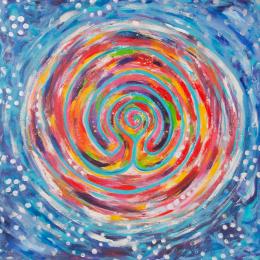
P.S.: The inspiration for this poem comes from the Greek mythology of the Labyrinth. The story, pattern, and design fascinate me and evoke a wide arc of thousands of imaginations. Riveting.
When the night gently descends upon the day on the earth’s bed
And he silences her secretly with a force of darkness
Whispering softly in delirium, murmuring faintly in fever
blinding her with an extraordinary frisson of ecstatic fear
the spirts of tragic heroines of love – Dido and Ariadne-
run to the top of the hill where the sky lies above the earth
and lament their earthly journeys that ended in love alone
as Hounds of Love howl beside the beautiful losers in love
till the lovers’ tryst ends in a mist of passion and intoxication.
P.S.: I am always inclined to the stories of beautiful losers whose loves for their figures of the affairs of the hearts are not returned because there’s something tragically beautiful in them. Dido, the beautiful queen of Carthago, was cruelly forsaken by trojan refuge and founder of Rome Aeneas and chose to end her own life thereafter. Ariadne was a Cretan princess who helped Athenian prince Theseus to kill the Minotaur and to bring out the Athenian youths from the labyrinth with her inscrutable ball of threads as a guide to a route out. But Ariadne was also later deserted by Theseus and let alone on an island and forced to marry Dionysus, the god of wine. Hence this poem about those who are unlucky in the affairs of the hearts.




You must be logged in to post a comment.