Tag: epic

  • at the sea

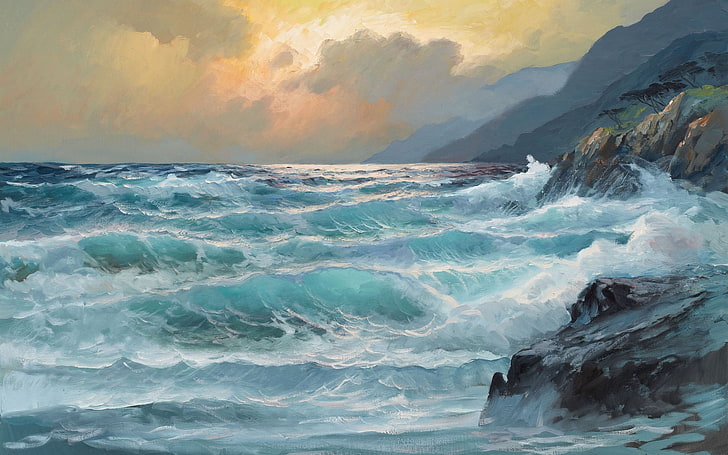
    I have seen the insidious sea
    Lull the children of the shore
    With the sweet aeolian lullaby
    And the pretty nymphs appear
    From the bottom of the ocean
    To bring them into the palace
    Where their father, Poseidon
    Keeps the souls of the sea
    As is his mighty brother Zeus
    For the world above and beyond;
    Woe betides those who forego
    The fates of the young souls,
    For their grandfather, whose eyes
    See the insidious machination
    Fascinate the innocent hearts
    In the whirlpool of rapid waves!
    The old man’s fury is greater
    Than the furious god of the sea;
    He dives into the angry waters,
    Fighting against the god in spades
    With his bare arms cutting the waves
    Like swords that could kill ghosts
    And wins of his two grandchildren;
    From the god whose wrath sees
    No end until it grows the waves
    Into the myrmidons of madness
    And carries the old man into the abyss.

    P.S.: This poem is based on my reading of a newspaper article that a sixty-one-year-old British grandfather died while trying to save his two grandchildren, aged seven and ten, in the sea off the island of Crete, Greece. The man got into the sea, fighting with the rapid, treacherous waves like Caligula, who declared war on the sea, whipping the waves furiously to invade Britain. Finally, his grandchildren got out safely, but alas, the old man was engulfed by the wrath of furious waves and drawn to the bottom of the sea. I could not just forego my feelings upon reading the story with poetic elements that also bring me the mythological image of Laocoon, the Trojan priest punished by Poseidon who sent the great serpent engulfing him and his two young sons for his discovering the Greek ruse about the wooden Trojan horse. Hence this little poem is in memory of the brave and loving grandfather.
  • In the Ruins of the Temple of Artemis

    f
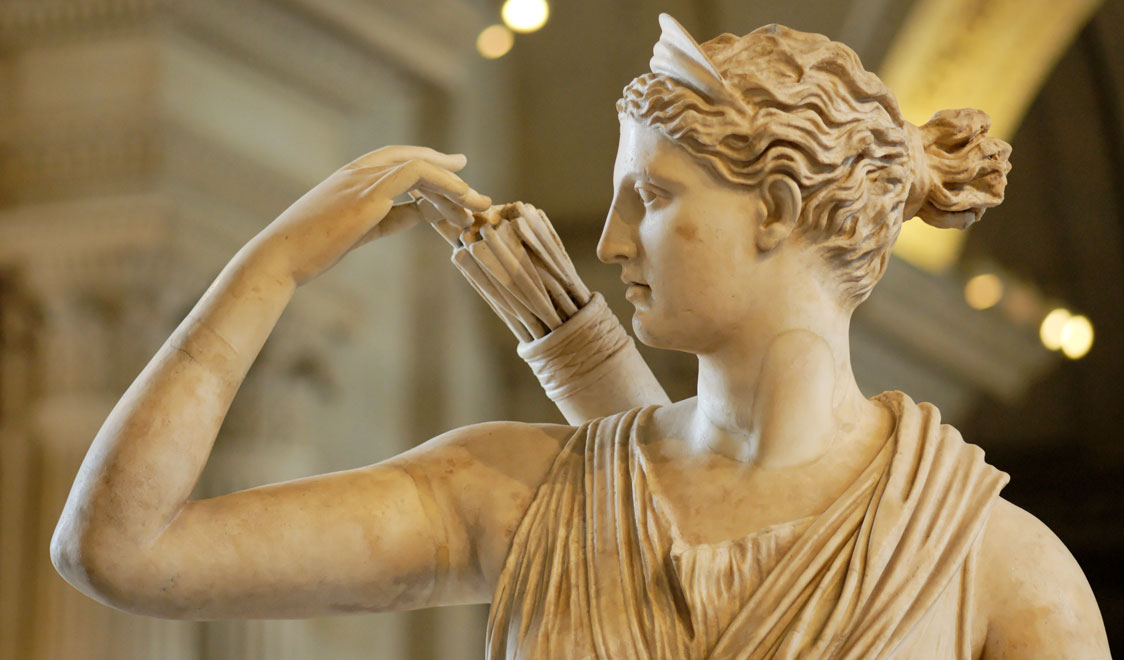
    Artemis, a Goddess of the Moon (from google)

    Over the relics of the marvels that belonged once
    To a sacred dwelling of a Lunar Goddess, a divine
    Maiden of Wild Beauty and Eternal Chastity destined
    To chase the wild from dawn till dusk with her golden
    Arrows missing nothing even from the top of Olympus,
    A High Moon spoke with full of pathos of her immortal story.

    “I once lived on the isle of Sicily with Athena and Persephone,
    Gathering flowers in the Elysian Fields during the days,
    Weaving our father Zeus’ robe at nights under the Moon and Stars
    Enjoying our muliebrity unscathed by the lust of amorous men
    Whose lascivious desire of women would forever be inordinate,
    Spurning Eros, Aphrodite, Songs of Love, and Bliss of Marriages.”

    “Then heard was no more; a mirth of our Persephone was heard
    Nowhere, for Hades, the god of Underworld, swiftly abducted her
    In his chariot and disappeared into the pit of the world down under,
    Where I and Athena could not penetrate even with our divine aide,
    Ending the blissful companionship of sisterhood for once for all – forever!
    And thus I left the isle in quest of eternal pursuit of wild beasts alone.”

    “Immune from the spells of Aphrodite and the arrows of Eros,
    I am an eternal maiden who is free from marital obligations
    So that I can chase down wild beasts with my ever loyal hunting
    Companions of a Bear, A Wolf, and a Stag behind me all day long
    And dispense my vengeful justice to all devoid of decency and civility,
    Like the ones who were cruel to my mother, my brother, and me!

    Such was the litany of woes told by a Goddess of the Moon
    On a night when a Full High Moon filled the night alone,
    Shining brightly alone above a lonely traveler listening to her
    Tale of her divine destiny of solitude chasing her objects of
    Pleasure for ever- forever continuing till her father Zeus takes
    Away her immortality in pity and makes her a star next to Orion.

    저장

  • Herculean Rhapsody

    horses
    Courtesy of google.com

    Thousands of years ago when gods and goddesses
    Lived among the mortal and made love to them,
    There lived a man in Greece across the oceans
    Whose muscles invincible, confidence supernatural,
    His spirit all greatness, all sincerity, all eagerness,
    Untainted by the vanity of his divine heritage of Zeus.

    A fruit of lustful possession of the mortal beauty
    Named Alcmena by Zeus, the god of gods, in slumber,
    The son of god, the infant prodigy toying with a snake,
    Grew out to be on a par with the strength and esteem of gods
    That was the sacred prerogative exclusive to the Olympian.

    But lo! It was nothing but the elitism of the gods, for he could
    Threaten the Sun to make it cool, waves when his boat’s tossed at seas,
    And his music teacher for forcing him to play the lute against his will.
    But alas, this man of incorruptible pride, of exceptional valor
    Was to be pierced by the unquenchable flame of jealousy and
    Hatred of Hera, the wife of Zeus, for his being the love child of
    Her ever amorous husband whose objects of passion knew
    No boundary between the mortal and immortal evermore,
    Which she couldn’t bear at the sight of Heracles, nevermore.

    Thus, Hera cast the spell of Madness upon the son of Zeus,
    Making him blind with terrible rage, talking sound and fury,
    And exciting him to slay his wife and their three sons with a sword
    smeared with their blood so crimson, so warm with their last breaths,
    Leaving the wretched man in a bottomless pit of guilt and shame
    In his awakening from the bewitched madness driven by the sulphurous
    Envy of the wife of god, who sired this son of god, who loved his mother.

    The great surge of remorse swept over Heracles with wells of tears,
    The sublime wish to expiate his sin suddenly urged him to go
    To the Oracle of Delphi for Apollo’s guidance for his penance,
    Where the sacred priestess in fits of divine frenzy told him to
    Eurystheus, King of Mycenae, his cousin, the inferior to his being
    To purge out his sins of Matricide, Uxoricide, Prolicide, and Filicide,
    Once for all, in the name of Apollo, god of the Sun, Truth, and Healing.

    Thus obeyed Heracles, our wretched but genuine man of courage,
    Who, at the command of Eurystheus, his loyal cousin, undertook
    The Twelve Great Labors so impossible, so unthinkable, so incredible
    By himself, alone, in act of penitence that was so brutal, so primordial as thus:

    Killing the Lion was met by vanquishing the Hydra;
    Then he had to capture the Stag and the Boar;
    He even deigned to clean the filthy Stables in a single day
    To kill the monster Bids, followed by capturing of the bull;
    Thereupon, he rounded up the Mares to steal the Girdle;
    Herded the Cattle so unmanageable and untamable;
    Went to fetch the Apples and then captured the Dog of the Underworld.

    The Greatness of the Spirit, the Purity of the Soul,
    Far excellent, far above the Reason clothed in cowardly pride,
    Far higher than arrogance and hypocrisy in the guise of intelligence,
    Was the name of Heracles to whom no fear and intimidation did appear,
    Nor the impossibility, nor injustice did exist in therein eternally evermore
    enshrined in the memory of the half-man, half-god who once lived among us.

    저장

    저장