Tag: essays

  • ‘The Lives of the Poets’, by Samuel Johnson – review

    The Lives of the Poets by Samuel Johnson

    My rating: 5 of 5 stars


    Great writers are not necessarily great people in the integrity of their characters, which perhaps most of us know, and yet cannot help but associate the excellence in letters with the personal attributes of the writers simply because we are enchanted and gobsmacked by the mind. Samuel Johnson, an eminent English cultural critic of the 18th century, also knew about these somewhat restively volatile facts about famous writers and poets of his time. The result was these entertaining and informative composite biographies of the poets of his time with his trenchantly honest eyes and esteemed erudition to disembarrass the person of the poet from the genius of the poetry.

    Originally written as a referencing preamble to an edition of The Poets of Great Britain complete from Chaucer to Churchill, Johnson’s supplementary prefaces became so popular that the booksellers decided they were worthy of separate publication under the subject title of this review. And there were reasons that make Johnson’s biographies of the eminent poets attractive among the insipid panegyrics to the famous. A good bio is read in a way a good novel or short story is enjoyed with characters that are differentiated from the common because of their recalcitrant individualism that gets away with the intellectual attraction and personal flairs despite their flaws. In this regard, Johnson’s wit and sagacity play an essential role in being an objective judge of the characters and their works to the extent that none of his subjective poets could escape from his hawk-eyed criticism, be that ever great or small. Johnson’s biography resembles Herodotus’ parataxis in narrating the accounts of people and events. It consists of a summary of the subject’s life; accounts of their personalities and analyses of their works. The individual narrative account became a history of the poet, which showed something about his work and indicated the person himself.

    For example, Johnson’s take on John Milton was so freshly revealing that it upended my view on the creator of The Paradise Lost. I used to think of Milton as a benevolent-looking wise poet whose blindness didn’t stun his will to knowledge and creativity and whose fatherly tenderness toward his daughters encouraged them to be his eyes and hands when the visions of the world became blackout totally for the poet. Instead, Milton was one of those who clamored for the liberty of others but did not grant liberty to others. He was an arrogant intellectual who disparaged the works of others whom he regarded as less intellectually esteemed than his standard, which was despotically biased in terms of impressive academic credentials. Milton’s poetry was intrinsically intellectual and not for the light-hearted pleasure of the heart roving through the meanders of fairyland. His elevated soul ascended in the sphere of the Form, the perfect beauty that was unattainable in this real world.

    Johnson also cast somewhat contradicting masks on the creator of Gulliver’s Travels, Jonathan Swift. Like Ben Jonson’s iconic characters in his plays, Johnson’s Swift appeared to be both miserly and munificent, flaunting and humble, aloof and social. I particularly liked Swift because, unlike other writers of his time and of our time, he was not an ace student with flying colors on academic subjects. Swift was, however, a great student of learning, always pursuing and laboring to learn however long it might take. He was a man of industry and diligence, which made him all the more human and imitable because his genius was hard-won, not easy born. Methinks that Swift’s resilient spirit tinged with feistiness for an Anglican Church priest had to do with his Irishness. He was an Irish man at heart, in nature and soul. Johnson also attributed the protean imaginativeness and admiring independence of ideas to his Irishness that resulted in wondrous creatures during Gulliver’s travels.

    There are other poets than Milton and Swift in the book, and you do not have to read about them all if you are unfamiliar with them or their works because that would go against Johnson’s purpose of the writing. Or you can read the book as an admirer of Johnson’s signatory witty and erudite writings from which you can learn a lot about his subjects and himself. The book serves as an eighteenth-century intriguing exclusive close-up documentary. It is about celebrity poets whom someone like Johnson, who was something of Roger Ebert in the criticism of the art of literature, could unpick and reconstruct as they might have been sans the mindless blinded paeans to their works without even being read. Undoubtedly, Johnson’s views on the poets have been and will be subject to criticism too, but his writings piled with a bonfire of splendidly sparkling expressions and apposite vocabulary drawn on his natural faculty of mind are nonetheless worthwhile to spend your time reading.


    View all my reviews

  • The Rambler on the interview

    In a post-industrial age, when the mingling of classes in streets is a norm, and social mobility is a reality in a society, the stories about royal families become reality period dramas that seem to give them a status that fuses the capriciousness of greek gods with the glamour of Hollywood celebrity.

    When I saw twitter’s promotion of Oprah Winfrey’s Harry and Meghan interview, I thought no wonder they were sought-after media darlings, living Romeo and Juliet, and something to talk about when things looked bleak and boring. And I honestly feel no qualms about them being a subject of gossip or the tabloid because they live in public eyes, albeit they most clamor for the privacy of their lives. Otherwise, what is the absolute need to broadcast their stories on a central television station at prime time? (No YouTube, please, in respect of their royalty.) Oprah Winfrey, who now seems to have replaced Barbara Walters’ seat, looks fit to the royal couple pleading for upscaled sympathy from the American public unfamiliar with the constitutional monarchy and possibly slightly partial to the name and images of monarchy without knowing them well.

    To put the wedding story of Prince Harry and Actress Meghan Markle on a par with Cinderella story is to ignore the fact she is from a privileged class in the States with expensive private education and parental support. Despite Princess Diana’s aristocratic family background, people sympathized with the lonely Diana because of her doe-eyed, ever muliebral innocent beauty that looked impossible for debauchery. By the same virtue of beauty fused with sensualness of exotic charm, the American actress/model Meghan charmed Prince Harry, who would even venture to Hesperides’ garden to bring her a golden apple should she request. And now Harry lives in the Golden State, the land of his Helen, with a face launching waves of media coverages.

    Ralph Waldo Emerson said that beauty tames the savageness of brutes and allays the hardened souls of criminals. Oscar Wilde added that a beautiful woman is the subject of conversations wherever she goes. The lovely Meghan beaming with sparkling amethyst eyes adorned with apricot cheeks reminded me of a modern-day Helen of Troy. After all, Helen’s prodigal beauty saved her from her first the ireful sword of her first and lawful husband Menelaus, the king of Sparta to whom she betrayed the slain Paris’s brother Deiphobus, her third husband. Despite vehement feminist catchphrases brandishing anti-sexism, beauty is still a woman’s privilege to achieve social escalation in work and an undefeatable power to purchase indemnity for all faults and foibles.

    In addition to the claimed blackness of Meghan’s heritage, the media seems to shoehorn it to fit her estrangement feeling in the procrustean bed to a histrionic degree because one cursory glance at her wouldn’t strike her as a black woman at all. I honestly think that if a woman is beautiful, then where she comes from does not matter. In fact, I feel something is not quite right when someone in her position keeps playing a race card as a chance gambit to muster her retinue against the criticism raised by her unwilling participation in royal attendances and cavalier attitude towards learning the royal manners, which appear antithetical to her carefree American spirit hard to domesticate.

    Call it an acrid narrative of a woman who juggles the daily affairs of life with what she has. Or you may say it is the usual cynical delusion of reference to those who got it all out of passionate envy burned in a fury. Yet, the interview appears to be nothing but their formal excuse for their present life, public proclamation of their still regal sovereignty warning people not to speak ill of them, which is probably directed to the ordinary whom they regard as meddlesome. Well, then let them be whoever they want to be. Playing Romeo and Juliet’s roles in a public theater in long-run shows will only lose favor with the audience, especially with Romeo now being well-stuffed, looking like a rich American, and Juliet still looking fabulous like a luxurious Beverly Hills demimonde.  

  • Samuel Johnson Rambles on the practicality of knowledge – essay

    Ignorance is the timorous and indolent plight from fear because knowledge is considered to be remotely extensive and inscrutable to be comprehended. It retards the progress of the mind and numbs the sense. Samuel Johnson avers in his weekly essay ‘The Rambler, No. 137’ avers that one remains unenlightened unless he is diligent to search for the origin of wonder with a pause of reason, a sudden cessation of mental progress when confronting the unknown to him. The need for general knowledge, the knowledge that confers Citizenship of the World, is an essential element of human characteristics, and an easy task to fulfill in search of meaning in life.

    Johnson’s idea of knowledge is simplicity. It is jettisoned from a concatenation of needless abstrusely sophisticated theories and ideologies. It also chimes the bell with the Renaissance virtuoso Leonard da Vinci’s adage that simplicity is the ultimate sophistication in all principles. However intimidating or formidable the unknown is, the essential feature is simple to understand by way of ‘Divide and Conquer,” a principle that complication is a confederacy of the abstruse that can be broken into parts marked by the gradations from the first agent to the last consequence. The force that breaks the shackle of fear for conquering the unknown huddle is patient diligence armored in confidence. The labor of inquiry for wonder follows natural curiosity and confidence that eclipses the soul’s darkness. It comes to fruition by ceaseless efforts to ascertain the origin of the wonder in simple ways. The English philosopher who also advocated democratic pedagogy, John Locke, affirms that the surest way of thorough comprehension knowledge is to attempt little by way of repetition. For the widest excursions of the mind result from short flights of mental imagery and instant thoughts triggered by neurons fired in our cerebral cortex, which can be transformed into an organization of ideas firmly engraved in the mind.

    However, knowledge loses its purpose if it dissipates into the possessor’s cerebral ether or is locked in the mind’s cabinet. It becomes useful and purposeful when put into practice. That is why Johnson gives heed to those who pride themselves in the impressive educational backgrounds and belittle others whose mental capacities they arbitrarily judge ignorable or even ordinary. Knowledge is for share, and it is a duty of a scholar who has a wider variety of knowledge through years of academic endeavors for the common benefits of the world he lives in. As Francis Bacon fittingly concurs, books can never teach the use of books. Generally speaking, it is common for intellectuals, despite their ostensible calls for democracy and justice for all, to live out of touch with the practical realities of life and often regard such matters as trifles. But what is worthy of their glorious learning if it does not accommodate the purpose of life? Johnson criticizes such lofty arrogance of the rarified subset of the general population because they lose their days in unsocial silence and live in the crowd of life without a touch of humanity. It also reminds me of Bacon’s utterance of loneliness in a group as such: “Magna Civitas, Magna solitudo.” In this regard, George Orwell is together with Johnson because they saw the educated’s superciliousness, the intellectuals, who often conferred their knowledge to their honor in the voluntary seclusion.

    Upon reading Johnson’s essay, I could not help but wholeheartedly agree with the purpose of knowledge and the idea of sharing it with others for the world’s common good. I was also glad to learn that I was not the only one who thought that people with academic credentials were frequently dismissive of the opinions of what they regarded as the mortals of the ordinary among whom I am. Therefore, I hope that the reader who reads this essay of mine should not belittle the soul attempting to obtain the sunshine of the light of letters to understand the world in a perspicuous way to declare to the world that I also can think and express it cogently. That is my essay on knowledge for the purpose of life.

  • A perfect cat owner?: confession of a novice

    I remember watching the cat guru Jackson Galaxy’s post on YouTube about a prison where a group of inmates is assigned each cat for mental and a behavioral correctional program. The inmates seemed calm and content just as their foster feline friends reflected and talked of the amazing effects on their hearts hardened by the world never kind to them. The images of a condemned man in a cell and a homeless cat from a shelter became a beautiful impressionist painting with an air of serenity wrapped up in the soft sweet twilight colored by the warm hues of pleasantness that filled the canvass and stayed in the heart of the beholder – forever. The loneliness cut in halves transformed into togetherness, and there was nothing else but the mutual need for love and care. With the picturesque imagery engraved in my heart’s shrine, I cannot help but question the generic prerequisites for being an ideal cat owner indoctrinated by those professing to know things about pets. The doctrines of a perfect cat owner are as follows: you have to live in a space wide enough for her to exercise her natural hunting instinct, to have another cat to prevent anxiety, aggression, and loneliness, and most of all, to be a near-perfect human full of love and understanding blessed with material means to satisfy the need of a cat to the extent possible. The protocols remind me of eugenics elements by which only the best males and females can produce offspring desirable for humankind. Only the superhuman race can fall in love, beget children, and raise them to be perfect in physical and mental attributes to continue the Superhumanity. On the same token, being an ideal cat owner is to be an ideal person who deserves love from nature because of his ideally perfect being—quite the Nietzschean idea of Superhumanity. 

    An ideal cat owner’s doctrines align against the condemned man’s images and the homeless cat in a cell. Then I also look at my 4-month old tabby cat Toro, whom I adopted from a shelter three months ago. Is he unhappy with me in this tiny apartment room? Is it because of boredom and separation anxiety doubled with a significant change of environment from pastoral life to city life that has driven him to a sudden pulsing and biting my hands and feet? Does he hate me because I leave him at home all day long with a mother who hates him when I go to work? Does he want to leave me and be adopted to a loving, perfect new owner because of my imperfection? Am I less qualified than the inmate to have a cat altogether? The thoughts smothered under the ineffective veil of forced positivism have reached the point where they can no more bear the suffocation and begun to erupt the lavas in the fiery magnitude.


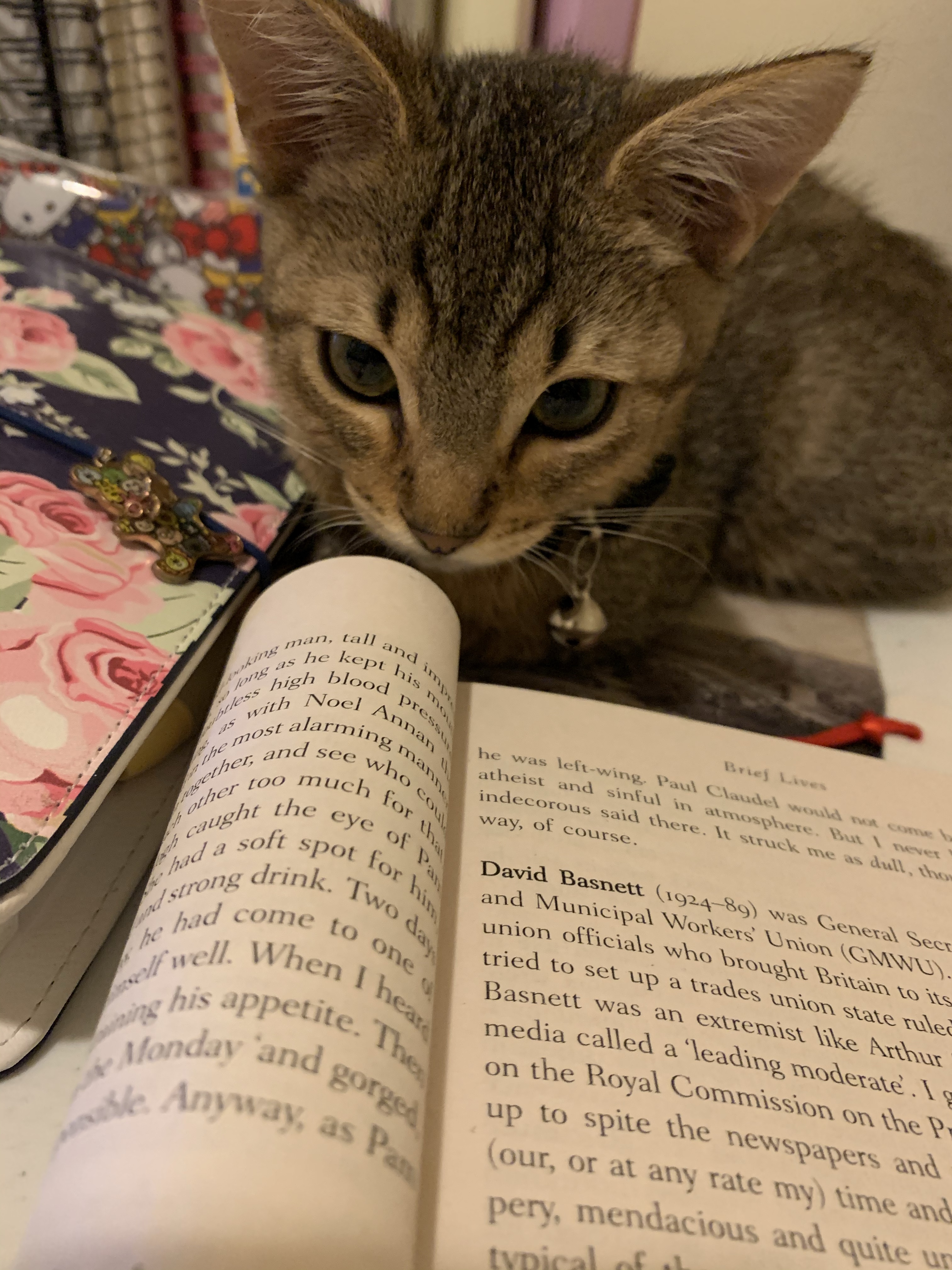
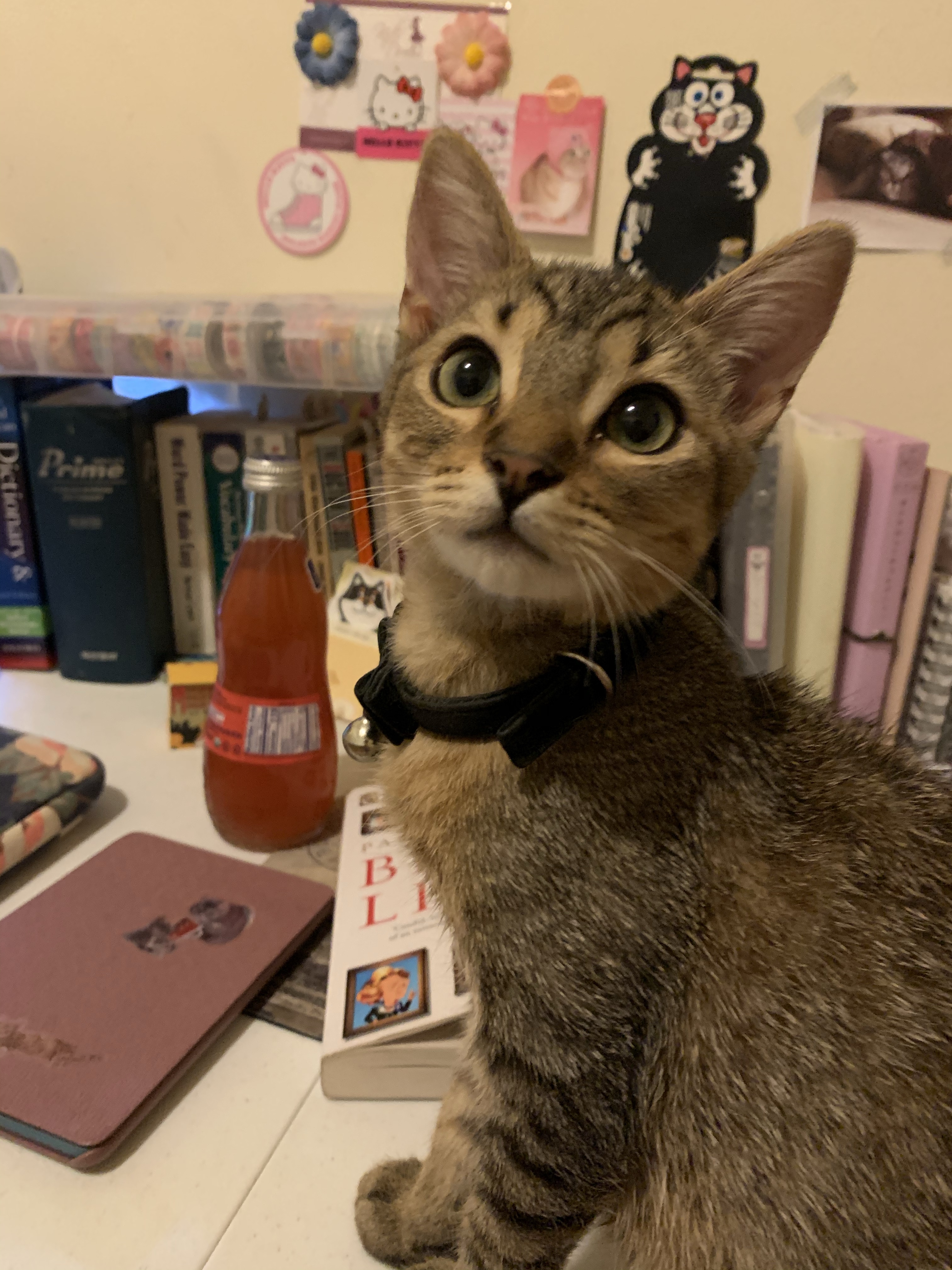
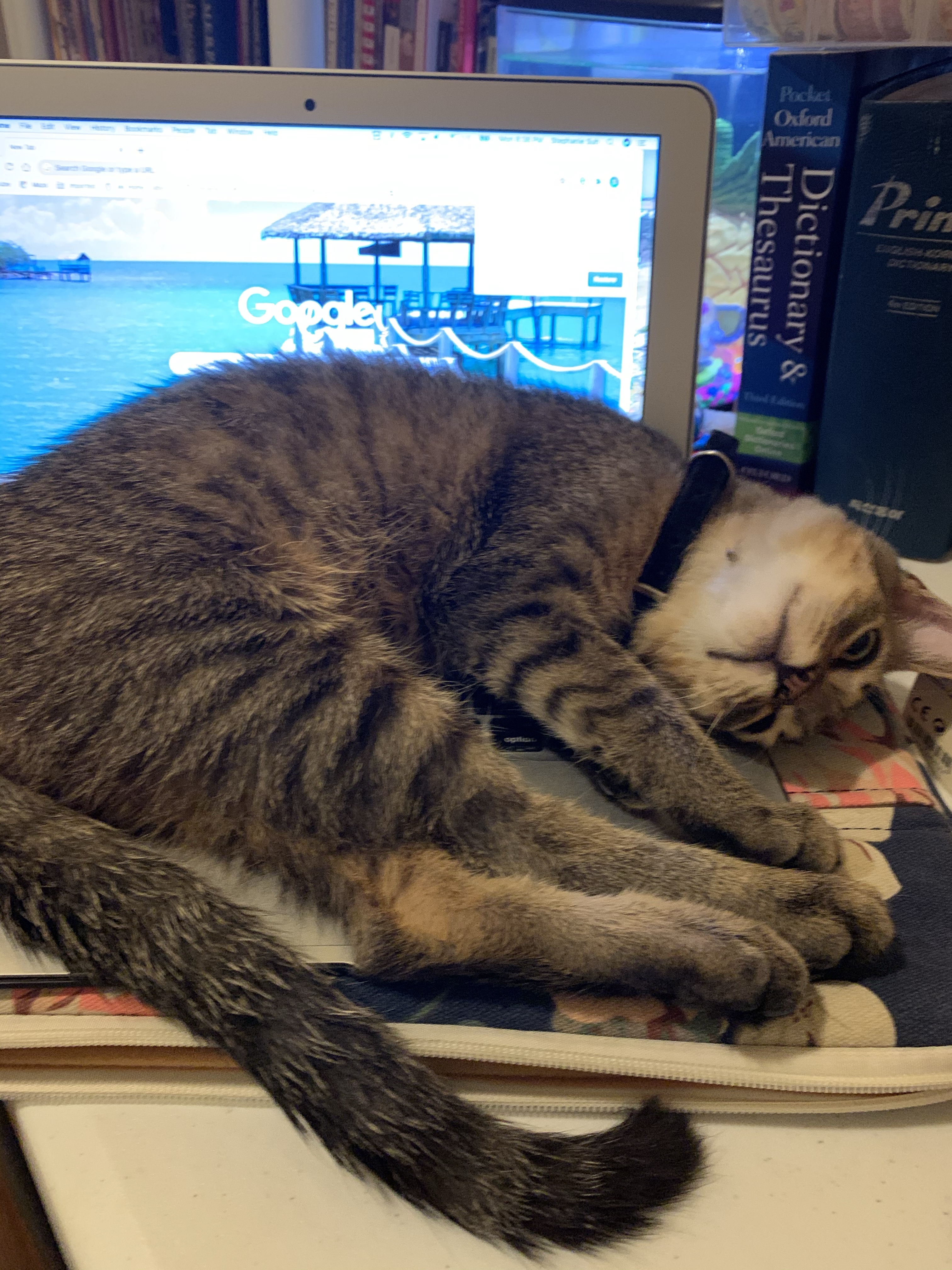
    As a first-time pet owner, I like to think that it is not a coincidence but Providence that Toro has come to my life because he was the only kitten who came to me and my brother bunting his little flurry head against our hands through the cold metals of the cage in the shelter. Toro and I are much alike in many aspects: leisured time in seclusion, uncompromising individuality, insatiable curiosity, innate sensitivity, and unfailing feistiness. We also instinctively know each other’s mood because when I am dejected, Toro studies my facial movements and comes nearer to me with those adorable eyes filled with liquid warmth. Then I look at the cute little Toro before me and think that genuine love and care transcends the high walls of a grim prison and eclipses the roof of a perfect happy house. There is a home sweet home for me and Toro in my tiny apartment.

  • Our Mutual Friends

    Some say animals do not have a faculty of mind that translates the sense into meaning.  I always find it ironic that educated people can sometimes be heartlessly benighted, belittling a simplicity of nature. That they do not have the emotional spectrums, ranging from guilty to remorseful, and to resentful, gives free rein on arbitrarily judging animal behaviors according to human rational thinking that supersedes instincts common to all living creatures. Nor does it sound sane to cosset pets with outpourings of maudlin sentiments out of anthropomorphism for our convenience. We are fortunate to live in the age of the Brilliance of Science. Still, the overflux of information sometimes begets counterproductive results. Amid the deluge of information on animal behaviorism available on the Internet, I am often doubtful, if not fearful, of the way I am raising my cat.

    I observe how my 14-week old tabby Toro behaves from defecating in the litterbox to drinking from the water fountain, playing with his toys, and to watching his new finned friend, Hope, a Betta fish. Although they do not have the faculty to produce physiologically-driven emotional effects as complex as humans, my observation has yielded that cats exhibit a feline version of a continuum from pleasantness to unpleasantness. For instance, when I discipline Toro for not behaving, he does about-face and hides under the bed or goes to a corner of the room, sitting there like a mini sphinx statue, sulking and avoiding my eyes. Then in about 10 minutes or so, he slowly (and stealthily) approaches where I am while still keeping his feline pride in a way he doesn’t want to ingratiate himself with my favor. When finally arriving at his destination of Me, he announces his arrival with the unmissable “Meow,” with his eyes pleading for my petting. Cats may not have the same kind of grudge that we humans secretly harbor as in William Blakes’ ‘Poison Tree.” Yet, they possess the tactile feelings at the primary level, which can be akin to those exhibited by infants. Also, I don’t think raising a single cat will prevent her from socialization or emotional well-being. Most cats do not like to be with other cats unless they are littermates from birth.

    My a posteriori opinion about a myriad of scientific theories and expert dos and dont’s about raising cats happy and healthy is an intelligent hypothesis of feline nature. It attempts to explain why they act the way they do so that we, as caretakers, should take care of them better and more effectively. From my personal experience thus far, it is really up to individuals’ discretion to respond to their cats (or other pets) because each animal has different characters with particular likes and dislikes. So I try not to read more than I need in terms of feline care. (i.g., Toro likes no cat tree, no chasing ball but likes to climb on chairs, shelves, and tables that humans use.) Cats are solitary and egoistic, but that is why they are so affectionate toward us.  As the Victorian British writer George Eliot said, “Animals are such agreeable friends, they ask no questions, pass no criticisms.” Therefore, I would treat my furry little friend as he is, rather than turn him into an obsequious, listless pet whose existence depends on the mercy of his master.


  • Pets are not of a fad but for life.

    I read the Guardian article “A dog is for life, not Just lockdown” by Donna Ferguson (September 13, 2020 issue) with intimately acquainted feeling shared by our understanding of pets as family members with care, not as luxurious commodities treated with whims and caprice. Her search for a Poochon puppy for her daughter reminds me of my own story of the recent adoption of a tabby kitten from a shelter.

    As I was going to move into a pet-friendly apartment, I was excited to bring a dog into my new home to share companionship. However, during my search for a canine company, I became aware of the ugly reality of “pet business” intent on swindling and ripping off naïve would-be pet owners. Ferguson’s experience of encountering sellers of puppies suspected of scamming or deceiving chimed the bell of my experience in which a dubious welsh corgi breeder insisted on “shipping out” a puppy to me in the convenient pretext of Covid-19 protocol. Even legitimate ones are not exempt from my continued disappointment: Shiba breeders in Southern California had their waiting lists closed. One pet shop owner on the phone revealed to me that since the outbreak of the Covid-19 and California state made it difficult to sell and buy a pet at a pet shop. Hence the supply and demand for pets have become disproportionately unbalanced, skyrocketing the price of dogs immensely. Worse, the procedure of adopting dogs from shelters makes it excessively challenging and disheartening for bona fide would-be owners disappointed with the requirements of a near-perfection environment for dogs.

    Maybe all the disappointments and disillusion of having a dog meant to lead me to the world of cats because now I have a 12-week old brown male tabby named “Toro,” a masculine form of Tora, meaning in a little tiger in Japanese. I brought him from Ventura Animal Services three weeks ago. He is a smart, capricious kitten charged with a sudden pop of energy to stalk and play with the toy rat and anything moving from the frills of my skirts to dangling straps of my iPhone cover. Watching Toro peacefully cuddle up on my laps or my desk when I read or write, I can’t agree more with Ferguson that our cat and dog are not for our pandemic solace but our wish to share our homes with the lovely creatures.