Alhambra (Alhambra de Granada): image credit from viator.com
He came down from the throne of the crescent moon
with the key to the paradise his ancestors gardened
for eight hundred years of harmony in Saracen haven
to the hands of the pious proud king and queen posing
to accept it as the Christian champions emboldened
by the surrender of the ruler of the Iberian paradise;

Yesterdays, yesteryears, and to the last of the time
crept upon the waters of the palatial fountains thence
and began to fill the heart of the sultan of the palace
whose eyes billowed streams of nostalgia’s longings
on his hallow cheeks and to the back of his horse
together, leaving the fortress of a thousand memories;

And Fate, whose wings did he fly? Now, all’s bygone-
Those melodies of sweet sojourns beneath visting suns
in the neverending abundance of warmth and mirth-
when every regret, every sorrow turned back his looks,
Every look shed tears in the shadow of the evening sun,
lingering in the recollection of the Alhambra Palace.
The morbidity of cannibalism is often associated with the primitive obscure tribes living on a faraway island or in the deepest heart of the darkest jungle over the other side of our comparatively Atlantis-like world. To put it more blatantly trenchant, it was a practice of uncivilized non-European races reported by European explorers of the age of voyage until the mid-twentieth century. As it is always dark under the lamp, the idea of eating human flash ipso facto overrides the fact of consuming it in one way or another yet purposefully. The evidence is the existence of mummia in recent Europe.
Mummia was human flesh or excretions mostly imported from the Middle East as medicinal palliatives in apothecaries’ shops, a prototype of a modern-day drugstore. It was made of desiccated human corpse matter from mummified bodies and ingested for its supposed healing powers in the same sense that the ancient Egyptians and Romans crushed up mice to put on cavities to cure toothaches. Farther to the east, people believed that the leg of a fresh corpse was to be a panacea to any incurable disease during the Chosen Dynasty in Korea. For mummia in the 16th and 17th Europe, it was recently deceased bodies of executed criminals, a youth of violent death, or unfortunate socially disfranchised. The former two kinds are the flash of passion that rushed thru the veins to the brain, resulting from a sudden frenzy of instantaneously leashed sensations. Such corpses were believed to possess magical feeling power akin to aphrodisiac or love potion, aka pharmaka, enveloped in an Egon spell with the aid of a demon. Mummia of the corpse was famous for abscesses, carbuncles, menstrual problems, and pestilence, all of which are directly or indirectly connected to blood circulation-related illness.
Believe it or not, the presence of mummia was conspicuous in British pharmaceutical catalogs until 1908. I think some people might have bought it without the information about the source. But even if they knew about it, if the poor people could not afford to see the doctors cure their painful illness, the abomination of a corpse would yield to the need. The intuitive preference of judgment by resemblance applies to the folk religion, especially in the form of magic or witchcraft to which ordinary villagers often had recourse in need of an instant response to their wishes without rigidity and arrogance of the church putting dogmas before hearts. So, I like to believe that the use of mummia was on the same continuum. After all, it was different from Druids, Mayans, and Aztecs, who killed humans in the most defiantly brutal ways as sacrifices to their devil gods.
Candide is a touchy-feely whimsical story about the absurdities of optimism against realism in a delightfully witty guise of romantic adventure fiction. An entertaining satire that is both intelligent and humorous at best, it is a collective coming-of-age story of a man whose anfractuous life passages enlighten him of the reality of life and the world.
As the novella’s title betokens, the protagonist Candide grows from a naïve young man sheltered in the Edenic castle of privilege and prestige in the protégé of philosopher Pangloss. Pangloss indoctrinates in Candide Leibnizian optimism, which posits that all is best for the best of all possible worlds. Candide’s expulsion from the castle because he was fascinated with his uncle’s beautiful daughter Cunegonde marks his journey toward the truth to the purpose of his suffering and what it means in life. Doctor Pangloss, a parody of collective complacent philosophers, keeps telling him that it is God’s will and that his life change is a manifestation of immanence, an intellectual belief in God’s presence in the world concreted by Spinoza. He preaches a pre-established harmony in the world because it is already the best in its most perfect form. Pangloss is an abstract philosophy and institutional religion incarnate in his glorious scholastic appellation and unyielding intellectual pride that refuses to recognize truth.
The adventure of Candide is similar to that of Gulliver in his travels to unknown worlds in Jonathan Swift’s Gulliver’s Travels. Gulliver is a ship’s surgeon full of ideals shaped by established a priori schools of thought until he encounters wondrous creatures in mysterious lands, all exhibiting the best and worst human characters manifested in their appearances. Swift wrote Gulliver’s Travels to criticize the ills of society’s need for reformation as one of England’s leading literary figures with social consciousness. Swift was also one of whom lent a kind hand to Voltaire when he stayed in England to avoid the growing fury of France’s church authority. Volatile Voltaire was known for capricious terms with his literary peers, but his admiration of Swift’s work and him as a brilliant satirist remained loyal. Voltaire’s Candide is more straightforward and realistic, sans mysteriously curious creatures of a wide arc of imagination. However, both Candide and Gulliver share the same thematic elements of parodying the hypocrisies of religious doctrines, and human nature laid bare in the style of chivalric adventure fiction.
The story is a carnival of characters united by deceptive fallacies, chased by untenable ideals, tangled by insatiable desires, obstructed by variants of life, and succumbed to deceptive pleasures. Nonetheless, one can’t weigh the misfortunes of humans and set a just estimate on their sorrows just as Pangloss deigns to aver, for humanity is imperfect in the imperfect world. Therefore we must strive to make it better for the common good of society as best as we can. Voltaire dreams of a new community with callous palms of laborers conversant with more delicate tissues of resilience, self-respect, and heroism in real life, whose touch thrills the spirit in the most exhilarating way than the idle hands of thinkers and priests. By writing Candide, he creates a society of people who sailed through the vicissitudes of life in the triumph of epistemological a posteriori truth over ontological a priori precepts.
Candide is surprisingly easy to read and wastes no time for boredom. Voltaire himself was a man of no-nonsense whose simple but effective use of words is reminiscent of Hemingway and Stephen Crane, who were titans of literary realism. John Milton’s metaphysical poem Paradise Lost rang hallow in its abstruse display of classical knowledge. Homer and Dante lost their luster in the words that people did not use any longer. An authentic intellectual lives among people and puts his learning into action for the good of people. Candide is an excellent company to console your weary spirit and sorrowful heart if you are tired of eternal optimism and forceful positive thinking that has become a still fashionable mass mantra.
The role of intellectuals is to see the corrupt at the heart of society and stand furious with the mass and constantly monitor the conditions of ill-effects and actively work on the improvement of living conditions. For books can never teach the use of books. Otherwise, they are no more than armchair academics complacent with their impressive scholastic achievements and high social esteem as elites of society, proudly distanced themselves from the general. But Voltaire wasn’t, nor was he a demagogic writer grandstanding with the ire of the have-nots.
Born as Francois-Marie Arouet on November 21, 1694, when the discovery of the New World and religious turmoil swept Europe, Voltaire was destined to become a cavalier of new thoughts, the Enlightenment of Thoughts, which the Catholic Church regarded as a dangerous school of ideas to the mass. Yet, Voltaire wasn’t hell-bent on destroying the Catholic Church as a freemason but pilloried the corruption of the ecclesiastical members and the duplicities of their teachings and acts in practice. Religion is also a social institution made and governed by people and therefore subject to corruption and dysfunction. Before the French Revolution, the Catholic Church controlled people’s ways of thinking and exerted its authority over political and cultural spheres. That was why Voltaire’s lifelong resistance against the Catholic Church arose, not from blindly malicious intention to sabotage belief of the religion.
Voltaire was very human with his volatile temper but also with passionate munificence. He was fluent in English and his years of stay in England, the country he regarded as a model country of liberty of thoughts and religions. During his visit, he met John Locke, Jonathan Swift, and Alexander Pope, to whom Voltaire was said to be very rude for reasons clandestine. Methinks that for a person as at once passionate and sensitive as Voltaire, the anecdotal vignette sounds true, but who can blame him for his temper and let it eclipse his wholesale brilliance as an unbridled thinker and writer unafraid of speaking against the social injustice against the unprivileged? Rousseau, a fellow freethinker, abandoned his child at an orphanage and berated the illiterate. Isaac Newton, whom Voltaire respected for his scientific findings and logical mind, mistreated his servants with whacks and beatings. But, on the contrary, Voltaire paid off all the tax debts of his tenants on his properties. Also, he published ‘Candide,’ which is an allegorical book about the absurdities of the teachings of the Church and a man’s search for a God in this world, in 1759 at a meager price accessible to poor readers yearning for a taste of Enlightenment.
The absence of God’s presence in the deeds of the clergy and religious people and the presence of injustice in the name of elusive God were the questions Voltaire had in mind, and yet he wasn’t blasphemous about the God they believed. On the contrary, Voltaire’s belief was ecumenical in the principle of syncretism founded on a universal belief system according to Natural Law, a conscience. He was liberal in ideas but responsible in acts by accommodating his knowledge to practice for ordinary life. Samuel Johnson’s definition of an imperiously sullen scholar who loses his days in unsocial silence and lives in the crowd of life without a companion was the opposite of Voltaire. Indeed, Voltaire had no morals, yet he was a very moral person for sure.
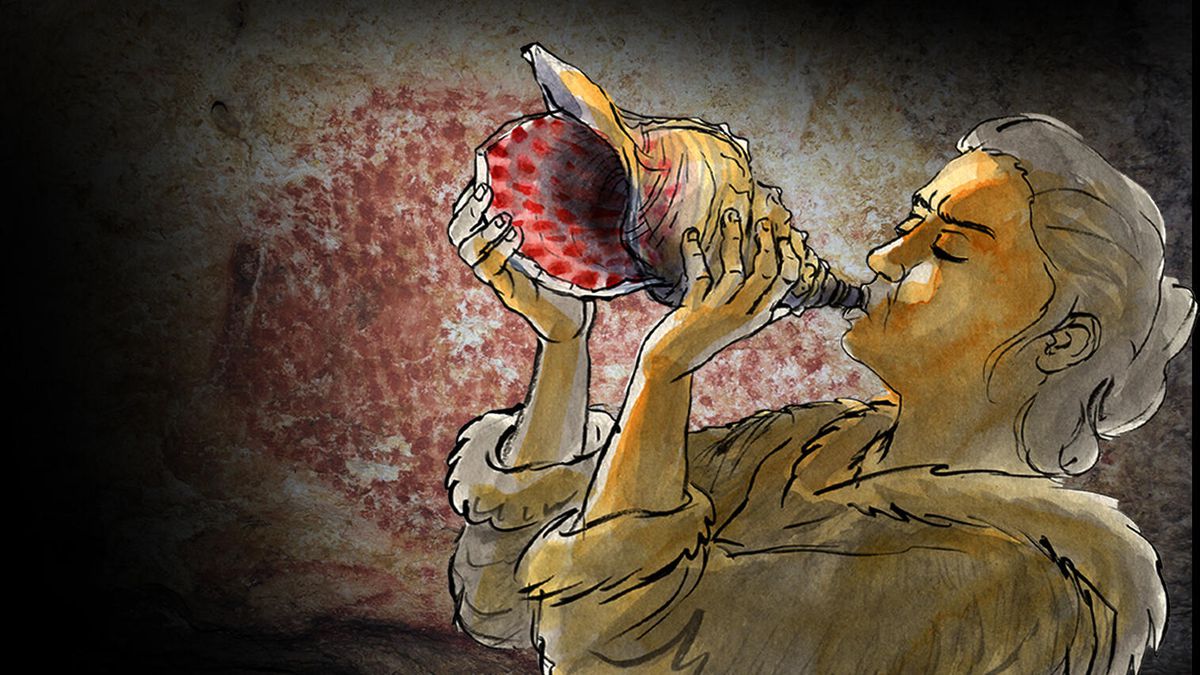
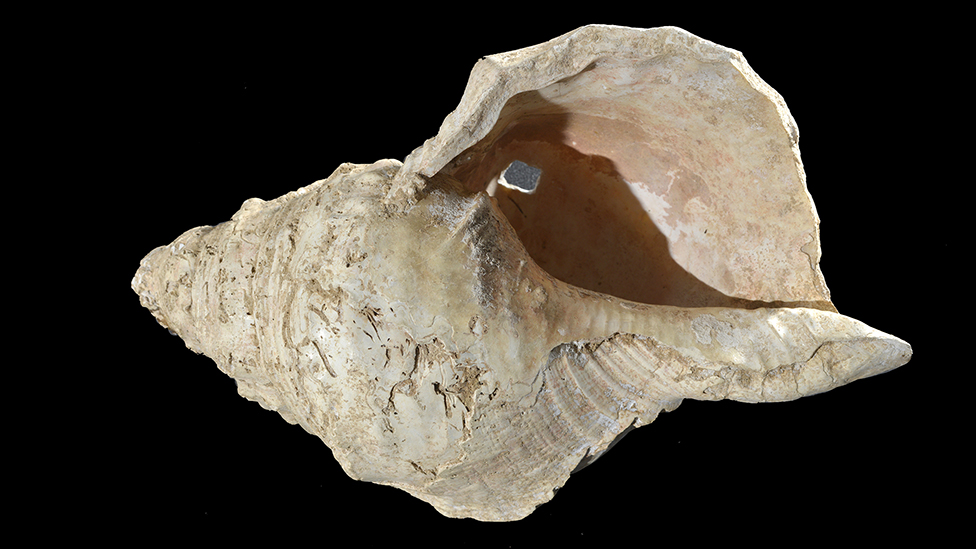
A team of scholars has recently reexamined a conch horn discovered around the Marsoulas Cave in southern France, the famous cave art site, and concluded that the conch was more than just an ornamental artifact used for a drinking vessel or any other trivial purpose in Upper Paleolithic Age, aka Old Stone Age, dating from around 17,000 to 12,000 years ago. It was an age when Cro-Magnons, a Homo Sapiens nomadic tribe in western Europe, emerged as formidable hunter-gatherers of reindeers and horses from a new cold and gray prehistoric horizon in the dawn of the ages of man. They were Magdalenian, named after a rock shelter located in the French Pyrenees where the artifacts and human remains were discovered. They left the prehistoric legacy in the form of the Magdalenian conch.
By using a carbon dating system and other state-of-art scientific apparatuses, the scholars posited that the conch horn was a musical instrument to enjoy the prehistoric Magdalenian symphony in the cave. The cause of reason for the hypothesis is a purposefully cut-off apex of the conch horn as if to adjust for blowing and making sounds. In fact, a modern music player tried playing it at its initial discovery and found out that the tunes were ranged close to the notes of C, C Sharp, and D, making it the oldest wind instrument of its kind to this date. Moreover, the conch patterns were similar to those appearing in the pictures of cave walls, which scholars deduced that they were significant in denoting cultural functions in the communes.
However, although the connections between the cave art and the conch horn are intelligent hypotheses, the idea of the conch as a musical instrument doesn’t quite hold water to me. First of all, the image of a conch horn always conjures up the dystopian vision of the boys in William Golding’s Lord of the Flies. In the story, boys blow the conch whenever they convoke meetings, which usually spring from sinister motives resulting in gloomy consequences. Also, the god of sea Poseidon blows a conch when he heralds his formidable divine presence, shaking the waves of the oceans. The use of the conch was to be more of notification of alarm for political or social events, not of a musical instrument for cultural appreciation. Besides, as aforesaid, a conch is often associated with the sea, unfittingly matched with hunter-gatherers in the mountain or sea-locked regions. Although scholars pointed out that the Magdalenian could travel to the shore and brought a conch as a souvenir, using it as a pastime wind instrument is a bit of stretch, a romantic imagination about the cave people differentiated from ruthless, animalistic, highly advanced kinds of ape.
If the scholars’ educated guess becomes a theory, then the Magdalenian conch horn will be entitled to the first place in the history of musical instruments. But considering the geographical reason and natural tendency related to a conch shell drawn upon historical and literary contexts, the Magdalenian conch shell must have been either a curiously collected souvenir from a trip to the shore or a valuable instrument to call upon meetings in the communes. Also, it could have been a convenient alarm to indicate a sight of animals for a hunt or protection. For melodious variations pleasing even to uncultured ears, the sounds of strings made from the leftovers of hunted animals hung on pieces of wood would be perfect for their hunter-gatherer entertainment.
Jack Strange’s England is never a bore; it is a mystifying country with its tempestuous history and colorful characters populated by the ever undead of the bygone eras still roaming their past abodes or workplaces among the quick. It is a quaint country where history meets myth and legend. This book will guide the reader to Strange England where fanciful folklores and historical facts are anchored in the traditions and customs.
The author admits that England is perhaps arguably one of the most haunted countries in the world, thanks to its religiously and politically tempestuous pasts spanning the wheel of time from the Roman colonial period to the present. To illustrate, in Derbyshire a spectral Roman sentinel is often seen leading a parade of a circus comprising gladiators, chariots, and slaves, then all of them disappear into the mist. Another lovelorn Roman soldier is witnessed alongside Hadrian’s Wall in Northumberland, wandering in despair of his betrayed love for a fair English maiden. The phantom English residents also encompass the Benedictine monks led by St, Cuthbert in Lindisfarne, which was a target for frequent raiding by Norsemen who also threatened the cradle of English Christianity. It is said that the best time to see the saint or the monks is when the tides are high and a full moon lights the shore as a natural lantern.
England is also a home of many interesting sports that are historically – and sometimes by happenstance – originated. The World Gurning Championship in Egremont in Cumbria was originated in 1267 when the Lord of the manor gave out crabapples to the locals. One can imagine without difficulty the consequence of tasting the apple, and thus can master the art of making as ugly face as possible. Hence this hilarious tournament comes to exist to this day. It’s open to everyone – yes, even to the fairest of all – , and it’s all about fun and participation. Also, there is Black Pudding Throwing Championship in Ridge, Lancashire. Originated in 1455, this tournament shows English humor mixed with historical irony, which makes it all the more convincing. It was during the period of “War of the Roses” elegantly referred by Sir Walter Scott (who was a Scot) to the feud between the House of York whose symbol was a white rose and the House of Lancashire a red rose. At the Battle of Stubbins in Lancashire in 1455, both forces decided to throw puddings at one another instead of lances. Believe it or not, the descendents still commemorate the incident by holding a championship every year with mirthful popularity.
Subsequent to Strange Tales of the Sea, the author Jack Strange has done a marvelous job gleaning the extensive historical documents and cultural artifacts from his tireless research to provide his reader with interesting facts about his England. Strange is a gifted artificer who digs artifacts buried in the depths of forgotten times and lost folklores. Strange is also a mysteriously reclusive figure himself because there’s no personal information about him. Maybe that’s why his writings are so hauntingly attractive and oddly addictive. Strange is an excellent storyteller who weaves a tapestry of legends and folklores imbued with his impressive knowledge of the history of England and his English humor permeated in his writings. This book is Strange’s winking invitation to his beloved England that spins a general image of the country with enchanting oddity and wide-eyed wonder that the readers will not tire of.








You must be logged in to post a comment.