Tag: faith

  • Live, Die, Repeat, Repeat…

    Life is still beautiful, even if it deceives you.

    I wanted to find the Church’s stance on reincarnation and, above all, what the Bible said about this seemingly endless shapeshifting until the purification of the soul is complete, so to speak. What about the Christian belief that we live only once and have no return of life?

    According to “A Concise Dictionary of Theology,” reincarnation is the belief or metempsychosis (“animate afterward”) that the soul preexists its embodiment. After death, the soul exists in a ghostly state before animating one again, a body of the same in a different state, which sounds a lot like a demon or malevolent spirit possessing the body of the living. It is this very belief in resurrection and official rejection of the preexistence of wandering souls without corporeal substance that denies reincarnation itself. By maintaining an endless series of chances, the doctrine of reincarnation reduces the seriousness of God’s grace and, most importantly, human liberty exercised in one life that is ended by once-and-for all death.

    Furthermore, in the Catechism of the Catholic Church, death is the end of man’s earthly pilgrimage. When the single course of our earthly life is completed, we shall not return to other earthly lives as “it is appointed for men to die once” [Hebrews 9:27]. Christianity defends the duality of the body and the soul. However, reincarnation defends dualism that both beings exist separately and that the body is simply an instrument of the soul; existence by successive existence as an altogether different body is repeatedly assumed each time one recycles life. Thus reincarnation denies the idea of the resurrection of the body, as evidenced by the resurrection of Christ, and most primarily rejects the Christian doctrine of salvation. Therefore, there is no reincarnation after death.

    I feel much better now than before. While I succumbed to the belief in reincarnation, I couldn’t accept the thought of my present life as punishment for my wrongdoings in my past lives. To think that I have to live in a miserable state of discipline until my subsequent due recycling puts me on the verge of lunacy in the form of murderous headache for which I recently found myself in the ER. Viktor E. Frankl, the survivor of concentration camps during World War 2 and the founder of Logotherapy, urged us to trust that there is meaning in suffering, which helps us lead to our purposes in life. Samuel Johnson, one of the most significant 18th-century English men of letters and the author of A Dictionary of the English Language, describes life as progress from want to want, not from enjoyment to enjoyment. Forget the arguments about the religious dogma dictating an institutionalized belief for mass mind control. Or it so, then so be it. After all, reincarnation is also another offshoot of mysticism developed into religious thought. Then I will follow the light that gives me a sense of hope. And for this reason, I proclaim that my body and soul are inseparable and that I live only once, and that’s it.

  • Dying today

    For all this time beneath this visiting moon,
    Where treasure is, my heart has not been at it
    with the lights of the lamp glowing in the gloom.
    But now I see the voracious time
    devour the kingdom of the shore,
    And the solid earth rule over the liquid main,
    Increasing store with loss and loss with store;
    When I see such vicissitudes of state,
    Or fate itself repeated over and over;
    Splashes of battle have taught me to ruminate
    That nothing stays the same to remain forever
    And I can’t depend on anything that changes.
    This thought is a truth that hope chooses
    And in the dying moments of today, fears I lose.

  • A gift from a heaven’s dove

    Going to mass every Sunday morning has become a mechanical reflex of programmed biological locomotion ever since I realized that my beliefs were abstract ideals hard to fit in the real world. All those sacraments of the church I learned by rote as a child has become the artifacts of ancient esoteric religion that has turned into institutional paganism itself. In a word, I am on the verge of losing my faith altogether, if not already, still tempted to recourse to the fragments of the belief that I try to reason on my own terms, which I often find hard to win because something such as the message supposedly from the Holy Spirit I randomly picked up yesterday after a mass permanently binds me to the old religion.

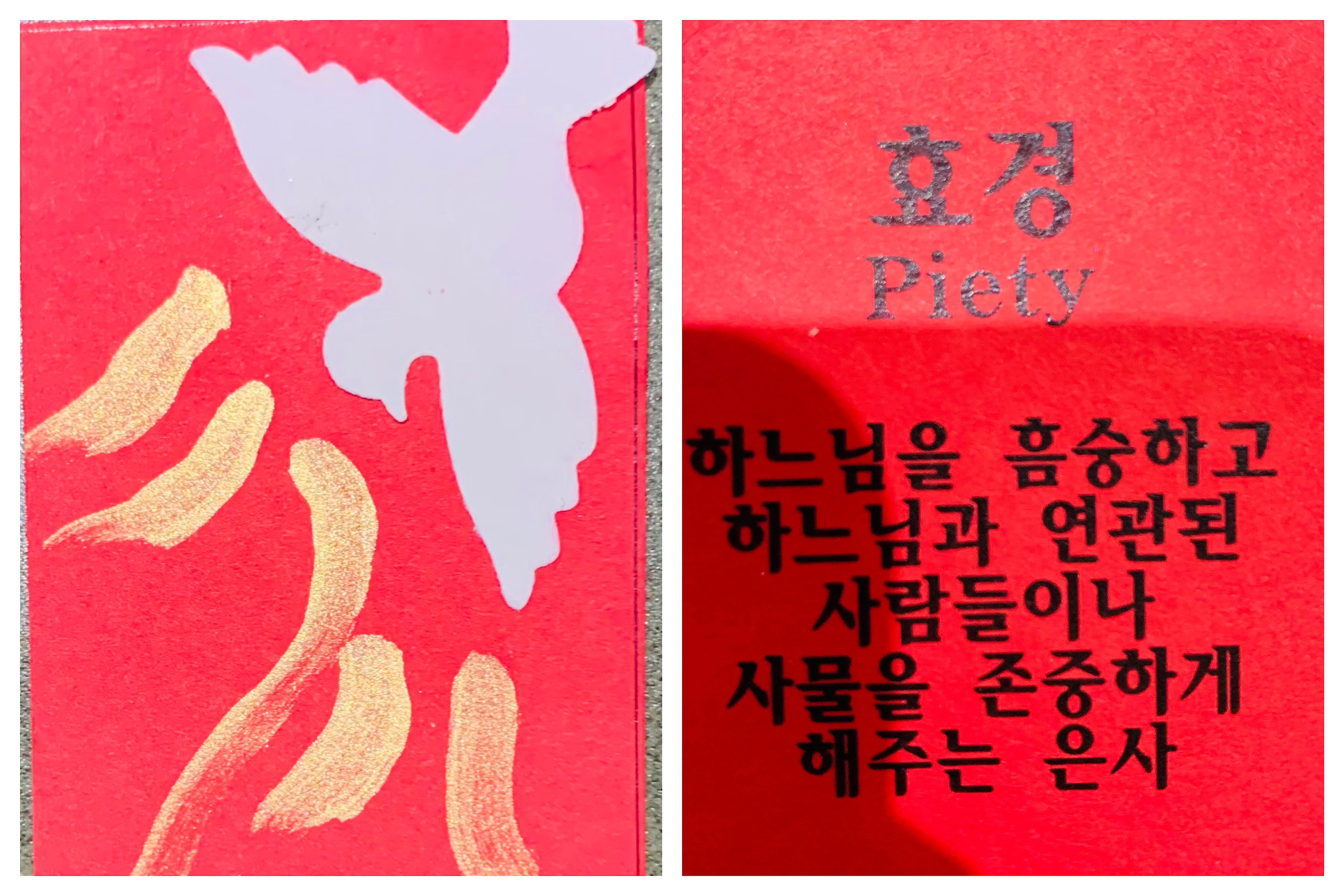
    I didn’t care much less about Pentecost Sunday when the Holy Spirit descended from heaven filled the hearts of the faithful with messages from God to each different individual. The little bookmark-like cards containing each of Seven Gifts of the Holy Spirit were randomly distributed to the attendants after the Eucharist. The priest said they were blessings from God curtailed to individual needs, never coincidental and ever mysterious. I picked up one that was not what I would like, but that what I had denied. It was not Wisdom, Understanding, or Knowledge that I still crave the most. But it was Piety instead, that not so wonderfully mysterious or romantically awe-inspiring banal word for showing respect for God, the church, and the religious people. St. Thomas Aquinas would rebuke me for my low regard for Piety, but it is rather clerical and prosaic virtue that even the most unlearned would have. After all, absolute obedience to God and the Church was what drew Luther’s bow of the Reformation.

    A Gift from God in the Holy Spirit: “Piety”

    But how could it be possible that my gift from God was Piety amid my own religious turmoil in soul’s dilemma? Indeed, there must be more than a respect for priests whom I think as presumptuous elitists inured to be respected, not accustomed to respect. Piety encompasses dutifulness, fidelity, allegiance, and loyalty, giving the impression of militaristic steadfastness. In my own words, I interpret this augury as indicating patience to endure and fulfill obligations till the ripe time and chance happen to me during my journey to a preordained end. My loyalty then requires fidelity of my consistent devotion to a job, filial duty, and the church by not falling wayside to the current instigation of a rebellious spirit. Am I not being an Oracle of the Holy Spirit?

    I keep the card and wonder if it is a manifestation of synchronicity. Whatever and from whom it may be, one thing is sure that reverence for obligations arising from a sense of duty helps your ship’s sailing across life’s undreamed shores and unpathed seas against the thunderous maelstroms in nature’s whimsical and capricious temper. It might be just a random message, but then there is nothing as coincidence because we are made of such wonderful stuff of fire, dew, and spirit. What’s more, if I can use the message as a divine oracle to guide my journey into the unknown tomorrows, then it will be all the more beneficial, just as the people of the ancient civilizations did the same. And I think that is why religion exists.

  • The Rambler – Religion

    “To one who has faith, no explanation is necessary,” said Thomas More, who died for his relentless faith despite Henry VIII’s promise of honor he would confer on to his most trusted counsel in his cabinet. Samuel Johnson also confirmed that faith required no byzantine theories or philosophy for the validity of truth. Until I attended a public Sunday mass in a parking lot yesterday, I had not realized the power of faith, which I doubted I still had in my heart.

    The beautiful liturgy of the mass, which culminated in the Eucharist, was akin to a flowing of streams of life to the eyes of a seasick seaman and the thirst of a weary traveler. I had never expected such exaltation of the soul with faith disappearing into an abyss of despondency populated with a school of doubt, disbelief, and frustration nurtured in a reality of everyday life. But while listening to a priest’s sermon based on the reading of Matthew 25:31-46, which is about the importance of practicing faith into actions, especially by sharing milk of human kindness with people you feel least likable or unkindest.

    The priest further asked if we would counsel with God in making decisions in life or just about anything needful of help. No one answered yes because let’s face it, we regard such tendency to recourse to God as a derogatorily medieval way of living life in this Digital Age of Artificial Intelligence. We try to reason our faith with the validity of practical truth and willfully turn our heads from the Gospel with the usual facade of “Religion has nothing to do with it.” But then can you also prove that we are nothing but of a highly complex living organism made of accidental atoms, sans souls? What is the feeling that urges you to search for meaning in life, our sense of purpose? Can atoms do it?

    It is my wholly solipsistic reflection of hearing mass, but now I feel like finding Ariadne’s Thread in the labyrinth to find a way out on this last day of the church calendar. What a feeling. Peace to be with you, and God bless you all. 

  • About ‘Ben-Hur’ (1959)

    img_1989

    A great film with a sincere message about life and human nature transcends a divide of time and a boundary of the territory. I believe that a good movie has a lasting sensory impact on the viewer and cultivates the mind with a visual efficacy of precipitation. In this regard, the epic historical drama ‘Ben-Hur’ (1959), directed by William Wyler, is an epitome of masterpiece cinema not for a time but all seasons. The remarkable triumvirate of the outstanding screenplay, the excellent performance of the cast, the fascinating cinematography produces supreme one of art that resonates with spiritual elements of humanity in the witchcraft of motion picture.

    ben-hur

    The film follows a history of Judah Ben-Hur, a young Jewish prince whose life is forfeited by a betrayal of trust and corruption of friendship. From the height of his prime to the fall, then to redemption, it is heroic acts of high human drama wonderfully conjoined with a tale of Christ whom Ben-Hur encounters by Providence. His wrath is untamed, and anger is the roaring of a lion. Ben-Hur chooses vengeance as a will to live in the march of death in the desert and the prison galleys on the Ionian Sea. He feeds on ire and utters curse every day until he intends to execute vengeance upon the perpetrator with recourse to the old retributory law of an eye for an eye, tooth for a tooth. Who can calm the turbulent vortex of the soul in despair and save him from the night of the soul?

    download

    The film revolves around Christ, and Ben-Hur is another disciple of his teachings through conversion into faith, charity, and hope. The figure of Christ is the central theme of the film, but his face is unseen, and his voice unheard. We can only see his rear, but it is the mysteriousness of the person of Christ that elevates the story of Ben-Hur to the sphere of hagiography. The providential encounters with Christ in the climactic moments of his life lead him to the way of Christ, which mirrors the process of Ben-Hur’s redemption from Wrath to Grace, from Desolation to Hope.benhur-christ-a

    Whether or not you believe in Christianity is not a prerequisite to appreciating this excellent epic drama because it would be a loss to any lover of arts to forego the spectacular beauty of the cinematography, not to mention the spiritual thematic of one man’s redemption from hopelessness. The grand epic scale of cinematography that depicts the tale of Ben-Hur in the trail of Christ from the Nativity to the Crucifixion is akin to watching Michelangelo’s remarkable frescoes of the Sistine Chapel that illustrate the story of humanity from the Genesis to the Last Judgment under God’s mysterious plan for mankind. In conclusion, ‘Ben-Hur’ is not a movie about a hero but about a triumph of hope over the desolation that saves a man’s soul from self-destruction, resonating with ‘Dum spiro, Spero,’ meaning ‘while I breathe, there is hope.’

    ben hur 3