Tag: history

  • Celts Vs. Romans?

    51n6uMCA63L
    Asterix (L) and Obelix (R)

    In The Adventures of Asterix, a popular Franco-Belgian comic strip whose protagonists Asterix and his friend Obelix in a village of Gauls during the Roman occupation in 50 BC outwitted their Roman colonialists with Druidic magic potion and spontaneous ingenuity laced with Celtic sense of humor and and mysticism, the Gauls were constantly at war with the Romans in the reign of Julian Caesar, who was bent on subjugating the culture of the colonials, let alone the recalcitrant Celtic spirit, to that of the empire. But it wasn’t always like that, pace popular conception of the Roman ruling of the Gauls and the Britons as widely portrayed in popular culture. The relationship between the Romans and the Celts was quite peaceful and even surprisingly symbiotically beneficial – that is, at least prior to the emergence of Caesar and Claudius.

    The Romans and the Celts were in Apollonian co-existence bound by flourishing trade and cultural exchange between the two peoples. There was a long period of peaceful trading between the Mediterranean Romans and the Celts of Gaul inhibiting modern-day France with exports and imports particular to each of the regions. To illustrate, the Gauls were known for their penchant for diluted Mediterranean wine that was transported by boat on the sea and wagon in land from the Peninsular. The Romans received in return Celtic slaves who never seemed to be short of a supply because there was a surplus of slaves in Gaul where frequent raiding among the tribes was the sine qua non of such abundance of exploited manpower to be used to tend the Roman vineyards and other aristocratic estates. Gaulish chieftains offloaded excessive number of newly acquired slaves by trading them off for proverbial Roman wine to distribute it to his followers as an ostentatious display of their wealth and prowess in their tribes. In fact, the Gauls’ love of the Roman wine was so undeniably famous that among the Romans the stereotypical image of the Gauls as drunkards slurping wine through their long, drooping mustaches was widely circulated in the empire.
    hqdefault
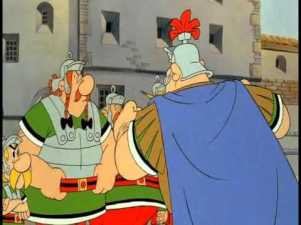
    Asterix and Obelix in the Roman Army

    Olive oil, tableware, jewelry, and other luxuriant goods were among the popular Roman exports, however expensively they were sold by canny Roman traders, who then bought metals, cured hams, beer, and hunting dogs from the Celts at low prices. Notwithstanding such discontentment in terms of fair trade, the prosperous bartering of the goods between the colonials and the colonialists brought the grist to the mill of effective management of the colonies in the context of regarding economic and political stability that could/would have been otherwise in turmoil as a result of despotic constraints on the preexisting native social and political structures characteristic of colonialism. This favorable symbiotic relationship between the Romans and the Celts (the Gauls in France and the Britons in Britain) greased the wheel of the cultural and political expansion of the empire by egging the Celts on to adopt Roman-style systems of government and the young ones on to enlist in the Roman army as auxiliaries.

    R22b
    Julius Caesar

    However, the pacific era of the Roman-Celtic relationship saw cataclysmic waves of change that would punctuate the stability of the status quo as destabilizing forces loomed large in Western Europe: Firstly, the prospect of Germans occupying the Alps was a cause of concern to the Roman Elite. Secondly, Julius Caesar, the ambitious Roman ruler who was seeking for a popular acclaim to fortify his rulership in the empire as well as booty enough to get himself out of debts, determined to impose his despotic rules on the peoples of the conquered lands as portrayed in The Adventures of Asterix. Then later, there came Claudius, the lame and slightly deaf emperor who was spared of his life by his nephew Caligula perhaps on account of such physical defects. Claudius launched a campaign of conquest in northern Europe to attain military prowess in the region and thus enforced totalitarian policy on the management of the colonial systems, discouraging autonomous trading and social and cultural exchanging between the colonial and the colonialist.

    In light of the above, the relationship between the colonialist and the colonial sometimes begets unexpectedly mutual benefits in terms of cultural exchanges between the two peoples counter-intuitive byproducts, such as attested in the case of the Romans and the Celts, which could lead to diversification of native cultures, enriching the wealth of cultural legacies that would become another mode of new culture. If the Celts had been vehemently resisted against the cultural influences of the Romans as a result of the conquest of their lands, the cultures and history of Western Europe would and could have become very different from what we have known today, such as the English language, architectural and other historical artifacts, and political systems. In my opinion, sometimes, the colonial regime is not altogether downright evil in the sense that it somehow results in amalgamation of cultures favorable to both of the ruling and the ruled, not out of the benevolence of the former for sure but of the necessity of governing the conquered in the most effective way in order that the conqueror may quell the social and political dissonance arising out of the inept administration of the colonial affairs. In point of view as held by Ancient Athenian historian Thucydides, one must listen to the other less popular side of the story to transcend the subjectivity of times and to test the validity of truth. In this regard, I opine that however adamantly one may object to the benefits derived from the Roman-Celtic relationship, it attests to the fact that it enriched the cultures of both of the peoples and helped them reshape their ideas of epicurean ways of life that has passed on to the present progeny.


    Author’s Note: The inspiration of this essay comes from my reading of “Traders to Invaders,” written by Barry Cunliffe, formerly professor of European archeology at the University of Oxford, from December 2018 issue of BBC History Magazine.


    저장

    저장

    저장

    저장

  • ‘The Memoirs of Sepp Allerberger, Knight’s Cross’, by Albrecht Wacker -review

    Sniper on the Eastern Front: The Memoirs of Sepp Allerberger, Knight's CrossSniper on the Eastern Front: The Memoirs of Sepp Allerberger, Knight’s Cross by Albrecht Wacker

    My rating: 4 of 5 stars

    Many books on Germany during the Second World War are written in a victor’s perspective. In the context of regarding the objectivity of the events, the point of views in which books on the Third Reich are written is oftentimes biased toward the perpetrators of the war without regard for the underlings, such as foot soldiers compulsorily drafted to the fronts who want to voice out for themselves. This tendency betrays ancient Athenian historian and general Thucydides’ definition of historical record as the ultimate objective to provide the most accurate record of the events “by recognizing certain commonalities, free from bias and embellishment”. One must also listen to the other side’s story to transcend the subjectivity of times and to balance objective equilibrium, wherefore my choice of this true story about the Eastern Front by a former Wehrmacht’s prime sniper was an act of impartial treatment of the history so overflown by untamed populist opinions on the volatile subject.

    The narrator of the book is Josef “Sepp” Allerberger, the second most successful sniper of the German Wehrmacht and an awardee of the Knight’s Cross as a private soldier. Originally from Austria as a son of a humble carpenter, he was conscripted to the Wehrmacht as a machine gunner in the Russian Front in 1942. Allerberger’s fitness in marksmanship soon shone through and was forthwith selected as his regiment’s only sniper specialist thanks to his commendable traits of disciplined mind and bravery in the battlefield.

    In his blatantly frank discourse of what he experienced and witnessed in the Russian campaign, it is unlikely to feel sympathy toward the Red Army soldiers and partisans who were as equally cruel and violent as their invaders. No German Prisoners of War were guaranteed to live once they were captured by the Soviets and the partisans alike. Instead, they were met with the most atrocious way of being tortured and executed against the Geneva Conventions. As a result, the whole scenery of the Eastern Front was the killing field of humanity, perhaps even more bloodstained and catastrophic than that of Trojan War.

    Allerberger is not apologetic nor sentimental about his actions as a German sniper. Nevertheless, his narrative is honest without adding any lyrical adjectives or warm recollections of comradeship shared with a Red Army soldier as often depicted in movies and fictional stories. The book resulted from a series of interviews with Allerberger by the author Albrecht Wacker, who was also Austrian feeling a need of transcribing them and publishing the account of the veteran as a book. This telltale narrative is worth being read as a historical artifact that is important to understand what it was like to be a soldier in a war that he and his country knew was losing but tried to fight until the end with valor and might for their country and battle buddies in the face of the utmost atrocity.


  • ‘The Library: A Catalogue of Wonders’, by Stuart Kells – review

    The Library: A Catalogue of WondersThe Library: A Catalogue of Wonders by Stuart Kells

    My rating: 5 of 5 stars

    Libraries are more than boring stockpiles of books gathered, nondescript depositories of books collected frequented by socially gawky individuals we love to call “nerds” or “misfits.” They are symbolic fortresses of our human cultural progresses as collective enterprises. In fact, libraries are precious repositories of our cultural wealth and knowledge inherited from the forerunners of the Humanities with prescient intentions to preserve the intellectual and spiritual prerogatives of the mankind for the posterity. Any book lover sees this magnificence of libraries, and that is the motif of Stuart Kells’s The Library: A Catalogue of Wonders, a vivacious, jocund presentation of histories and development of libraries and an uplifting rhapsody of bibliophile – love of books. What’s more, this book is not a product of armchair thesis of a library as an anthropological institution, but of an empirically telltale account of cultural, aesthetic, literary, and social phenomena dedicated to preserving the writings of Mankind based on Kells’s actual visitations to the libraries he presents to us.

    To begin with, Stuart Kells wears many hats in this book: a teacher, a guide, a book-collector, a historian, and a confirmed book-lover. But most of all, the image of him as I follow his narrative is that of a cross between a teacher and a tour guide with erudition and bonhomie. Like peripatetic Aristotle communicating to the minds of his students in the ancient Greek Lyseum, Kells invites the reader to saunter with him in his own mental library of snippets from a variety of literature and history that merit their substratum of textual human cultural artifacts bestriding the shelves of the Humanities ranging from the classical to the contemporary, all in the loving and caring custodianship of the author whose love of books is so deep and passionate that it’s almost physical. It’s personal, historical, academical, and magical in a way that imparts a sense of flitting in the phantasmal reverie of the world of libraries, now and then, existing and extinct, and  real and imaginary, to the reader.

    We travel along with Kells playing the role of a likable and knowledgeable cicerone from the Library of Alexandria to the Italian monastery of Bobbio in the Middle Ages that was said to house 666 manuscripts, Germany’s Wuttemberg State Library possessing a 17th century portrait of Vlad Dracul, aka Dracular, and the Abbey Library of Saint Gall, aka St. Gall’s Library, in Switzerland, which is now a UNESCO world cultural heritage site holding more than 400 manuscript volumes produced before the year 1000. And before we know it, Kells also brings us to the fantastic libraries of the famous Hobbits, also known as a race of bibliophile with personal libraries at home, however small the size might be, and the medieval monastery library in Umberto Eco’s The Name of the Rose, where lightheartedness of the atmosphere contributes to the joy of knowledge and the elevation of the mind and soul. Although Kells’s Australian identity tells of the superiority of J.R.R. Tolkien’s Mathom House, a wondrous library of literary paraphernalia, over the Italian Eco’s monastery library, it’s altogether a magical sightseeing of the mystical libraries conjured up before our eyes by the imaginativeness of Kells, and we can decide which of these fantastic libraries appeal to us.

    To conclude, the book is an axiomatic compendium of world’s famous libraries throughout the western civilizations, smartly studded with tidbit information on eccentric librarians, book-collectors/booksellers, and historical figures in between the chapters serving as a kind of delightful intermissions introducing a subject of each new chapter with provocative anecdotes and vignettes, which are pleasingly digressive rests from the tour of the libraries. It’s really a bright book, not a heavy-duty one with lots of footnotes and scholastic priggishness that the reader may expect a book of this subject matter to be. Notably, Kells’s interpretations drew on his impressively eclectic knowledge of these extensive sources as a respectful book-trade historian, but he wears his learning lightly and writes with a general reader in mind. And I believe that just as the famous English poet Samuel Taylor Coleridge often kissed the books of the Dutch philosopher Desiderius Spinoza, out of Kells’s passions for books and possession of the knowledge of multidisciplinary studies comes his love child in the form of this jolly, easy-to-read book.  In the end, the reader will come to love this book for simple, pure pleasure of reading and may kiss the book.

  • Fairy summoning in the Florentine Renaissance period

    41a59389f2e8e71b94e50f9d1ae7d39a--vintage-fairies-vintage-artwork
    A supernaturally pretty fairy deludes men’s hearts.

    There are magical elements in religion, and there are religious facets to the practice of magic, as succinctly summed up by Sir Walter Raleigh: “The art of magic is the art of worshiping God.” That’s how I feel and what I see during my Dutiful Sunday Morning Masses, the ancient rite of the Church, a perennial panoply of syncretism with its splendid paraphernalia of prayers and the liturgical ceremony of rites and mechanical recitation of prayers; it is the melding of religions or beliefs of the similar elements but of different origins. Hence, to come upon an article in the recent issue of BBC History Magazine about an academic study by a certain British scholar of the existence of fairies in the context of the validity of cultural and historical artifacts gave me an uncanny pleasure.

    Dr-Faustus
    The famous Dr. Faust, summoning Mephistopheles for his service

    In fact, Religion (that is, Christianity) and Magic (in the forms of divination and sorcery) are not to be seen as polar opposites and antithetical systems of belief because they are interdisciplinary agencies of attempting to seeking and offering a panacea to our dilemmas – physical, metaphysical – competing for supremacy in propitiation. Such mysteriously syncretic elements of the two different agencies of beliefs became the academic subjects of intellectuals, such as Francis Bacon and John Aubrey who accepted the potentialities of physiognomy as an infallible guide to predicting one’s character and argued for the validity of non-Christian practice based on certain intellectual bases therein. With this in mind, you would not be surprised to learn that fairy summoning rituals were all the rage in the Renaissance period (15th~17th centuries), indiscriminately practiced by all strata of society, learned or ignorant, rich or poor, Christian or pagan. The author of the article informed the reader that the early Renaissance idea of fairies was pretty nebulous and varied with a wide arc of wonder and trepidation and that the dainty image of ever famous “Tinker-bell” was a Victorian construction of the whole fairy race.

    Then, how did the “real” fairies look? Although there is no magisterial, definitive version of the physiognomy of a fairy, a collective description gleaned from various records boils down to it as a supernaturally attractive man/woman imperiling the souls of whoever it was summoned to, which is reminded of incubus/succubus, consecutively. Notwithstanding the dubious nature of fairies, the invocation of fairies halfway between angels and devils was widely used in hope to (1) acquire medical knowledge, such as whereabouts of herbs and their properties; (2) delight in the highest degree of sensual ecstasy; and (3) reveal the future and prevent from misfortune in advance. Be it as it may seem wholly pagan, the summoning ritual was surprisingly required for God’s intervention because it included periods of purification through abstinence, fasting, and prayer in preparation, all of which would testify to the sanctity of the performer ministering to the moral and ethical character. God willing, a fairy at request manifested to the summoner, but he should not come out of the circle he had drawn because it protected from sudden maleficence of the ambiguous fairy.

    Delphic_Sibyl_Michelangelo___21969.1501257269
    Delphic Sibyl from the Sistine Chapel fresco by Michelangelo

    In sum, the article was an elegant primer for a further interdisciplinary study of literature, religion, and folklore from the medieval times to the Reformation period and possible stretching to this date. The exemplary texts that spring to my mind are Religion and The Decline of Magic by Keith Thomas and Christopher Marlowe’s version of the legend of Dr. Faust, both of which are excellent testaments to the contextualization of the esoteric knowledge on the grounds of intellectual bases into academic studies of social, cultural, and historical facets of different zeitgeists, which also serve as invaluable literary artifacts to epochal changes. But for all that is worth, this relation between religion and magic is commensal, exhibiting a mesmerizing consilience of gods and God, profane and holy, pagan and ecclesiastical, forbidden, and disciplined, as superbly unfolded in the Sistine Chapel fresco, prodigiously expressed by Michelangelo.


    저장

  • Tarantism: St. Anthony’s Fire – review

    My-Neighbour-Totoro-5-940x460
    This was exactly what it was like while I was waiting for my bus to work.

    The Kingdom of Rainfall, Dampness, Stuffiness, and Grimness reigns supreme all day long today without a ray of sunshine peering through the heavily downcast gray sky so lowly hung in the celestial ceiling of the Atlas that it almost looks like collapsing to earth. While basking myself in the typical Atlantic grayness of this somber weather, I could understand why the legendary lost Roanoke Colony was doomed to fail in the late 16th century; it was primarily due to this grim and damp weather condition only congenial to mosquitoes and other kinds of pest that thrived on the unpleasant sogginess. In the reign of the somber weather, to come upon an article in this month’s National Geographic History called “Killer in the Rye: St. Anthony’s fire,” which was also related to the gloominess of the weather seemed a tad pat.

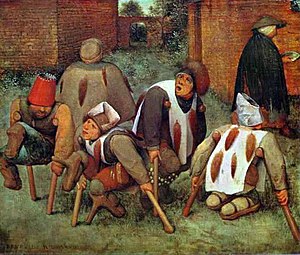
    300px-Pieter_Bruegel_the_Elder_-_The_Cripples
    “The Beggars” by Pieter Bruegel the Elder is said to have portrayed the victims of rye poisoning, most likely of St. Anthony’s Fire, as shown herein.

    Between the middle ages and the 17th century, inhabitants living in the proximity of the Rhine (Austria, Germany, and Flanders) where damp climate affected the crops adversely were frequently subject to a diabolical malady caused by a consumption of infected rye with symptoms of seizures, hallucinations, and infected limbs with excruciating agony that was said to be similar to the spiritual torment suffered by St. Anthony of Egypt. Hence the naming of the agricultural disease ensued. It all started with eating grain infected with a fungus called claviceps purpurea, black growths resembling a rooster’s spurs. This heinous fungus became ergot, toxic alkaloids cutting off the blood supply to the body’s extremities, which caused the hellishly burning sensations to the limbs. Since the cows were not immune from this fungus by dint of eating the infected crop as a staple diet, large parts of the population were exposed to the risk of contracting St. Anthony’s Fire.  In fact, this rye poisoning was multifariously diabolic in the saintly names, such as “St. John’s Dance” and “St. Vitus’s Dance”; the victims displayed tantrums of bodily movements – also known as tarantism – as if they were possessed by demons. Although the rye poisoning began to die out in the Western Europe as wheat replaced rye in the kitchen, the most recent cases of the rye-poisoning disease were seen in the early 20th Soviet Union and Ethiopia and India in the late 2oth century.

    My-Neighbor-Totoro-Rerelease-2018-30th-Anniversary
    Sun, Sun, Sun!

    Indeed, to happen on the article such as the aforesaid while I was sulking in the unpleasant conditions of damp weather gave it an extra fillip. Maybe I am being grumpy about one of those lousy weathers that may be beneficial to the others on the other hand, such as farmers needful of precipitations for their parched land or vendors and manufacturers of umbrellas and rain boots whose businesses hinge on the whims and caprice of Mother Nature.  But as the aforesaid historical records evidence, when dampness and cloudiness in partnership reigns supreme, it turns the world grim and dreary, listless and lethargic. And that is why the ancient civilizations began and prospered in the places where the gods of sun Ra, Apollo, and Helios claimed their sovereign powers among the dominant high gods and goddesses and retained their divine radiance.


  • Divine Serendipity

    713218978

    Of all the quotations about learning from one’s experience, none is more tangibly perspicacious than one from the English Romantic poet John Keats (1795-1821), who sagaciously said, “Nothing ever becomes real until it is experienced.” How rightly so when it reflects a posteriori empirical truth. In fact, nowhere is this more evident than in the case of our health, which is subject to illness due to causes preternatural however trivial or diminutive they may be. For being the experience of a painful ordeal, I say that illness has inculcated in me a profound reverence to the disciples of Hippocrates and medical efficaciousness. I could not have been more appreciative of the remarkable medical progresses we often take for granted, one of which is the benevolent agency of antibiotic that has been saving lives of people from infections since its discovery by Dr. Alexander Fleming (1881-1955) in September 1928.

    fleming-rm-af-swDr. Fleming’s finding of Penicillin was something of serendipity or more likely divine providence. Dr. Fleming, an erstwhile captain in the Royal Army Medical Corps during World War I, began researching antibacterial substances at St. Mary’s Hospital in London after witnessing so many deaths of soldiers due to rampant pervasiveness of infections even though the wounds were not seriously intractable. Then one day in August 1928, Dr. Fleming left his bacteria cultures stacked up on a bench before embarking on his family holiday. On his return in September, he found a mould growing in one of his sample cultures, destroying the bacteria. What’s more, the mould produced a substance that destroyed the bacteria responsible for scarlet fever, diphtheria, pneumonia, and meningitis. Dr. Fleming first named it “mould juices” in 1940. Then in 1940, two medical researchers from University of Oxford named Ernst Boris Chain and Howard Florey succeeded in mass-producing penicillin. The concerted collaboration of the three trailblazers of the first modern antibiotic awarded them with the Nobel Prize in Physiology in 1945. Indeed, the laborers were worthy of the rewards.
    28ee176bcf6b40d8175ed42c72d7f3ee

    The discovery and development of Penicillin is akin to Prometheus’s stealing of divine fire to mankind.  By the end of 1940, more than 250,000 patients a month were treated with the antibiotic for a variety of infections that had meant a death sentence for thousand years, ranging from the time immemorial to the medieval when a scourge of the Black Death swept away thousands of lives to even the simple cases of abscess, especially prevalent in the 17th century London where more than 200 people died therefrom, and to the early 20th century case of Alexander of Greece who contracted sepsis from the bite wound by his pet monkey while trying to pacify a fight between his dog and the monkey and died shortly after from the infection. Furthermore, the use of  antibiotic enabled doctors to perform more invasive –i.e., opening a surface of skin and infiltrating into the inner layer of skin with surgical tools – without having to worry about the high risk of infection.

    To think that I could have been in the canon of the dead! Dr. Fleming’s breakthrough discovery of penicillin that has heralded all other subsequent medical and medicinal munificent largesses contributing to the human race imbues me with exultation at the blessing of having born in this post-penicillin era when I don’t have to have occasional bloodletting for frequent dizzy spells, to have my tooth crudely pulled out without Novocain by a barber, or to endure the gruesome pain of going through a surgery without anesthesia. On a very rare moment of personal note, I wonder if my existence in this era I am living is whether or not truly divine providence. If so, then let it be, and I am all the more certainly happy that I began to live once again in this post-antibiotic era.