Tag: history

  • The Pope and the Heretic by Michael White

    I first learned about Giordano Bruno through a tweeter thread about Shakespeare discussing his one of many influences, including this Don Quixote-like miscreant Dominican priest who wrote The Art of Memories, the subject I was and still am keen on to improve my regressing memory. Since then, Bruno has resided in my memory chamber as an enigmatic pariah, a formidable rebel without compromise. So when I came across this book by Michael White, a former member of the 80s pop group Thompson Twins, I knew I had to read it.

    White describes Bruno as a martyr of enlightenment, thinking ahead of his time. Unfortunately, Bruno was born into the wrong place at the wrong time, so he suffered from the Catholic Church’s authoritarian rule that dominated the World’s knowledge. However, Bruno’s theory that Jesus was preternaturally a superb magician and therefore not the Son of God, not to mention that the Holy Ghost was the spirit of the World and that Satan would be saved, was sufficient to raise the eyebrows of the ecclesiastical figures. Also, he opined that the stars seen in night skies were actually suns and that there were other worlds in the universe where living beings like humans existed. I speculate such an opinion might have influenced a modern-day belief that we are not alone in this universe because there are extraterrestrial beings. All these ideas were indeed revolutionary. But unlike Galileo, who was said to murmur, “Still, the earth circles round the sun” after he was acquitted of heresy, Bruno was stubborn in his ideas. He proudly defied the Church’s intention to pardon him if he would recant before the death sentence. In his excellent lyrical portrayal of the dramatic confrontation, White sees it as the microscopic representation of the conflict between religion and philosophy, myth and truth, superstition and science.

    Notwithstanding White’s admirable wealth of knowledge used in defense of Bruno, I cannot help but think that White’s stance on Bruno overlooks or connives at some facts. The Catholic Church put him at stake on account of his theological errors, deemed dangerous to the spiritual formation of the Church and the Faithful as a priest to the Church. Bruno was not a willing martyr of his ideas but a Simon Magus-like figure trying to trade his knowledge for recognition in the arms of different sects of Christianity, such as Calvinism, Lutheranism, and Episcopalianism, across Europe.

    It’s an irony that rather than the man written about, the man writing about him turns out to be a genius in writing. Perhaps White, a former musician, attributes this to his lyrical rhythm of narration drawn from his emulous erudition. Moreover, he writes the language of the general reader in the panoply of academic disciplines, and the reader will find no time for disorientation or disinterest. This book carries a tone of what the Italian anti-Catholic activists campaigned against the Church, with Bruno as the symbol of persecution against what they believed in. Nevertheless, it is worth reading it if you are a proponent of Giordanism or just a curious bystander like me.

  • Hounds of Night

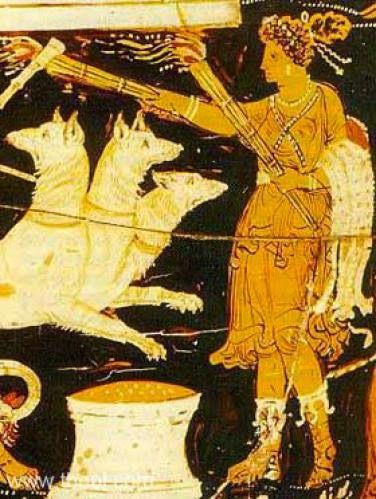
    The curtain of the night has drawn. Selene has started her nocturnal promenade with a moon mirror carried on her celestial chariot across the starry highway. Then the earth begins to bellow with great silent roars, trees to dance with leaves rustling in the wind as the chariot is racing, owls to call with their wings flapping, and the hounds howl from the end of the horizon in the glimmering light of the distant stars like lamps flickering in the desolate wilderness amid the haunting sound of Pan’s flute yonder. It’s Hecate’s Time, the Wandering Goddess of Night, appearing from the crossroads with her faithful hounds, heralding the staging of their divine mistress.

    Hecate has often been associated with all things witchery, magic, and death, not in the least due to modern-day Wicca practice identified heavily with the Greek goddess, but there’s more to her. She is a protector of the wrongfully accused, a goddess of retribution against injustice and impurity, and an advocate for underdogs. Perhaps, that’s why her animal is a dog, not a cat, which betrays a common association of the latter with someone like her. (In fact, Artemis is the only goddess whose animals are a cat because she was once transformed into it when chased by a besotted man.) Her hounds all have names: Kynegetis (Leader of Dogs from the Orphic Hymn), Kyneolygmate (Howling like a dog), Kynokephalos (Dog-headed), Kyon Melaina (Black Dog), Philoskylax (Lover of Dogs), Skylakitin (Lady of the Dogs). Of all the hounds, Kyon Melnia, aka Black Dog, used to be the wife of the last Trojan King Priam named Hekabe, who threw herself into the sea after the collapse of Troy by the Greeks. Hecate took pity on the queen and transformed her into a great black dog that became her familiar. What a manifestation of divine mercy it was.


    It is said that dogs and cats see the spirits of the dead, especially at night. If you have heard a dog howling, another howl, then another, and so forth, as if all of them sing in a canine polyphonic coda. When Hecate’s hounds howl, mortal dogs respond to their divine canine entity as the goddess and her entourage pass by. The hounds also bring victuals offered to Hecate to their mistress at a cemetery where she partakes her daily victuals. So if you think it’s just an ancient myth, listen carefully when your dog or any dog within your earshot howls. It’s either it sees a spirit or Hecate and her nine hounds. For me, well, I have a tabby cat named Toro, and he sees it and them but won’t participate in the chorus because he has her mistress at home.

  • ‘Life below Stairs’ by Alison Maloney

    The idea of domestic servants and their relationship with the masters is superficially romanticized not in the least due to period dramas, such as ‘Downton Abbey’ or Victorian masterpiece theater. In such fictionalized stories, the social dynamics between the classes are often bowdlerized or beautified, in addition to the romanticization of the working class as though to neutralize class antagonism in fear of marring a lofty literary theme. That said, ‘Life Below Stairs’ by Alison Maloney is a documentary of the real people who had to find themselves in servitude of their betters and their live-to-tell accounts of what it was like to be servants.

    While reading the book, I could not help but think that the professional domestic service in the capacity of maids, footmen, and butlers was not so much different from today’s social dynamics of at-will employees who provide their labor to employers for livelihood. Of course, the labor conditions and workers’ rights have been considerably improved, thanks to continuing reformation of workers’ compensations. However, the essence of the exchange of labor for necessities of life and the nature of employment is often precarious and insecure on the whims and caprice of businessmen and women. For example, recent union movements of Starbucks employees have prompted the company to close down under the pretext of low sales or redundancy. It betokens that the company will not tolerate such defiant action by the employees who provide their service in pure physical labor and mental exertions in catering to the needs of customers daily. Servants in the Victorian and Edwardian eras were employed chiefly by the middle-class bourgeoise who regarded keeping servants as a status symbol in the emulation of their upper aristocratic betters. In the States, servitude equated the slavery in the South, which was also maintained by merchant and business classes. Although I am not a proponent of aristocracy, aristocrats knew better how to treat their underlings because the need for servants arose from the necessities of keeping their estates and domesticity, not from a flash of ostentatious wealth that their jealous middle class was envious of.

    I envision myself as a housemaid in one of the early Edwardian eras (1900-1930), working from 6:00 am till 11:00 pm for a mistress whose temper is mercurial like Hera. That would be miserable with no weekend offs and mandatory church going with her. Then I feel okay to live in this moment of history even if my mistress boss is a modern-day bourgeoisie woman who wants her underlings to do thngs in her way because thanks to labor law, I only work from nine to five with saturdays an sundays to myself. Thank God for that.

  • Upheaval: Turning Points for Nations in Crisis by Jared Diamond – book review

    Jared Diamond’s Upheaval analyzes why a nation is how it is now. Of course, culture plays a role in changing the ethos of each new zeitgeist. Still, it is not so much a differentiating element as a distinguishing factor to characterize a national character. Instead, it is a mindset of individuals, including the governing elites in the nation, that determine the success and stagnation of the nation’s progress.

    Of all nations’ approaches to and results of political and sociological revolutions, the most successful example is Japan’s Meiji Restoration in the 19th century and democratization in the aftermath of WWII, both of which are one-of-a-kind upheavals yielding to outstanding progress. Japan’s confrontation with the West might have blown their isolated cultural prestige. However, rather than coiling in fear of the changes, Japan sprang back with new attitudes adapted from Europe’s and the U.S.’s technological development and cultural legacy to survive the new zeitgeist as the time’s juggernaut.

    On the other hand, the United States today needs change because it is highly polarized by political affiliations, ideological inclinations, and racial stratifications. The U.S. seems to have lurched in the above marsh when it should focus on the constructive, substantial, and realistic aspects of political agenda and social movements. For example, Americans tend more to ideas than facts that collectively affect individual needs, such as universal healthcare, a better educational system, employment opportunities, housing assistance, welfare programs, and workers’ rights. It s because American politicians aim to mobilize an army of people, aka constituents, to win their ideological war for occupying more congressional seats. In fact, American exceptionalism, that America is the best of all other countries in the world, averts the eyes from the lessons from other countries simply because they are beneath.

    Diamond is a polymath well versed in science, literature, philosophy, geography, psychology, and sociology. He talks about his family, students, and friends from other countries. He is no stranger to their cultures with the knowledge of the languages and cultural cues, which entitles him to an appellation of “a citizen of the world.” This book reads persuasive and perspicacious, among other books on similar subjects. Maybe I am biased, but if the man whose assessment of nations strikes my chord, then I can’t help it.

  • Old Astrologer

    An astronaut may orbit
    the earth in spacecraft
    and colonize the moon,
    but an astrologer watches
    the constellations of stars
    that house the spirits
    like he’s done for thousands
    of years from the sacred
    stairs of the ziggurats of Ur
    and tells of the stars
    that made us.

  • Don’t Stay here

    Walk around
    Turn around
    You’re the one
    Who knows better
    In this grim town
    You’re the stranger
    The faces lit ashen
    The shadows unseen
    Beneath the sun
    Ride on the wind
    Chase the eagle. Move to freedom.