Tag: language

  • why she wrote

    Like muffled drums in rains of thunder and lightening, her heart was still beating as the intuitive leap within her was on the verge of falling into the crevice of darkness. She hoped that life would be better or that if life wasn’t unresponsive to her hope, she could seek an elbow room in her writings blog, her glass castle of the soul. In this regard, her purpose of writing and that of George Orwell agreed that it was for sheer egoism of being an individual and recognizing it. For all she had read and seen, her spirit wanted to record it in writing before leaving the world without a trace. How pathetic it would be!

    If only. The girl hoped to articulate her thoughts to the unseen public somewhere out there. But above all, the girl used her writing practice as an autodidactic exercise to improve writing skills in the language she fell for. She loved the English language so much that she was ready to forsake the native language if she must choose one. She would have wished to possess the art of English Writing if a benign fairy had asked about what gift she would want. Perhaps she would have made a Mephistolean pact for the craft. Yet her love was alone because she loved the language more than it reciprocated the appreciation to her. How cruel it was!

    To pure lead into an open wound, the girl realized her brain was not as alert as it used to be in the locomotive of thinking. As thoughts shape language, she reasoned that a slowly deteriorating neuroplasticity in her brain might have contributed to her difficulty in reading and writing. Something ominous was happening to her, and it was gripping her spirit under its diabolic aegis for the sheer pleasure of tormenting the soul in hopelessness. Words she saw refused to make a coherently complete sentence and enter a faculty of thinking. The circuits to the control center of the brain felt blogged or damaged to the point of making telegraphic phrases swiveling at a vortex of frustration. It had never happened until last year. But why was it happening to her? Alas!

    She tried to find reasons for the ghastly maladies and self-diagnosed the following:

    1. Moving to California
    2. Demanding nature of her roles and tasks at the workplace
    3. Attending her elderly mother
    4. Approaching her end with no security for future

    She further decided that the existential frustrations were exhausting her will to essay her creative and experiential values in fulfilling her meaning of life to be expressed in writing. All of it was tantamount to the enormous boulder Sisyphus had to roll up on a steep hill in Hades as punishment for his trickery on gods. But the girl was more akin to a Caryatid, a sculptured female figure used as a pillar supporting an entablature of a building on her head. 

    But what then was her solution to untangle the web of the menacing spider? She had nothing but her will and resilience born of eruditeness and level-headiness. It helped her sail through some of the difficult adventures between the Scylla and Charybdis in her life’s odyssey. Like an earthling who never gives up hope on getting a signal from an extraterrestrial being via radio transmission, every day, she would write even if it would receive no response. Thereby hangs a tale told by a mad girl in hopeless love with words, full of words and madness, but signifying something.

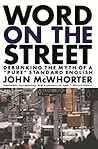
  • ‘Word On The Street: Debunking The Myth Of A Pure Standard English’, by John McWhorter – book essay

    Word On The Street: Debunking The Myth Of A Pure Standard EnglishWord On The Street: Debunking The Myth Of A Pure Standard English by John McWhorter

    My rating: 5 of 5 stars


    Sometimes, the courage to express my thoughts in English as a second language meets with insidious challenges between the grammarian Scylla and fault-finding Charybdis, lurking in the safety of anonymity on social media to stalk the prey with perverted joy. So, it is only natural for me to find encouragement from the books reassuring me that the mastery of language does not equate with intelligence. So, it is no wonder that I have the pleasure of reading  Word on the Street, an invigorating narrative told in scholastic zeal and impressive erudition flavored with street-smart audacity. McWhorter, who belongs to the constellation of brilliant linguists, such as Samuel Johnson and Steven Pinker, talks about language in terms of social and cultural contexts, making the academic subject a hot topic of a Charlie Rose talk show.

    McWhorter takes his view against language relativism that language shapes thoughts. The possession of words does not determine the thought process to contextualize the mentalese. Therefore, slang, idioms, and parlance outside the elite group of society and the educated middle class are not denigrated as improper English. In this sense, Pidgeon English, the quaintly charming admixture of scattered English words and a speaker’s native language, is not a corrupt version of pristine English but a hybrid of languages born out of the ingenuity of the human mind and changeability of language in nature. Isn’t English a living proof of the incredible amalgamation of languages still undergoing evolution? Who would have thought that English of the underclass would shine as a lingua franca?

    What strikes me most about the book, which concurs to his fellow linguist Pinker’s point of view on language not as a touchstone for one’s cognitive ability, is that solecism in spoken and written language does not reflect the user’s less desirable trait of academic ineptitude. To put it more bluntly, just because your grammar is besotted with errors doesn’t mean you don’t know what you are saying, or forthright, you are less intelligent. Take Leonardo da Vinci, the Renaissance polymath, who had no fewer than six grammar books on Latin and Greek to grasp the syntax of the classical dead languages he was so hopeless to learn thanks to his lack of formal education. In fact, da Vinci’s writings are ridden with misspellings and amorphous sentence fragments, just as Leo Tolstoy, Jane Austen, and Emily Bronte showed in their manuscripts. So, did their imperfect language skills overrule their force of imagination and contextualizing it in words? Does this betray that language shapes thought? 

    McWhorter can transcend the demarcation of race in the communication of this extensive knowledge about the subject drawn from a wealth of learning and scholastic industry with urban wit and debonair guy attitude to his readers, academic or general. His intelligence freely crosses over time gaps, chasms between class divide across continents and oceans with a universal theme of words that we, as human creatures, have spoken thus far. And he tells it using full of scintillating metaphors, examples, and anecdotes, which helps the reader comprehend otherwise monotonously academic subject without pressure and enjoyably. Samuel Johnson said that the possession of knowledge is to share it, and the possessor of the knowledge shines when he applies the knowledge to the crowd of life. Well, Word on the Street shows it all.


    View all my reviews

  • vertigo of words

    Stokes_The-Passing-Train_WEB_cover

    Words inviting, the eyes accepted

    the spirit willing, the heart exalted

    the mind laboring, the brain revolted

    against the lust of learning to be learned;

    Woe was to her as her will yet essayed

    Amid the vertigo of cogitation whirled

    Like a never-ending merry-go-around

    Swiveling her head in pandemonium.


  • ‘Proust and the Squid: The Story and Science of Reading Brain’, by Maryanne Wolf – review

    Proust and the Squid: The Story and Science of the Reading BrainProust and the Squid: The Story and Science of the Reading Brain by Maryanne Wolf

    My rating: 4 of 5 stars

    The act of reading is a noble achievement of mankind that has been developed through a succession of ages; it is a collective biological, cultural, and spiritual progress because human beings were never born to read according to Maryanne Wolf in Proust and the Squid. Wolf guides the reader in the capacity of a learned cicerone to the ancient worlds of Sumer, Egypt, and Greece to show us the cultural history and the neurological development of reading through a succession of ages. Wolf’s provocative theory that we were never meant to be natural readers corresponds to Darwinian evolutionary theory in terms of its illuminating reconstruction of fundamental beliefs in the reading brain that we take for granted in this book about the magic and mechanism of reading.

    As the title of the book indicates, Wolf’s analysis of the history and development of reading encompasses the two dimensions in the reading process. – biological/neuronal as symbolized by the squid with tentacles of each different function vis-a-vis cognitive/spiritual by Marcel Proust, a French visionary writer who sublimated a reading experience into a sovereign miracle of transcendence into a spiritual realm. These two complementary dimensions in reading process are a testament to evolutionary traits of our reading brain and our innate spiritual essence that is our prerogative. Wolf starts with explaining the neurons and the brain structure responsible for decoding letters and grasping their meanings in coherent linguistic arrangements. We come to understand the context of reading by dint of retinotopic organization of the eyes and capabilities of neural circuits until the received information reaches the frontal lobe, the control room of all our cognitive activities. What seems to happen in a blink of eye is the grand beginning of a wondrous phenomena of human psyche from the moment of perceiving letters to passing over to the world of the book itself and mind of the writer. In fact, this reading brain is an epigenetic manifestation, which explains a modification in our genes can upend the whole functions of neuroplasticity (the ability of the brain to rewire the connections between neurons) and neurogenesis (the ability of the brain to form a new neuron). The epigenetic revolution in the brain started with the invention of writing in the form of Sumerian cuneiform developed out of accounting necessities. Then came the Egyptian hieroglyphs, the Phoenician, Linear B Script of Crete, the Greek, and the modern day global lingua franca English, and what’s more fantastic is that the evolution still continues in our time.

    The leitmotif of this book is to know the history and development of our reading brain, which are a remarkable collective human biological, cultural, and cognitive progress, and to preserve it against the prohibitive surge of the Internet on which we mindlessly surf the on-screen letters for instant information. Wolf’s concerns about the increasing dependency on the Internet for easy information relate to Socrates’ disagreement to the encouragement of reading at the time when the ancient Greece was in transition from the oral tradition into the written culture. It was not that Socrates was a Greek version of luddite against reading, but that he distrusted the effects of the written words to become internalized knowledge itself in the minds of readers because by reading, readers would absorb the letters without wholly understanding the gist of the meanings. The mutual misgivings of Wolf and Socrates are understandable, but I opine that they stem from the unfamiliarity of the new modes of learning at their incipient development. Just as Socrates were unfamiliar with the power of the written words as an unlocking key to the inner dialogue with the mind of the other, Wolf seems to magnify the manifest and latent dysfunctions of the Internet that can be used as an effective educational tool for spreading knowledge under sagacious guidance. For instance, nowadays volumes of classic literature can be retrieved from the Internet, let alone be downloaded as e-books on Kindle. Books are books in whatever form they are fashioned. A book is merited by its content, not by its design or form. Moreover, it’s up to the reader’s ability to merit the content of the book and to reach the most profound realm of spiritual experience, which Wolf seems to disregard.

    Perhaps, Wolf should have considered the case of Maximilian Kolbe, the Polish Roman Catholic priest who volunteered to die instead of a married Polish man in a Nazi concentration camp; he was all for the advantages of modern technological inventions, such as films and radios, to use them for the benefits of mankind under wise discretion, instead of worrying about the presumed dysfunctions. All of the human inventions are neutral, and whether or not they are harmful to our human enterprise boils down to our own wisdom and guidance of how to use them to our advantage.

    Written in a kindly tone of an altruistic scholar trying to explain the modus operandi of the reading brain and process as easily as possible, the book is not entirely intended for the uninitiated without  basic knowledge of neurological terms and the brain structure in the background information on the ancient civilizations. Also, Wolf’s frequent dichotomy between the Chinese language and the English language in attempt to differentiate the neuronal and cognitive functions in the mechanism of the reading brain is less effectual than her assumed efficacy, for the syntaxes of the two languages are not totally apples and oranges. It could have been more apt for Wolf to pinpoint a language whose grammatical structure is wholly different – say, Japanese or Korean belonging to the Ural-Altaic lingual family that also includes Turkish, Finnish, and Hungarian – from English of the Indo-European lingual family.

    Notwithstanding the dissension as aforesaid, the book is an informative guide to the history of how our brain has been geared to read through the ages, which speaks to the wondrous capabilities of the brain and the infinite varieties of the human mind that is always in progress of evolution. All in all, the book transforms an act of reading to an act of magicking in the panoply of the biological, cognitive and spiritual dimensions that creates the wonders of connecting us to the minds of the others in solitude, uniting us with the souls of the book, and thus making us a citizen of the world. For this reason, we become what we read, and we are never the same ones we were before reading the books of our choice. And Wolf wants to make sure we know of this secret magic of reading. That is the beauty of this book.