Tag: myth

  • Dokkaebi: the gullible goblin

    img_1901
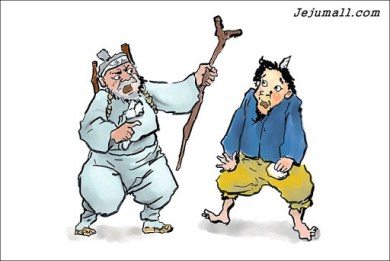
    Ireful old woodcutter castigating a not so menacing Dokkaebi

    The Dokkaebi is a mischievous, playful fairy-like spirit that is equivalent to the western counterparts of leprechauns in capricious temperament and of goblins in formidable appearance. The legend says it that an old broom made out of dried bush clover with bloodstains on will turn into a Dokkaebi, who will hold a spell over the mind of an unfortunate passer-by at night in the field or on the mountain. Befriending with a Dokkaebi can bring you a fortune at a house that he has lived as your protective spirit, but you must live there for precisely ten years only. Otherwise, the Dokkaebi will leave you with the ruins of your fortune and health. There are still people in Korea who believe this belief tradition by offering the Dokkaebi buckwheat cakes, spirited beverages, and steamed pork when they open businesses and move into new houses. Some people even report seeing them when walking alone in the thoroughfares or any lonely path where lights are dim at night between midnight and 4:00 am.
    main-qimg-603a724d0d501bab985518fa3c134c3f
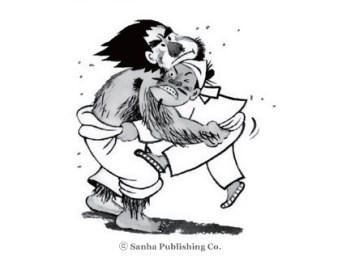
    A Dokkaebi likes to challenge a passer-by with a wrestling match.

    The Dokkaebi may seem to possess the caprice and whims natural to fairy-folk. However, it embodies the human characteristics of compassion, selfishness, naivety, shrewdness, durability, and formidableness. The Dokkaebi reflects the pathos of life indelibly embossed in the collective consciousness of the Koreans. They have endured the anfractuous national tragedies and yet maintained their unique language and culture.

    Faerie tales often belong to the days of yore before the advents of industrialization, and the fairies are either imaginative creatures or exaggerated figures of fashionably esoteric religions in the west. Still, the Dokkaebi is a living spirit in the minds of the Koreans and has wept and laughed with Koreans.
    kim-jung-gi2-444x356
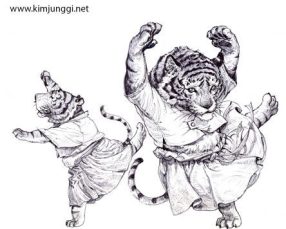
    A tiger is a Korean totemic animal that can mimic human voices.

    P.S. This post is my solipsistic response to #FariytaleTuesday, whose theme for today is the Asian fairies/spirits in folklore. The community is inundated with the wondrous tales of Japan and China but scarcely Korea. Koreans, like the Irish, love to talk and laugh with precious human sentiments, which result in the creation of the Dokkaebi. The Korean culture, as evidenced in the language, is closer to the cultures of the Ural-Altai language family, including the Finnish, the Japanese, the Turkish, the Hungarians, and the Mongolians.  Since there seems to be a scarcity of Korean spirits represented in the tweets, I felt responsible for writing about this playful Korean spirit with human characteristics.

  • False histories

    183-1830697_cliparts-free-download-clip-art-carwad-net-history

    History is a nonfiction narrative that reads like a novel, packed with actions, emotions, and characters, in the discovery of the universal human traits; it is both considered as parts of Humanities and Social Sciences in modern academia with the beauty of literature and the authority of science. That is why history is the most potent basis of political tool for manufacturing ideology in the form of a myth. Nazism was the proverbial example of the myth as an effective propaganda that called for the unity of the Germans. But the building of myth is not confined in the Germans; it’s an in-vogue political trend across the Seven Seas, which shoehorns ambitious political ideology into a suitably fashionable story of national pride and beguiling ethnocentrism.

    Historian Michael Wood’s article “Dangerous Histories” in this month’s BBC History is the most apposite to such current revisionist view on history. In the article, his example of India, where the rise of the Hindu nationalist movement imbibes the populace with the mythical Hindu past that was claimed to be distorted by medieval Muslim conquests and British colonialism, bespeaks a danger of rewriting an untruthful history without objective facts, tempered by blind jingoism and askew ethnocentrism. In fact, such revisionist rewriting of history contributes to a powerful social cohesion of the populace  in times of national crisis. It’s really a case of mass mind-control by means of myth, the imagined history tinged with false patriotism and insular outlook on the world.

    History is a collective narrative of a people who have been together through thick and thin, warts and all, sharing the same culture in the same place for centuries. Thus, it shapes the sense of identity of the people among others. However, if history serves to berating peoples of other nations to claim its own cultural superiority over them and therefore rightful subjugation of their cultures, then history as the factual subject in the academia loses its force of truth and becomes no more than a propagandist manifesto of jingoism. Let history be history, not a legend. Maybe it is high time we invoked the spirit of the ancient Greek historian Thucydides, who put forward factual and empirical elements in historical narratives.

    저장