Tag: Nature

  • Inside American’s Tomb for Illegal Wildlife Trade

    RE: July 16th, 2018 article of “On the Grounded in Commerce City, Colo. : Inside America’s tomb for illegal wildfire trade by David Kelly of the Los Angeles Times

    Imagine the vistas: a cornucopia of a mounted tiger fetus with its tiny ears, a grand giraffe head, a pair of shiny python skin-made thigh high boots, a black bear’s toes coupled with its gallbladders, and many more artifacts made out of animals that will never cease to blindside your vestige of humanity and overawe your tactile senses. If your mind tells you to think that the imagery is but a visceral affectation of a surreal painting of Salvador Dali, you just think yourself awake in the stupendousness of dreamlike morbidity. They are just a few illustrations of taxidermic animals confiscated in the course of international illegal trafficking of endangered animals exhibited in the National Wildlife Property Repository (the “Repository”) located in Commerce City, Colorado.

    My opinion on the report of the Repository as to its existence and nature is threefold: First, I can’t believe that there is such a horrendous and macabre exhibition of the animals killed and stuffed – and in the shoddiest way – open to the public, especially aimed at school students. Second, the grim underworld of a huge illegal trading market where a great demand of the coveted animal products is constantly met with a colossal supply of the dead animals is a stark reality even in this age of technological supernova. Third, it shudders me to think the wantonness of avarice and gluttony for which the sinners would find themselves in the third and fourth circles of Dante’s Inferno. What’s more, the fact that the Repository of such abhorrent kind is located not in the outpost of civilization where the artifacts of the sorts would be regarded as a cultural tradition but in Commerce City in Colorado chills me to the bone.

    It is reported that the purpose of the Repository is to educate the public on the gravitas of poaching and trafficking of endangered animals systematically perpetrated in global criminal syndicates of Chinese origin active in South Africa. However, I am concerned about the effects it intends to produce, however noble it may seem, which will likely work at cross-purposes, even counter-productively, pace its original intention to raise social awareness and ethical context of the issue. It might be all over but the shouting that rather than promoting awareness of destruction of the ecological system and its inevitable adverse impacts on mankind as well as the nature itself, the sight of the mutilated dead animal bodies and/or parts may be regarded as a freak show for those who have bizarre tastes of necrophilia and/or sadism emanating from the perceived sensual pleasures of watching animals torn apart from rib to rib, ear to ear, or head to toe in perpetual torture.


  • The Rise of Fido : Book review on Dogs by Raymond Coppinger

    513eG+OX1CL._SX329_BO1,204,203,200_Dogs: A New Understanding of Canine Origin, Behavior and Evolution by Raymond Coppinger

    My rating: 5 of 5 stars

    We claim to love dogs, and yet we know so little about them. We long for their unconditional affection, but we are ignorant of their needs and our faults altogether. Moreover, we like to think dogs as wolves and believe it so. Since I am a kind of person who says hello to a dog I encounter in the streets, this book caught my eyes and mind to know more about dogs, a beautifully different organism worthy of our attention and care, and to find out how they got their way based upon scientific and cultural examinations of dogs.

    Faculty_RayLornaCoppinger_011_300-237x300
    Raymond and Lorna Coppinger with their fido friend courtesy of google

    This book, written principally by Raymond Coppinger, professor of biology at Hampshire College, a former sled dog racing champion, is unique among many other books about dogs I have read in terms of its scientific bases of anthropological and behavioral studies of canine familiaris, i.e., the dog. The most significant fact about this book is that the author forthwith and forthright argues that dogs are not direct descendants of canis lupus, the wolf. Furthermore, he counters Darwinian evolutionary theory based upon the three factors of anthropological evidence, behavioral ecology, and Belyaev’s tamed foxes.

    dex
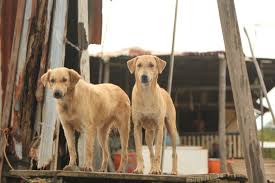
    Pemba Village Dogs courtesy of marinebiologist.com

    To begin with, the author takes readers to to a village of Pemba, an island off the East African coast in the territory of Tanzania, where the inhabitants still live on a boundary between hunting-gathering of the Mesolithic period and agriculture of the Neolithic period. In Pemba, dogs exemplify village dogs with a prevalent display of the uniformity of shapes, sizes, and colors of the coat, all of which indicate isolated gene pool untainted by any other strain of dog that would introduce a variation in appearance. The Pemba village dogs have co-habituated with their human inhabitants by choosing a niche close to human existence as a place of steady supply of food, safety, and reproduction. This leads to a conclusion that they are the descendants of the first evolved domestic dogs from the Mesolithic period of human history.

    Belyaev_foxes
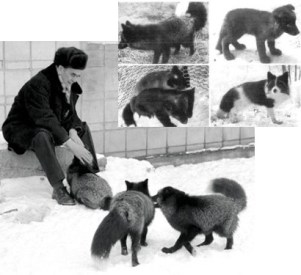
    Dmitri Belyaev and his tamed Silver Foxes courtesy of es.turopedia.com

    First, people created a new niche called the village. Then some curious wolves came to the niche and gained access to a new food source. These wolves adapted to this new convenient niche are “genetically” predisposed to show less “flight” distance than those of their wild peers and become tameable. A Russian geneticist named Dmitri Belyaev’s long term experiment with the Russian Silver Foxes corroborates this domestication process: after 18 generations (36 years on our evolutionary clock), the foxes became naturally tamed and remarkably resembled dogs in appearance and temperament.

    domestication-and-evolution-41-728
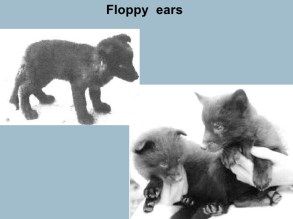
    Characteristics of  juvenile features of wolf pups courtesy of evolution-slideshow.net

    Moreover, Coppinger ardently disagrees to the wolf-turned-dog theory. Rather, dogs descended from a “wolf-like” species that became extinct is their paramount contention to the widely accepted opinion. In addition, dogs possess characteristics of neoteny by retaining wolfish juvenile shapes and features, such as round and short facial shape with floppy ears, and care-soliciting behaviors into adulthood. That is, by keeping the cute and lovable appearance of wolf puppies into adulthood, the behavioral developments of dogs still remain in perpetual juvenile stage, which makes themselves well adapted to the human inhibition and thus able to survive in their niches for their safe existence.

    1a254e2871ced71d4b2d38a9b598403e
    A Little heartbeat at my feet courtesy of naver.com

    Dogs are one of the fewest animals who share our lives and require our tender attention and care for the reasons concerning the above and most of all, the feelings we get when we see the eyes of dogs that are so soulful and insightful. We need to take a close look at our canine fellow creatures in their true form based upon their biological needs and behavioral tendencies, to love them as they are, and treat them as a wonderful creature of nature that has been with us for so many years in our human history.

    Don’t forget the little heartbeat when a dog is at our feet. Never forget that they are only dogs.