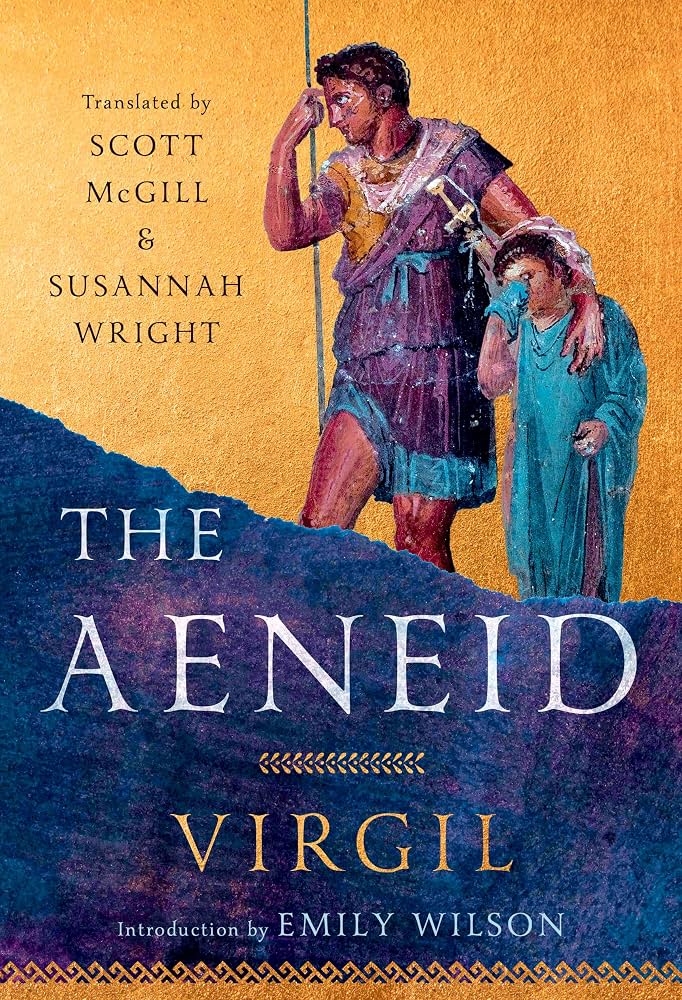
First, let me confess that I have not yet read the translation of The Aeneid by McGill and Wright. Maybe I will after I finish reading Robert Fagles’s translation. So, while it would be unfair for me to judge which translation better serves readers of the twenty-first century, I can say that Fagles’s translation of Virgil’s epic narrative of Aeneas reads like a prose poem to me, simply because its language and arrangement suit my taste.
This essay is not for general readers but for readers with an academic background in Latin. Therefore, for general readers such as myself, its comparison of the original Latin with the English translations—in terms of metrical structures, the choice of words, and their juxtaposition—may not ring a bell. My interest in reading The Aeneid comes from a purely personal curiosity: I want to understand why Aeneas is the way he is, breaking the hearts of the women who loved him dearly. In that regard, Fagles’s translation chimes the bell of my heart and soul because his words are poetic and, at the same time, go straight to the heart. Take a look at these translations:
Fagles:
“Wars and a man I sing—an exile driven on by Fate,
he was the first to flee the coast of Troy,
destined to reach Lavinian shores and Italian soil.”
Robert Fitzgerald:
“I sing of warfare and a man at war.
From the sea-coast of Troy in early days
He came to Italy by destiny
To our Lavinian shores,
A fugitive, this captain . . .”
McGill and Wright:
“I sing of arms and of a man displaced
by Fate, the first to leave the coast of Troy
for Italy and its Lavinian shores.”
Fagles’s version of “Wars and a man I sing . . .” clearly expresses Virgil’s intention to sing about a man destined to put duty before feeling. By placing the mainstay of The Aeneid—the fate of the man—at the beginning, Fagles conveys to his readers that Aeneas was not born to be a romantic figure, or even a heroic star, but to be a man torn between what he wants and what he must do.
Through Fagles, we hear Virgil sing of Aeneas, a demigod and an excellent soldier: the embodiment of the Roman ideal, whose pietas and gravitas signify personal virtue as well as martial prowess. But Virgil was not a soldier; he was a poet. Bernard Knox, however—the classicist who wrote the introduction to Fagles’s translation—brings the crack of a horsewhip to it. A former U.S. Army captain and World War II veteran, Knox had literally followed in the footsteps of Antony and Octavian during the Italian campaign. He must have carried Euterpe and Calliope with him—the Muses who had also stood behind Virgil thousands of moons before.


You must be logged in to post a comment.