Tag: readers

  • The Ghost Generation

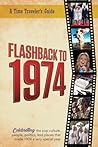
    Flashback to 1974 – Celebrating the pop culture, people, politics, and places.: From the original Time-Traveler Flashback Series of Yearbooks ― news … 1974. (A Time-Traveler’s Guide - Flashback)

    Flashback to 1974 – Celebrating the pop culture, people, politics, and places.: From the original Time-Traveler Flashback Series of Yearbooks ― news … 1974. by B. Bradforsand-Tyler

    My rating: 5 of 5 stars

    I always think that people born in the 1970s are in-betweeners. Visible, yes, but not conspicuous. It’s the transitional generation, crossing over the boundaries of the 21st and 20th centuries like faerie children, hybrids of yesterday and today. The last generation of the 20th century fully lived and ended in the new era. And it’s hard to encounter them in reality for some mysterious reasons. It makes one feel like a changeling among new and newer waves of generations.

    The choice of this book is, therefore, something akin to encountering an acquaintance among total strangers in a strange land, even if such excitement is not reciprocated. The 1970s was when the world we know now began to form its familiar landscape with the birth of new words as society became more technologically advanced and culturally enhanced. Here is a list of the terms we use, like commodities born in 1974: Touchscreen, telecommute, supermom, CT Scan, memory card, transgender, wake-up call and GOTCHA.

    It’s not about being proud of my generation or criticizing their generations. It’s about the generation I see as half visible and half invisible, especially in the current workforce, from law firms to the entertainment industry dominated by millennial babies. Of course, Watergate and the inflations from the oil shock imprinted on the generational pictures, but those born in the 70s grew up to enjoy the privilege of fully appreciating the digital age and its conveniences in every aspect of life. The Who’s “My Generation” should be the soundtrack of my generation.

    People try to put us down (Talkin’ ’bout my generation)
    Just because we get around (Talkin’ ’bout my generation)
    Things they do look awful cold (Talkin’ ’bout my generation)
    This is my generation
    This is my generation, baby

    GOTCHA.


    View all my reviews

  • ‘The Time Traveler’s Guide to Elizabethan England’, by Ian Mortimer – review

    The Time Traveler's Guide to Elizabethan EnglandThe Time Traveler’s Guide to Elizabethan England by Ian Mortimer

    My rating: 5 of 5 stars

    People tend to make an anachronistic mistake of assuming that their times are more culturally and socially superior to their previous generations’ times, whereas forty years on an evolutionary scale amounts to a million second on a twenty-four-hour clock, the amount so infinitesimal that it makes you smirk. What makes us set apart from the predecessors of our human civilization is not how they looked but how they looked at the landscapes surrounding their everyday lives, which led to the creation of the ethos of society peculiar to the different historical periods of time. This Thucydidean approach to history as a branch of social science as well as humanity strikes the chords with Ian Mortimer’s perspectives on his Elizabethan ancestors in his scintillating book, The Time Traveler’s Guide to Elizabethan England.

    Rich in details and splendid in descriptions that successfully and naturally resurrect the period, Mortimer’s vividly atmospheric accounts of the era transform the people and the landscapes of Elizabethan England from one-dimensional textual elements to animated figures in his engagingly vivacious narrative that strut in the mind’s theater of the reader, commanding attention in every chapter in a way that looks virtually real, evoking a phantasmagorical display of the periodical images. Mortimer is a knowledgeable and witty guide well versed in the English Renaissance with a practical sense of reality, which makes him something of Dr. Who, who pitchforks his wide-eyed volunteer reader to the subject time and then materializes when the reader is in a pickle. He shows the reader both the beauty and the beast of the Elizabethan society at its core with his wealth of knowledge drawn upon extensive research on the period and general erudition without putting a supercilious air of a highly learned man and stands in awe with the reader of the cultural and social progresses of Elizabethan England that began to define the “Englishness,” with which we tend to associate when the name “England” chimes the bell of literature, religion, and geography, all in the collective image of being “English.” Mortimore does this wonderfully with his engaging narrative skills that will not make you bored and skip a page.

    Mortimer as a literary Dr. Who aims to bring the gaps of time and space between the reader and the populace of Elizabethan England to elucidate his stance on the truth about unchanging human nature wrapt in a periodical costume; in fact, history is a branch of literature made by artificers and artists with stories full of events, persons, and places that are woven into a tapestry of time, which also reflects how we have become what we are. In light of this, Mortimer is a cross between Herodotus with his entertaining narrative skills and Thucydides with his objective analysis of the historicity of society and culture. At the end of the book, the reader will find William Shakespeare, one of the most notable figures of Elizabethan England, holding up “a mirror to Mankind and shows people what they really are.” This is a cracking read packed full of interesting tidbits on the ways of life in Elizabethan England which he relates with wonderfully lucid insights into the turbulent but magnificent era that marks an indelible landmark in the history of England, and ultimately, of the world.

    View all my reviews