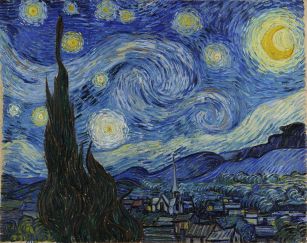
It is the star above her that governs her conditions. Iris knows that the fault is not entirely in herself but mostly in the lucky star that does not seem to know where to find its beneficiary. The star was born when Libra and Capricorn were met in the house of Aquarius on the nineteenth hour of a blustery snowy wintry night. The star hangs on the vault of nightly celestial ballroom among the other stars twinkling merrily and boldly but alone in a corner of the limitless dome, twinkling ruefully and dutifully as if it were trying to signify its insignificant presence on the nocturnal cosmic stage. For this lone star has not found its beneficiary, the ascribed terrestrial hair of its power, and without it, the star cannot become a lucky star. Which is a tragedy for both Iris and her star.
In fact, Iris’s existential frustration or noogenic neurosis agrees to what Shakespeare was suspected of harboring in all his life. Surely, the Bard was a very successful playwright and poet who marched in a parade of famed hits in his time, but he was wrestling with a doubt whether it was Fate or Freedom of Will that governed human lives as conveyed in his works, such as “Julius Caesar”, “Othello”, and “Hamlet”. The characters of these plays fight for their causes as masters of their fates, but the consequences are not entirely fortuitous in bliss. That’s why the Greek soldier and historian Thucydides regarded vain hope imbued with a paroxysm of flattering confidence and blind devotion to the law of attraction as a dangerous hubris to one’s philosophy of life.
Hope plays its role as a morale booster when one sees it as a card of chance in awareness of odds in one’s favor. In this manner, one does not have to think about it but can fight with every hope of winning. This also relates to a principle of Logotheraphy: the less one cares, the more one can without stress for success. But alas, my dear reader, to pour lead into the wound, all the aforesaid needs luck as the Bard chips in thus: “There is a tide in the affairs of men, which taken at the flood, leads on to fortune.” A tide of the deep wide ocean of Life that arises from the heart of the ocean to surge in bounty of fortune to a weary wayfarer on the land is what Iris has been waiting for till now.
All this thought, all this doubt about her so-called life – the existential frustration- are vexing her mind and crippling her faculties of the mind like vermin, so much that she feels utterly disoriented and deserted in the crossroads of life. The faith she has begun to lose with reasons justifiable only to herself, meaning of life she still hasn’t found, Iris finds herself lost in the Labyrinth where the Minotaur is roaming around to find his prey. And she does not have the hero Theseus nor Ariadne for help. Iris must find the way out anyhow for her dear life. But one thing is certain my dear reader; that although fortune’s malice or absence might conspire to overthrow her state, her feisty and recalcitrant mind will eventually exceed the compass of her will of fortune with a triumphant laugh.

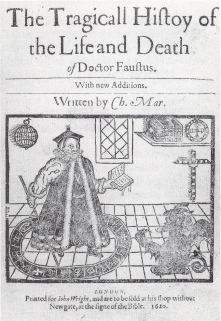 He was a formidable agent provocateur: a blasphemous rebel, a proud atheist, a counterfeit, and a sybaritic seeker of tobacco and boys and an alleged spy for the government with his literary arsenal and daredevil machismo toward life. It was no less a dramatist, playwright than Christopher Marlowe, who introduced the concepts; a man whose life was staged so mysteriously and controversially that even his death was enveloped in a provocative imbroglio of factoids. In a case of life imitating art, Marlowe’s life was an epic tragedy for a literary enfant terrible struggling to mark his name in the Elizabethan England, where his literary genius and individualism were something of irreligious decadence to be reckoned with. Marlowe’s version of Dr. Faustus was his testimony against conventional absurdities of life in defense of his existential meaning of life, and there’s his outcry of existential dilemma spreading through the mind of the reader and connecting to the world of Marlowe.
 The witching hour was nearing to cast its spell on the night under the aegis of Artemis, the goddess of the moon, and the passengers on the last train to East Ventura were inwardly invoking the power of Patience for a high hope for a low heaven – they all just wanted to go home after a hard day’s work, and no more. These aggregates were all bound by the same fate of being held up as hostages to the less practical and more unnecessary delay due to their inapt handling of one unruly passenger on board at Moorpark Station. The force of one unruly passenger carried the aggregates over the edge of their collectively simulated sanity and suspended their precious time to be spent at home. This nightly act of daily drama in the life of a commuter was in fact a repertory regularly put on stage by a company entitled Metrolink. It was performed yet again last night for an hour. Without Applauds, of course.


You must be logged in to post a comment.