Tag: virgil

  • Reading Book II of the Aeneid by Virgil

    Thursday, September 10, 2026

    I often wonder why God allows the ills of society to persist and their victims to suffer violence for no reason. What are the sins of children who suffer such violence? Why can’t he care more about changing the fates of these children? The same question arises through Aeneas in Book II when he sees his beloved Troy burning and, with a yearning heart, seems to demand an answer. If fate requires suffering, what is fate? Is God truly omnipotent and omniscient?

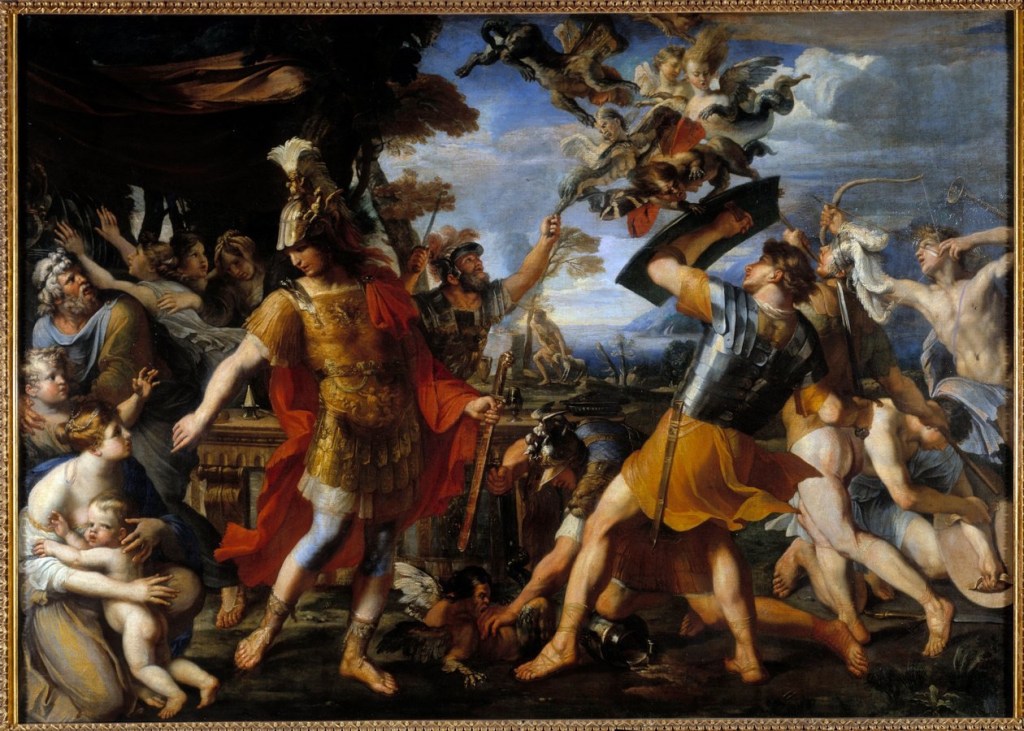
    Book II is Aeneas’s ballad of burning Troy—the story of his fate, which does not allow him to enjoy the ordinary life of a married man. His life doesn’t seem to be protected by the gods, even by his divine mother, who appears to her son as Venus, not as a mother. They force him to fulfill sacred pietas by carrying Troy’s future to foreign soil, where his descendants will build Rome. He tries to resist their gambit on the chessboard, where he is their number-one knight, moved around at their pleasure. Even his mother Venus is part of the divine ilk and hurries him out of Troy like a mom sending her son to school before it’s too late. In Aeneas’s mortal eyes, the idea of becoming the forefather of Rome appeals to him less than being a husband, a father, and a son at home. Can even his divine mother protect him from this fate?

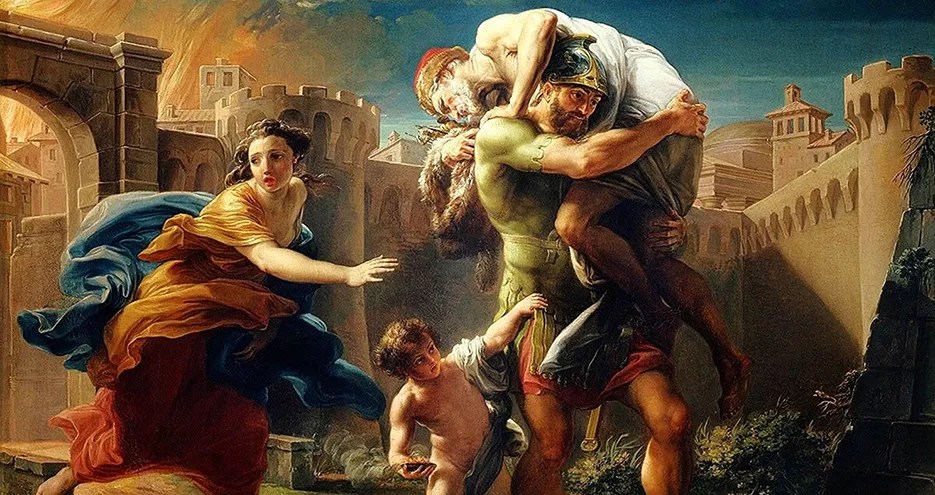
    Gods are cruel just as God is cruel. They make his life easy only when he acts according to their will. Without the gods’ command, Aeneas would not have thought of fleeing the burning city with his elderly father Anchises on his back, his little son Ascanius at his right hand, and his wife Creusa following behind. But then Creusa must stay away from her husband, who has a duty far greater than his personal life. Her ghost appears and tells Aeneas that he must leave; as she vanishes into the folds of mist, all his chances of escaping his fate and its burdens vanish with her. He has no reason to stay but must move forward against his will.

    The Trojan Horse, Laocoön and his two sons engulfed by the sea serpents, and the cries of Priam and his wife Hecuba all signify the great labor of birth in the process of dying, all within the fate of a man who must act out his assigned role in the divine chess game.

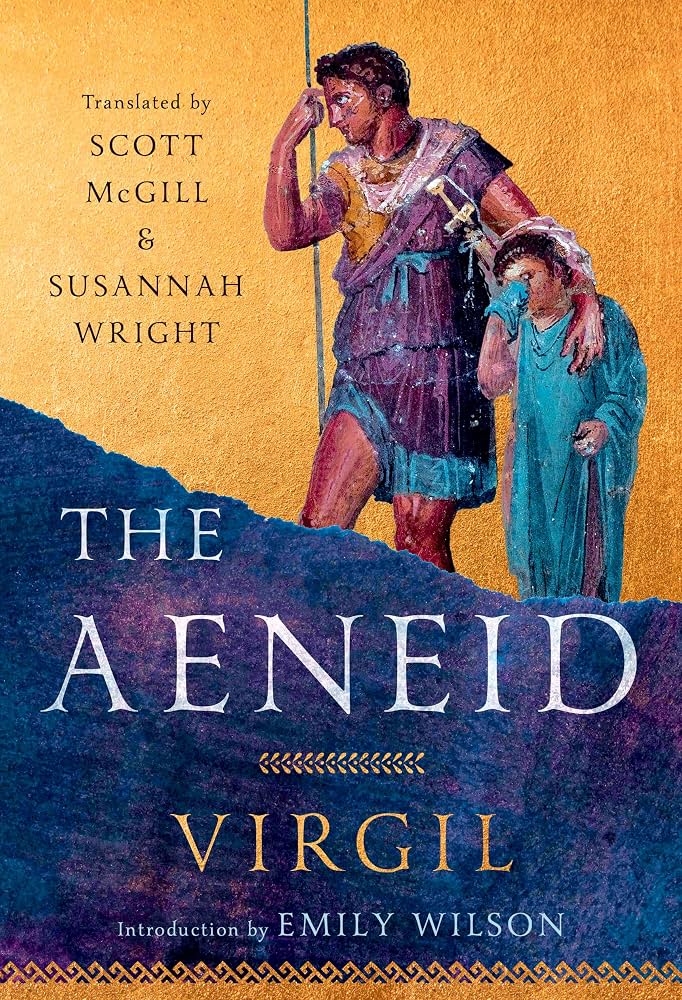
  • Reading on A Review of the Aeneid, Translated by Scott McGill and Susannah Wright, by Deborah Warren

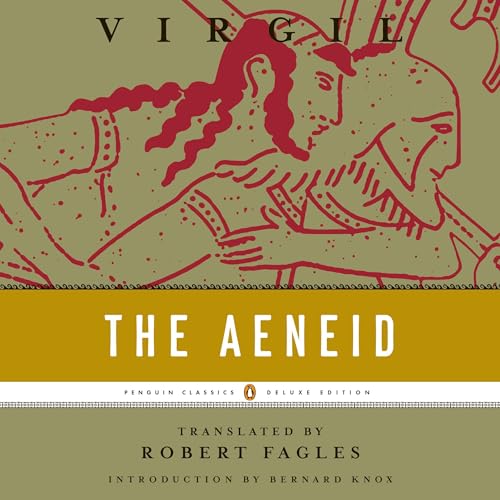
    First, let me confess that I have not yet read the translation of The Aeneid by McGill and Wright. Maybe I will after I finish reading Robert Fagles’s translation. So, while it would be unfair for me to judge which translation better serves readers of the twenty-first century, I can say that Fagles’s translation of Virgil’s epic narrative of Aeneas reads like a prose poem to me, simply because its language and arrangement suit my taste.

    This essay is not for general readers but for readers with an academic background in Latin. Therefore, for general readers such as myself, its comparison of the original Latin with the English translations—in terms of metrical structures, the choice of words, and their juxtaposition—may not ring a bell. My interest in reading The Aeneid comes from a purely personal curiosity: I want to understand why Aeneas is the way he is, breaking the hearts of the women who loved him dearly. In that regard, Fagles’s translation chimes the bell of my heart and soul because his words are poetic and, at the same time, go straight to the heart. Take a look at these translations:

    Fagles:

    “Wars and a man I sing—an exile driven on by Fate,
    he was the first to flee the coast of Troy,
    destined to reach Lavinian shores and Italian soil.”

    Robert Fitzgerald:

    “I sing of warfare and a man at war.
    From the sea-coast of Troy in early days
    He came to Italy by destiny
    To our Lavinian shores,
    A fugitive, this captain . . .”

    McGill and Wright:

    “I sing of arms and of a man displaced
    by Fate, the first to leave the coast of Troy
    for Italy and its Lavinian shores.”

    Fagles’s version of “Wars and a man I sing . . .” clearly expresses Virgil’s intention to sing about a man destined to put duty before feeling. By placing the mainstay of The Aeneid—the fate of the man—at the beginning, Fagles conveys to his readers that Aeneas was not born to be a romantic figure, or even a heroic star, but to be a man torn between what he wants and what he must do.

    Through Fagles, we hear Virgil sing of Aeneas, a demigod and an excellent soldier: the embodiment of the Roman ideal, whose pietas and gravitas signify personal virtue as well as martial prowess. But Virgil was not a soldier; he was a poet. Bernard Knox, however—the classicist who wrote the introduction to Fagles’s translation—brings the crack of a horsewhip to it. A former U.S. Army captain and World War II veteran, Knox had literally followed in the footsteps of Antony and Octavian during the Italian campaign. He must have carried Euterpe and Calliope with him—the Muses who had also stood behind Virgil thousands of moons before.

  • The Aeneid — Book I Reading Note

    Version 1.0.0

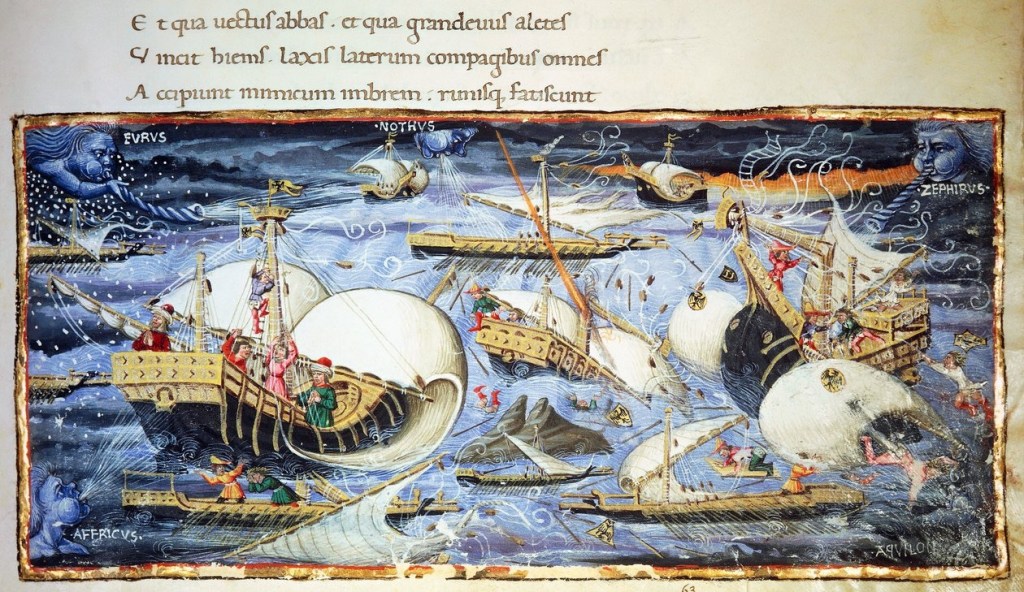
    Book I begins in the middle of Aeneas’s journey to his fated destination of Italy. Virgil seems to sympathize with the man who surrenders his personal feelings to the public duty of building a new Troy, as arranged by the Fates. Gods can interfere but cannot change his fate. It’s a case of Thus Spoke Zarathustra—but who is Zarathustra here? Aeneas, or Virgil speaking through him?

    If it’s Aeneas who speaks, then he does so through Virgil as his advocate for the glory of fulfilling pietas with gravitas. Cupid is not for him, but for Dido, who became enamored with a man whose vulnerability was braided with virility, clothed in beauty. Then Juno’s absurdly violent rage against the Trojan general, who laments his fate, forces him to wander across the seas through the vicissitudes of gain and loss, loss and gain. But that doesn’t mean Aeneas is a man of steel, because when Venus appears to him in disguise as a wanderer, he rebukes her for behaving like an immortal rather than a mother, even when she is trying to help her son.

    Book I presents Aeneas as a man who agonizes over the conflict between his desire and pietas, born of a mortal father and an immortal mother. It is the dual nature of man: physical and spiritual. This could later be applied to the Christian teaching that the will is strong, but the flesh is weak. In Virgil’s view—his imagination still cloaked in the Republican toga, albeit under Emperor Augustus—Aeneas was the model Roman man and soldier who placed honor and valor before beauty and love. He was Virgil’s kind of man, one who would build the grandeur of Rome.

    Book I ends with a scene in which Dido, the queen of Carthage—Juno’s beloved land—is infatuated with Aeneas after Cupid sprinkles powdered amour upon her. This is Venus’s machination to secure protection and refuge for Aeneas and the Trojans. Would this be a plot of Fate too? Then, does it mean that Venus is also a gambit in Fate’s chess? Then, what is the meaning of living a life in the mirage of hope?

  • Thursday, August 27, 2026 – Entering the Virgilian lottery (Reading Day)

    I am reading The Aeneid by Virgil, translated by Robert Fagles. Today I set off for Italy as a ghost to find the faults of the man who was irresistible to women and to examine his fate: everything seems to exist to fulfill his destiny—to found a city that would one day lead to Rome, whose influence would last for thousands of years. But then I see the image of him carrying his old father on his back, with his young son Ascanius at his side and his wife Creusa behind him as they flee burning Troy. That is why I have always wanted to know more about him. Is he really an egoist or a victim of fate?

    But first, I needed to know about the whys and wherefores of the man, Troy, and Italy. Reading the introduction was necessary. This was unusual for me because I usually skip introductions and read the book with a tabula rasa in order to form my own understanding of its content. Not the Aeneid. Not Virgil. Not Robert Fagles. For me, The Aeneid, Virgil, and Robert Fagles form a trinity. The epic has survived for two millennia. A second trinity shaped Aeneas’s identity—pietas (duty), gravitas (seriousness and moral weight), and auctoritas (authority earned through public service). It is even tattooed into his very identity as pius Aeneas—“pious Aeneas.” This is not solely religious but also conveys a sense of duty toward values deemed admirable and essential to being an admirable Roman man and soldier.

    Knox told readers his own story about why the Sortes Virgilianae and Virgil’s work entranced him. He was also destined to become a reader and a soldier of Virgil, both literally and figuratively. As a U.S. Army captain during the Second World War, he and the Italian partisans marched through regions of Italy once crossed by the armies of Octavian and Mark Antony. King Charles I was no exception to the Virgilian way: during the civil war, he read Virgil and tried to discover his destiny by playing the Virgilian lottery. This involved picking a passage from The Aeneid at random and interpreting it in light of his own situation—a literary equivalent of bibliomancy. It was regarded not merely as superstition but as a guide to what might happen and what one should do. Of course Knox did it too.

    Now that I am finally aboard the ship with Aeneas as I begin Book I, I want to decide whether to try the Virgilian lottery and join the king and the captain. But first, I want to see whether Aeneas deserves my accusation that he is a heartless man who, under the aegis of his sacred pietas, makes the women who loved him—his wife Creusa and Dido—face their fates.

  • Prompt 31

    What principles define how you live?

    Ask any acclaimed mountaineers, such as Edmund Hillary and Reinhold Messner, why and how they climbed up the highest mountain in the world, Mount Everest. Their answers were simple: there was a mountain to climb, and they had to move forward. Likewise, here are my life’s three guides: imagination, creativity, and hope that accompany me in this life’s journey.

    I am a figure of paradoxes, contrasting light with dark, ideal and worldly, bright and melancholy. I see myself trapped in the Labyrinth of Crete, where the Minotaur lurks in the corner of the maze, waiting to ambush, yearning to eat me. (It is more poetic than being lost in a level of the dreadful Backrooms, as it were.) Normal is not default, and insecurity constantly stalks me like a haunting revenant, resisting departing this world that it longs to remain for an unfinished business. And yet, there is always this impalpable, mysterious sense of what-if flickering in its iridescent halo from a distance. So, I follow the light, walk forward, and never look back because moving forward keeps me alive. Didn’t Stephen Hawking also collaborate with it by saying that it is possible for humans to travel to the future but impossible to return to the past?

    Creativity is essential because it gives a sense of existence, of what it means to be a human. Viktor E. Frankl said three values shape a meaningful life, which are creative value, experiential value, and attitudinal value. I enjoy appreciating the artistic works of others and learning to accept who I am. But I am also delighted in creating my own creations, however good or bad they may be. Writing is such a means of expression by which I can express myself. It is fearful of disappearing like a speck of the world, and I am not nothing.

    I can imagine myself one day arriving as an acclaimed memoirist, diarist, or essayist. Novels are not my forte because I can’t write things I pretend to be or know. That is why I prefer reading nonfiction, and I like to think that I can write it well.

    Thus are my principles – or, more fittingly, my guides – in life. I am a Dante who imagines, a Virgil who creates, and a Beatrice who hopes through life’s journey.

  • On Ovid: The Exiled Poet in Woe

    oviduo

    People tend to think that the books of antiquarian authors are far-fetched from the reality of our digital era, whereas our calendar years on the evolutionary scale amount to microseconds on the twenty-four-hour biological clock. Apart from a great divide of time, great writers of all time show us the wounds and mirth at the heart of humankind and stand observant of the anfractuous human lives as though to be seen through opera glasses. In this respect, Ovid, author of Metamorphoses, can be regarded as an ancient trailblazer of popular literature whose subject matters, such as cause and effects of love and devotion, are still appealing to readers.

    Ovid first gained popularity with The Ars Amatoris (The Art of Love), a kind of self-help book for men on how to woo women and keep their love with practical tips under the guise of a formal didactic reference to avoid censorship. Heroines, a series of dramatic monologues centering on mythological women, including Penelope, Dido, and Ariadne, lamenting on their mistreatment at the hands of their men, earned him the sobriquet of best-seller writer of his time. However, what Ovid secretly and really craved was a learned readership vis-à-vis the reputations of his peers Horace and Virgil whose works were regarded in high intellectual esteem by the elites. Hence, Metamorphoses, a series of 250 stories of gods and immortals intertwined in a vortex of love, lust, grief, and terror, was his magnum opus, a kind of literary vindication of mass demotic literature. It seemed that Ovid as a man of flowering Roman letters arrived at his pinnacle of literary career until fortune’s malice overthrew his state.

    Ovid suddenly fell out of favor of the emperor and exiled to Toms, a city on the Black Sea. Whys and hows of Ovid’s exile are still clandestine to this date as Ovid also never recorded any details about what caused the emperor to banish him to the backwater of the empire. As with many a conspiracy story, there are hypotheses of the cause of this unfortunate event: (1) Ovid had a love affair with Livia, Augustus’s wife, while married with children; (2) Ovid knew of an incestuous affair between the emperor and his daughter Julia; or (3) the error might have been of political nature because Ovid might have gossiped about certain political factions. But then any of the above can be a figment of imagination.

    Notwithstanding the above, I like to think that Ovid is a great benefactor of mankind with his dazzling reworking of Latin and Greek myths and entertainingly vibrant guidance of practical love. In fact, he was far more gentlemanly in treating women regardless of their age and looks than any of our contemporary man writers are. To Ovid asking a woman’s age was highly improper and telling a woman of good things about her were a must to keep her love ongoing. In light of the above, none of the aforesaid presumptions rings true to me, and it is my presumption that maybe Ovid’s jealous contemporary despising the well-deserved success of Metamorphoses conspired against him and pushed him to banishment in the outpost of Rome, the city Ovid loved so much.