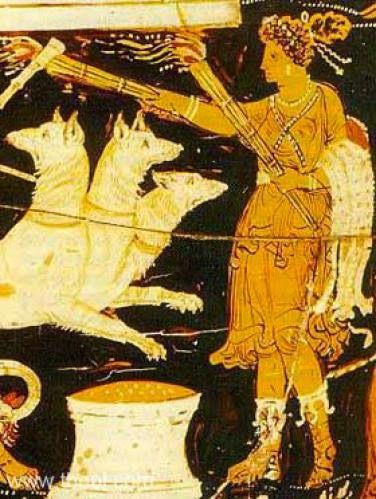
The curtain of the night has drawn. Selene has started her nocturnal promenade with a moon mirror carried on her celestial chariot across the starry highway. Then the earth begins to bellow with great silent roars, trees to dance with leaves rustling in the wind as the chariot is racing, owls to call with their wings flapping, and the hounds howl from the end of the horizon in the glimmering light of the distant stars like lamps flickering in the desolate wilderness amid the haunting sound of Pan’s flute yonder. It’s Hecate’s Time, the Wandering Goddess of Night, appearing from the crossroads with her faithful hounds, heralding the staging of their divine mistress.
Hecate has often been associated with all things witchery, magic, and death, not in the least due to modern-day Wicca practice identified heavily with the Greek goddess, but there’s more to her. She is a protector of the wrongfully accused, a goddess of retribution against injustice and impurity, and an advocate for underdogs. Perhaps, that’s why her animal is a dog, not a cat, which betrays a common association of the latter with someone like her. (In fact, Artemis is the only goddess whose animals are a cat because she was once transformed into it when chased by a besotted man.) Her hounds all have names: Kynegetis (Leader of Dogs from the Orphic Hymn), Kyneolygmate (Howling like a dog), Kynokephalos (Dog-headed), Kyon Melaina (Black Dog), Philoskylax (Lover of Dogs), Skylakitin (Lady of the Dogs). Of all the hounds, Kyon Melnia, aka Black Dog, used to be the wife of the last Trojan King Priam named Hekabe, who threw herself into the sea after the collapse of Troy by the Greeks. Hecate took pity on the queen and transformed her into a great black dog that became her familiar. What a manifestation of divine mercy it was.
It is said that dogs and cats see the spirits of the dead, especially at night. If you have heard a dog howling, another howl, then another, and so forth, as if all of them sing in a canine polyphonic coda. When Hecate’s hounds howl, mortal dogs respond to their divine canine entity as the goddess and her entourage pass by. The hounds also bring victuals offered to Hecate to their mistress at a cemetery where she partakes her daily victuals. So if you think it’s just an ancient myth, listen carefully when your dog or any dog within your earshot howls. It’s either it sees a spirit or Hecate and her nine hounds. For me, well, I have a tabby cat named Toro, and he sees it and them but won’t participate in the chorus because he has her mistress at home.


You must be logged in to post a comment.