Tag: writer

  • Saturday, September 26, 2026 – Saturday Reading of “Veronese’s Dogs” by Thomas W. Laqueur, published in The Public Domain Review on September 16, 2026

    The Feast in the House of Levi (1573) from Wikepedia

    When Odysseus returned home after twenty years of war and wandering, the first to recognize him was not his virtuous wife Penelope. It was Argos, his faithful hound, who greeted him and breathed his last after seeing his master once more. In Homer’s time, too, dogs must have been man’s best friend: loyal, devoted, and artless. So, it’s not new that dogs deserved recognition in art over time. Paolo Veronese, a Renaissance painter, joined this tradition by making dogs mirrors of human emotions and behaviors through their unspoken gaze. 

    Thomas W. Laqueur’s “Veronese’s Dogs” tells us what dogs represent in Paolo Veronese’s paintings, most of which depict colossal religious and moral scenes. Because the essay is excerpted and adapted from Laqueur’s own book, The Dog’s Gaze, this reading is like hearing the author’s mind directly, without another critic’s interpretation. Among the paintings he discusses, I am drawn to Veronese’s dogs as silent witnesses to the manifold human characteristics revealed when people are placed in moral quandaries. One that lingers in my mind is The Feast in the House of Levi. The scene shows Jesus at the center of a ballyhoo of raw human expression. Around him, the figures appear exaggeratedly excited and excessively vociferous: dubious-looking clerics and a copious assembly of porcelain-skinned characters displaying their wealth. Only Jesus and the dogs retain a serene, dignified composure, as if they were looking upon all human acts without interfering. Christ and the beasts. But who, then, appears impulsively theatrical, gesturing grandly, while the dogs look almost divine?

    But not everyone was pleased with Veronese’s artistic freedom, especially in The Feast in the House of Levi, so the Inquisition called him to replace the dogs with figures such as Maria Magdalena. But why on earth would she be in the Feast, even if she wasn’t there? But Veronese was braver than Galileo. Instead of removing his beloved canines, he added the inscription “Levi made the Lord a Great Feast” (Luke 5:29), and the painting became The Feast in the House of Levi. His wit saved the painting from a flaming stake.

    Animals do not speak human language. My cats do not speak, but they understand Korean and English. How I know is no mystery: they look happy when I come in from outside, bunting their little heads against my legs and looking up at me with their beautiful emerald and amber eyes. And that’s not all. When I tell them, “I love you,” they snuggle their soft, furry bodies into my arms, and I know they know. Veronese knew.

  • Thursday, August 27, 2026 – Entering the Virgilian lottery (Reading Day)

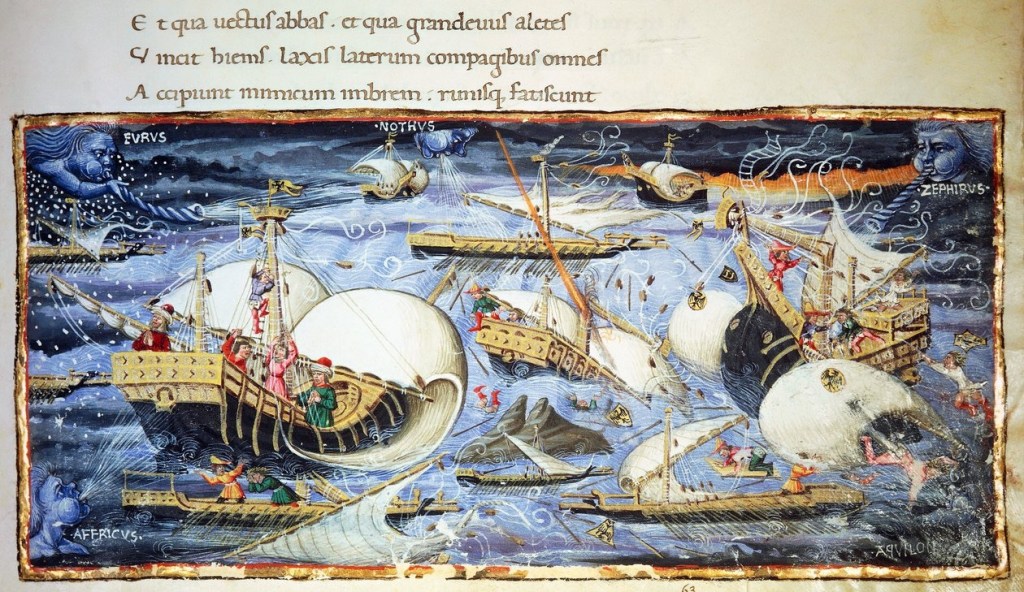
    I am reading The Aeneid by Virgil, translated by Robert Fagles. Today I set off for Italy as a ghost to find the faults of the man who was irresistible to women and to examine his fate: everything seems to exist to fulfill his destiny—to found a city that would one day lead to Rome, whose influence would last for thousands of years. But then I see the image of him carrying his old father on his back, with his young son Ascanius at his side and his wife Creusa behind him as they flee burning Troy. That is why I have always wanted to know more about him. Is he really an egoist or a victim of fate?

    But first, I needed to know about the whys and wherefores of the man, Troy, and Italy. Reading the introduction was necessary. This was unusual for me because I usually skip introductions and read the book with a tabula rasa in order to form my own understanding of its content. Not the Aeneid. Not Virgil. Not Robert Fagles. For me, The Aeneid, Virgil, and Robert Fagles form a trinity. The epic has survived for two millennia. A second trinity shaped Aeneas’s identity—pietas (duty), gravitas (seriousness and moral weight), and auctoritas (authority earned through public service). It is even tattooed into his very identity as pius Aeneas—“pious Aeneas.” This is not solely religious but also conveys a sense of duty toward values deemed admirable and essential to being an admirable Roman man and soldier.

    Knox told readers his own story about why the Sortes Virgilianae and Virgil’s work entranced him. He was also destined to become a reader and a soldier of Virgil, both literally and figuratively. As a U.S. Army captain during the Second World War, he and the Italian partisans marched through regions of Italy once crossed by the armies of Octavian and Mark Antony. King Charles I was no exception to the Virgilian way: during the civil war, he read Virgil and tried to discover his destiny by playing the Virgilian lottery. This involved picking a passage from The Aeneid at random and interpreting it in light of his own situation—a literary equivalent of bibliomancy. It was regarded not merely as superstition but as a guide to what might happen and what one should do. Of course Knox did it too.

    Now that I am finally aboard the ship with Aeneas as I begin Book I, I want to decide whether to try the Virgilian lottery and join the king and the captain. But first, I want to see whether Aeneas deserves my accusation that he is a heartless man who, under the aegis of his sacred pietas, makes the women who loved him—his wife Creusa and Dido—face their fates.

  • At the Harbour, Before I Know the Story

    Reading Day — Thursday, August 13th, 2026

    On Elizabeth Taylor’s A View of the Harbour

    My first time in the harbour: at the dock, standing in the sea breeze. English air. An unfamiliar coast, oddly familiar. But this is not a book about the cozy English sea town in a postcard.

    I have read only the first few pages of the book, and it has already given me its weather and atmosphere. I feel the harbour holding the secrets of the townspeople. I feel the sea carrying the flotsam and jetsam of life quietly and bringing them into the harbour—an always moving inside a never-arrival.

    The characters I have met so far are ordinary in the sense that none of them has that fierce individualism, existential malady, or anything that instantly piques the senses. But people may find pornography in Jane Eyre: the tension, the ache, the desire. They are not spoken but felt. People keep them in the mind, as if giving a voice to the forbidden would desecrate Jane Eyre.

    I think that is what the book wants us to see: what may seem ordinary on the surface, like a calm sea, hides a storm spiraling into a pillar of fury, discordance, and disorientation. I have not yet come to know the characters, except for Prudence, whose two Siamese cats love pushing their small heads against her legs. It is the cats that draw my attention to her, but she seems to have a story to tell as a beautiful young girl who does not act like a beautiful teenage girl.

    Prudence is Prudence: Quaker in name, puritanical in action. But she may turn out to be someone different from what I have seen as I progress through the pages, although I want her to remain as I see her now. I want her to be beautiful without being popular.

    That is life, isn’t it? Change is human, an uninvited grace. You want someone you like to remain the way you know them. That is what I want to know after I complete reading the book.

    The sea will remain the same. The harbour may not.

    — Stephanie Joori Suh

  • prompt returns

    Daily writing prompt
    What’s a promise you made to yourself that you’ve actually kept?

    I collect promises like Swarovski jewelry, from necklaces to earrings, to bracelets, and more. I love pretty things, so I change them, but it all comes down to a few select ones that I usually wear to my heart’s liking. So are my promises. There are many, but only a few of them remain, and one of them makes it out to a World Cup final.

    I have always wanted to write a book that I can leave as my legacy, just so to prove I have lived, that I, Stephanie Joori Suh, lived, saw, and wrote. The thought that one day my body will become a speck of dust or ashes gives me a panic attack amounting to losing my eyesight completely. The ancient Greek poetess Sappho also felt the same, as found in one of her surviving fragments. Besides, there is something in me urging me to write as it is my nature. My father once told me that he had the same urge to write poetry, as his mother did too. Maybe it’s in the genes, like a family of practicing ancient secret rites.

    What I have done is to write my first chapbook of poetry this year. It is a collection of poems I wrote from my East Coast years to the present West Coast years. I auto-published a short story before as a Kindle Read, but this is my first time submitting a poetry chapbook to editors of ten presses. Some of them are for chapbook prizes, and some are regular chapbook submissions. And… one of them sent me an email last Wednesday that they wanted to publish my chapbook. I do not want to open a champagne early until I have an actual chapbook of mine in hand. Still, I feel I am in the procession of poets from the misty past and continuing as long as humanity remains.

  • Mirror Lake


    Tonight, the sea is a sheet of glass,
    holding the moon’s timid face.

    “Don’t look at me—
    but don’t look away.”

    I lean toward her under the water,
    my face bruised with sadness,
    trembling beside hers
    in awe of still beauty.

    Two girls gaze back at me—
    sheepish, curious, luminescent:
    one made of ache,
    one made of flame.

    Her eyes—two diamonds
    cut from the tears of indifference.
    Drops fall into the lake,
    ricocheting sorrow into smile.

    I reach to touch their faces,
    but their reflections dissolve—
    a shimmer undone by my hand.

    I try to gather the pieces,
    but the more I gather,
    the deeper they sink
    to the bottom of the water.

    I lost the only friend
    who looked like me.
    Now my face alone—
    a ghost-girl drowning in her own reflection,
    born from love, but never for it.

    If you like this poem, you can support my writing at Ko-fi:

    https://ko-fi.com/steph79650

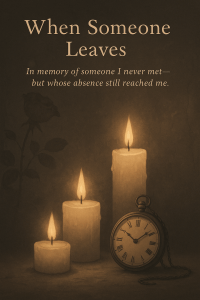
  • The Poignant Loss: A Reflection on Absence

    I never stood beside him.

    Nor did my eyes ever meet his.

    But when I heard he was gone—

    forever, yesterday—

    a strange sadness fell upon me,

    like dusk after the sun has set.

    One soul less in the world,

    and silence filled the void.

    We will never see him again.

    His voice and face are lost to us,

    like an old photograph of the beloved

    set quietly aflame.