Author: Stephanie Suh

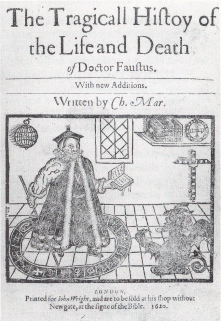
  • ‘Dr. Faustus’ by Christopher Marlowe – review

    Faustus-tragedyHe was a formidable agent provocateur: a blasphemous rebel, a proud atheist, a counterfeit, and a sybaritic seeker of tobacco and boys and an alleged spy for the government with his literary arsenal and daredevil machismo toward life. It was no less a dramatist, playwright than Christopher Marlowe, who introduced the concepts; a man whose life was staged so mysteriously and controversially that even his death was enveloped in a provocative imbroglio of factoids. In a case of life imitating art, Marlowe’s life was an epic tragedy for a literary enfant terrible struggling to mark his name in the Elizabethan England, where his literary genius and individualism were something of irreligious decadence to be reckoned with. Marlowe’s version of Dr. Faustus was his testimony against conventional absurdities of life in defense of his existential meaning of life, and there’s his outcry of existential dilemma spreading through the mind of the reader and connecting to the world of Marlowe.

    Dr. Faustus is a collective model of existential dilemma of Marlowe and his educated poor peers boxed in clerical positions with paltry sustenance in the Church of England. In fact, the strains of daily life of an educated poor is inculcated in the figure of Dr. Faust in retribution of their social confinement unparalleled to the scholarship and academic achievements. Marlowe saw poverty obstructing the progress of gifted minds, and consequently, it became his literary and psychological stratagem of fictional world populated with characters terminated by inner conflicts set in the background against the class divisions and religious dogmas intractably entrenched in Elizabethan England. Thus, Marlowe carried out his poetic justice by making Dr. Faustus able to fulfill his materialistic objectives by the agency of magic from the demonic power, even though it required of him a spiritual as well as physical quid pro quo in this story laden with super abundance of religious tenets and morals that all seemed a pompous, sanctimonious hokum.

    Marlowe used Dr. Faustus as his literary artifact, a psychological and spiritual medium through whom he made parallels with his own life, measuring himself against the burgeoning careers of his peers of his time. Dr. Faustus was in a way Marlowe’s mirror image that reflected all things about himself in the peculiar alchemy of literature. It all seems to me that Marlowe was a way ahead of his time because the contextualization of inner conflicts of the characters and the thematic substratum strike the chords of readers of post-enlightenment, post-Second Vatican Council and post-modernism. His behemoth contemporary peer William Shakespeare said, “Some are born great, others achieve greatness.” I like to think that Marlowe was both in the canon of English literature.

  • Classy and Fabulous


    “You can never be overdressed or overeducated,” said fashionable Oscar Wilde. Sure, they say beauty is only a skin-deep, but what eyes can see determines what the mind judges. Jane Austen also corroborated being a sensibly fashionable and culturally sophisticated woman thus: “Woman is fine for her own satisfaction alone. No man will admire her the more, no woman will like her the better for it. Neatness and fashion are enough for the former.”

    In this time of social media, propriety and civility seem no longer requisite for ladyship because the impersonality of urbanity and the mingling of ranks in streets have licensed shabbiness and incivility in the facade of casualness and convenience. However, one thing is certain that as our human nature has not been changed since the time immemorial, our appreciation of aestheticism remains in every culture. So much so that even someone like Albert Einstein who looked care less about his appearance said, “Even on the most solemn occasions I got away without wearing socks and hid that lack of civilization in high boots”

    Hence, the beautiful ladies wallowed themselves in classical elegance, strolling the elegant arcades of Biltmore Tower, where they work as legal assistants. They are fashionistas in their own rights whose ingeniously elegant style endures and emanates from their minds and characters, which are even more fabulous. For they dwell on the beauty of life and think that a thing of beauty is a joy of life.

  • Ballad of Dido and Aeneas

    6858611048029cebdb3615280c191a3a--oil-on-canvas-dido
    Aeneas leaves Dido, courtesy of pinterest

    From a land ravaged by a wooden horse with a golden apple for the fairest of the divine beauties appearing to a prince so young, so impetuous in judgment thereof,

    There came a poor beautiful stranger destined for the supernal fate to rule the mortal to the diamond eyes of a maiden queen ethereal in beauty, graceful in act and hapless in love.

    Blindsided by Juno’s machination, swept by passion growing strong, growing stronger for the stranger,

    The queen bade him with tears and roses in succession day and night, in desperate attempt to keep his presence, his body and his soul, all but an entreaty so futile,

    So forlorn, with a promise of her kingdom and her fidelity in return for nothing but his surrendering of himself to her and herself to him till the mortal fate was ended, till one had to cross the River of Styx.

    Alas, but the queen’s to be thwarted, she’s to be abandoned by the divine plan forced by the arrival of Mercury, god of war whispering to the poor stranger for the imminent departure for destiny far more magnificent, far more supreme,

    As dictated by Jupiter, god of all regions crossing death and life forever who put forward a divine plan over mortal feelings however pitiable.

    Thus did the stranger set to sail the seas full of perils ever more.

    The queen defied, she cried, she pleaded, but all ended in nought as the poor stranger was to depart cruelly with no tender words of love that’s planted, nourished,

    And admired by the queen so now distraught by his betrayal of her love with her plea wreathed in tears and flowers.

    Now her love became her poison consuming all of her ever more,

    Now he became her foe ravishing all of her in surrender of love.

    But what of it when all’s ended in a sea of heartaches thousand times, with no reason to reign as a queen without her lover by her side?

    Nothing, nothing’s to remedy her spirit that’s broken thousand times, for nothing, nothing would console the lonely queen in cruel abandonment,

    But the last will to burn her body and soul consumed in madness of passion on an ancient funeral pyre that engulfed every part of her whispering to her departing spirit that love would come never more – Nevermore!


    저장

  • ‘Kiki’s Delivery Service’ by Hayao Miyazaki (1989 film) – review

    kikidoyouloveme-c537c2fbe895a651b76179c8b7a4f23bBeing a witch can be this fun. She can fly on a broomstick anywhere faster, higher and further and see the world in her own eyes, which takes her to a higher plane of existence. Perish the titular image of a spooky hag with an equally evil-looking black cat flying together on an old broomstick on Witches Sabbath as a medieval invention of a woman laden with sexual and spiritual depravity. For a witch can be young, innocent, good-hearted and hard-working into the bargain who tries to live purposefully and meaningfully with what’s given to her as a result of responding genuinely and humanly to life’s challenges.  Such is a growing tale of Kiki’s Delivery Service, aka Witch’s Delivery Service.
    Kiki, a thirteen-year-old witch, leaves her mother and father for an independent one-year training of witchcraft at a faraway place where no other witch lives. Her companion is a witty and trusty talking black cat named Jiji that is more of kin than a pet. When Kiki finds a place in the port city of Koriko that has the outlook of San Francisco, Marseilles, and Nice beautifully combined, she sets up a delivery service as a messenger flying on a broomstick passed down to her in a long line of witchery by her witch mother. The business is in bloom because of her excellent customer service, positive attitudes, and beautiful heart, boosting her self-confidence, filling her heart with the love of humanity. Her broomstick and craftiness in flying with amazing navigation skills are part of witchery. Still, her real magical power is her empathy with people that infatuates all with a sense of euphoria. Kiki comes to know that the real magic comes from within, not from supernatural entities.

    Kiki’s Delivery Service is a 1989 Japanese animated film that was written, produced, and directed by great Hayao Miyazaki, which was an adaptation of the 1985 eponymous novel by Eiko Kadono. The fineness of Japanese animation is at the meticulous rendering of an original literary source text to the animated version without losing the authenticity of the unique theme and maximizing the emotional and visual effects. Also, there is a polyphony of pathos and affabulation found in Miyazaki’s animations, such as Graves of Fireflies, My Neighbor Totoro, and his other television works, as presented in The World Masterpiece Theater. Kiki’s Delivery is a bildungsroman film of an adolescent girl who tries to establish her place in the world while growing up, independent of the comforts of her home and conformity of lifestyles that are likely to be pinned down on her by a society’s convention. In a way, it is reminiscent of Jonathan Livingston Seagull in terms of his search for self-identity and growing into adulthood through the difficulties of life. However, Kiki’s rite of passage seems more adventurous, more libertine, and more animated, all in the artistic mastery of Miyazaki’s creation of La Vie de Rose, according to the eyes of young and resilient witch Kiki. Young, Old, Man, Woman, regardless of where you are or what you do, this is a film that will bring you all to the world of fantasy wonderfully anchored in the reality that will entertain you with beautifully rendered scenery in detail and a story worth the keeping at heart.

  • Simple delights

    boznanskainteriorstudio
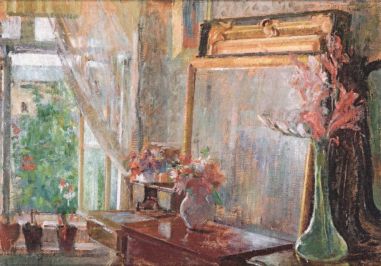
    Olga Boznańska (1865–1940), Interior of the Artist’s Studio in Krakow (1906)

    I’d rather have good books than designer bags;

    A few good readers than a legion of followers;

    and a faithful true lover than a band of admirers.

    For a bloom of roses satisfies me more than a rope of rubies.

  • Dialogue on Five Ages of Man

    IMG_3900
    Horatio (L) and Larry (R)

    Larry: I wonder what age we are currently in.

    Horatio: How do you mean? You sound like a peripatetic thinker like Aristotle.

    Larry: I mean the age according to Hesiod, the father of western narrative history. The name may sound Greek to you, my dear friend.

    Horatio: So, you think I am a philistine because of my patently plebian appearance and mercantile profession? I take false shadows for true substances, buddy. I have read about Five Ages of Man according to Hesiod and can tell you that we are in Iron age to which Hesiod himself also belonged. In this age, we human beings must toil away for livelihood, get old quickly, are besotted by troubles and more troubles under constant stress and pressure. In fact, it’s not our mortals’ faults but those Olympians who continued a cycle of creation and destruction of a human race on their whims and caprice in epicycle. In the first place, Zeus and his ilk drove away the benevolent race of the golden age after Titanomarchy, a ten year war against Titans, then began a recycle of the races for the silver, bronze, heroic and iron afterwards because they did not like what they saw in the races on the grounds of morality and maturity. It’s like the Olympians regarded us humans as a sort of puppets or marionettes. Or they are playing chess of our destiny with our beings used as pieces to be moved on a chess board. Yes, we live in the iron age, but I reject the idea that we are all living in a doomed scenario because we human beings have amazing intelligence with its general multipurpose learning strategies to triumph against the outrageous Olympian pandemonium. So, my friend, fear not. Boldness be our friends. For as Shakespeare encourages us that “true hope is swift, and files with swallow’s wings.”

    Larry: My dear friend, Horatio. Thank you for your sagacious thinking and brilliant advice on humanity. And let’s just say that for all what’s worth, mankind has resilience to spring back from the ashes of destruction with its fortitude and instinct for survival. It’s our human nature. And let us also remind ourselves of the dictum of Hemingway: “Man can be destroyed but not be conquered.”