Out of labor comes sweet lull,
From this in turn sounds a fanfare
that chimes the golden merry bell
of heart with mirth and laughter.
Author’s Note: I was on the Metro this morning, and a lady sitting next to me who was a total stranger told me with a wink, “Thank God, it’s Friday. Aren’t we just glad?” Ditto. It’s the Friday Euphoria that assuaged the constraints of our weekday malady and neutralized our fear of strangers. We all deserve a pat on the back for having made it through this week, as Snoopy cheers us up jubilantly.
History is a story of a people who have accumulated their cultural artifacts, political crafts, and societal conventions into a great reservoir of Tradition that becomes the bedrock of a country. Therefore, it is always helpful to understand the origins of political and social systems as well as cultural propensities of a country if you want to pronounce your opinion on the stimulating current affairs of a country without Ignorant Prejudice.
The one such apposite example can be illustrated in the case of Brexit, which is the UK’s withdrawal from the E.U, seemingly unwelcome by people who are involved in international businesses and those who want to work and live in the UK as non-citizens. As an outsider who has never been to the UK, I think it deemed inappropriate to criticize its decision to exit the E.U. for the reason that only the decision makers and the people favoring the Brexit should know better. Nonetheless, one thing is certain that the current Brexit fervor and all its inclusive phenomena are never a new thing.
The proverbial English isolationism or exceptionalism, a quaint sense of Englishness different from its continental counterparts, goes back to King Henry VIII’s break from the Church of Rome in 1532. His unquenchable passion for Anne Boleyn, while still married to Catherine of Aragon, led him to bold separation from the Church of Rome, the Pan-European, supranational ancestor of the EU and the Leviathan of Christendom, which would disallow his divorce from his wife who was an ardent Catholic from ardent Catholic Spain. With an audacious proclamation of being the Head of Church of England, Henry VIII ordered a confiscation of the lands and wherewithal of monasteries and convents all over the Island and banning of professing the papist religion to his subjects from the Duke to the Butcher. Furthermore, the king constructed Royal Navy to remind himself and his subjects that England was Fortress bound by watery demarcation. In this manner, Henry VIII gained the absolute jurisdiction over the ecclesiastical as well as political matters and rejected any foreign authority within England. In fact, the substantial consequence of all of it is the king’s creation of England – not Great Britain (excluding Northern Ireland) or the United Kingdom (including Northern Ireland) – as a national and cultural identity, firmly entrenched in religious, political, and cultural sensibilities of the English that we frequently associate.
In view of Henry VIII’s schismatic separation from the Church of Rome, today’s Brexit movement is a historical reprise of the English exceptionalism that has something to do with its geographical characteristic as an island that shaped the particular national character known as “Englishness.” Hence, Henry VIII’s establishment of the Church of England can be regarded as the forerunner of Brexit today and the invention of the cultural sensibilities encompassing all things English deeply embedded in its national character. With this in mind, we can look at the Brexit phenomenon in a more sensible and balanced perspective and understand that history is not a thing of the past but an ongoing process that moves on within its cultural legacies for centuries.
Author’s note: this is based upon my reading of an article about ”Henry VIII’ s invention of England” from this month’s issue of BBC History. Knowing one’s history can quell blatant antipathy. Hence this essay.
Fashion fades, but style reigns.Anne Klein Women’s Dot Print Long Sleeve Blouse
“A girl should be two things: classy and fabulous,” said Coco Chanel, Godmother of the Mods. Ditto. Hence my choice of this pretty blouse:the sleeves are coquettishly but not provocatively diaphanous with cute stand collars and pretty polka dots adorably decorated on the front and back sides of this tunic-like blouse that gives the illusion of an authentic silk blouse redolent of a muslin black dress I fell in love with from Chanel 2007 Spring Fashion Show because it looked so ethereal, so graceful, and so beautiful even in its simple design bereft of any sparkling ornaments. What’s more, this blouse is very appropriate for work, rendering both professionally sleek and fashionably chic impressions. The loveliest thing about this pretty blouse is the way it hangs on your body when you walk or even stand, especially in breeze: it sways like a willow or a cosmos on a slender reed. This sensible and fashionable blouse will look just beautiful on all women with wings of fairies and aura of mysteriousness in any setting.
Author’s Note: I love this new blouse of mine, so I had to write about it. Vain? Immodest even? Hardly ever so because even someone like Virginia Woolf , who is revered as a forerunner of feminism, admitted thus: ” Vain trifles as they seem, clothes have, they say, more important offices than to merely keep us warm. They change our view of the world and the world’s view of us.” This betokens Woolf’s indelible trait of femininity in her regard of fashion as wings of social mobility and status in society. So why not making fashion as an expression of myself in the most fabulously fashionable way?
Cheerfulness and rest are handmaidens to productivity. They come in tandem and frame your mind to mirth and merriment, which stunts malaise and spreads happiness. For the mind is the foundation of the universe. The modes of enjoyment are subjective according to an individual’s taste and personality: creativeness by doing creative things or experience by appreciating works of arts. Whatever it may be, it does good on your soul and body. “Mans sana in coporore sano,” a Latin maxim meaning “Sound mind in healthy body” applies to the all of the above.
Letters revealing Dickens’ attempt to accuse his wife of being mentally unstable (from Google)
All would have been well if the truth had remained buried under the dusty files of forgotten letters from the past in the bottom drawer of History. Alas, it happened – a recent revelation of the letters delineating Charles Dickens, a literary great whom I admired, concocting a plot to send his sane wife to a mental institution in order that he and his 18-year old paramour could be forever together.
How and why these forgotten letters have been brought into light out of the blue are clandestine from my reading of the article about such letters from the recent issue of a history magazine. Besides, the possession of the letters is curiously divided between the Atlantic Ocean because some of the letters are held by Harvard University in the U.S., while the others by the University of York in the U.K. The article does not provide the reader with more detailed information as to whys and wherefores of such divisional custodianship of the letters, not to mention the background of such uncovering of the provocative textual artifact that would certainly do no good on Dickens in any way. Methinks it would be a possibility that a descendant of the estranged wife Catherine Hogarth or even of their eldest child might have staged this rather dramatic publicity of the letters revealing the other side of the great writer out of indignation as comeuppance for his sins of adultery and perjury, which in a twist of whimsical irony befits the ethos of #MeToo Movement.
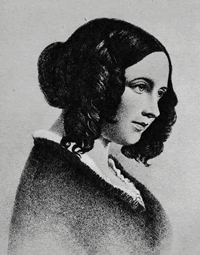
Mrs. Catherine Dickens
The content of one such letter written by a neighbor of Catherine Hogarth details the following: (1) Dickens at the age of 45 fell madly in love with 18-year old actress named Ellen Ternan: (2) it was the death-knell of the marriage, pace Dickens’ complaints about his legal wife; (3) his wife confronted him when a bracelet meant for the young actress providentially was delivered to her, after which she separated from him by moving to a house in Kent with their eldest child. The rest of the children were in the care of their aunt, while Dickens continued his relationship with the actress until his death; and (4) after the separation, Dickens tried to seek for divorce from the court by trying to prove that his wife was mentally unstable and that she would be sent to an asylum. However, the attempt to seek such remedy was foiled by the absence of proof of her insanity.
The whole scandalous charade of this great literary figure reminds me of the axiom by Ralph Waldo Emerson that the admiration of great works of geniuses should not become the worship of idols. That is, one must disembarrass the idea of a story from the person of the author, who is only a fallible, whimsical, temperamental human. The works of writers, I believe, are a separate reality based upon their epistemological knowledge magically alloyed in imaginativeness, ideals, and dreams in the peculiar alchemy of literature that deserves of distinguished approbation and recognition. In this regard, my disappointment with Dickens as a person should be kept separate from my admiration of the humane characters he created and the benevolent stories he entertained. Sometimes, it’s better not to know much about whom you like lest his follies and faults should dishearten you against your wishes and imaginations. For these reasons, I am more in sorrow than in anger upon reading this troubling article about Dickens, one of my all-time favorite writers, which leads me to the lamentation of Et tu, Mr. Dickens?




 Cheerfulness and rest are handmaidens to productivity. They come in tandem and frame your mind to mirth and merriment, which stunts malaise and spreads happiness. For the mind is the foundation of the universe. The modes of enjoyment are subjective according to an individual’s taste and personality: creativeness by doing creative things or experience by appreciating works of arts. Whatever it may be, it does good on your soul and body. “Mans sana in coporore sano,” a Latin maxim meaning “Sound mind in healthy body” applies to the all of the above.


You must be logged in to post a comment.