Category: Miscellany

Anything that’s on my mind.

  • Beggars can’t be choosers?

    Have you ever felt why you are here facing the ugly realities of life, enduring insults right in front of you after you are invited? I have, and the experience is still so fresh that if I don’t manifest it in writing, the grief will knit up the overwrought heart and bid it shatter to pieces, which has already been cracked, broken, then repeated. Job interviews are arguably the most tricky and adrenaline-inducing passage of livelihood for which some introverts have to give in at the expense of our fairy-like stealth, Sanity. You can either win or lose at the impression on the interviewer, who is more often than not less cultivated, let alone understanding humanity, no matter the social status. But then, you should not let your dignity and Sanity be ripped off or broken apart because you deserve a good one.

    It all started when I got first called in for a zoom interview last Thursday. It was for the position of part-time legal assistant at a small family law office in Downtown Los Angeles (not to be confused with Downtown Abbey, LOL). The office proprietor, an old man lawyer, was a typical lawyer who must have inspired Shakespeare to exclaim, “Kill all the lawyers!” It was not so much a job interview as an immigration or any bureaucratic interview, I gather, because of the following: 

    (1) His question of whether I had any family member or friend with divorce experience is irrelevant, knowing that I had no experience in divorce law. When I said no, he cast a doubtful glance at me;

    (2) After the zoom interview, what was the need for a second interview in the office for a part-time position in such a small law office?; 

    (3) I referred him to my blog as writing samples at his request, but he never gave me feedback on them;

    The interview reminded me of a police interrogation I am familiar with by watching British and American procedural detective TV dramas. He questioned me and observed my facial expressions to find faults. He was cross-examining me with the questions he had already concocted in his petty lawyer mind and insulted my sensitivity. He seemed to be of a typical victorian/Edwardian bourgeoise (not even peerage) would-be employer pleased with himself for being so rich, so successful by his so clever lawyering. 

    I am seeking employment to make a living, but I don’t want to work for/under such a rude and unpleasant employer. I wasted my time on earth because of yet another traumatic experience of failing humanity. What change has been improved since the labor movements in the tacit relationship between the worker and the employer when I cannot speak my mind because ignoring it in the oblivious land of forced amnesia will make me fall apart, and I can’t take it anymore? And it didn’t end on that day. He dared to inform me of my not being hired the next day at NIGHT. Thank God for not giving me the job. And I wish it was all just a nightmare, and that’s all.


  • Who is the patron saint of the Internet?

    The Internet is a vast open ocean of knowledge ranging from how to fix your clogged toilet and where to find the nearest dry cleaners to the meaning of language you have no idea about and to the year when the world came to being (4004 B.C., just so if you are curious.) Not that the Internet has obliterated the places of encyclopedias or dictionaries, but it has outranked popularity for its convenience with your fingertips without getting your fingers flipping pages after pages. So when I came across an article that the Catholic Church has a patron saint for the Internet, my pique spurred me to write about it.

    It is no other than St. Isidore of Seville, a man of God who was keen on anything in the world’s knowledge. His ambition to know everything was sanctified in making Etymologiae, meaning Origins. It is a significant encyclopedia on everything from grammar to medicine, law, religion, and war. But that doesn’t end it. It encompasses pace, animals, ships, clothes, etc. Until the renaissance, the 20–volume magnum opus was a chief reference book in Europe. In the 1990s, a group of Catholics related Isidore’s achievement to the Internet, which the late Pope John Paul Second agreed with but didn’t extend to the patron-saint naming process.

    I think it’s fitting to regard Isidore as a Parton saint of the Internet in a religious hint of expectation that he will use his spiritual guardianship of the Internet productively and extensively. Naive as I may be, I hope there will be more pros than cons to using the Internet for knowledge of the world. You don’t have to be Catholic, of course. That would be like refusing to serve someone at a restaurant or a fast food joint because they are different from you.

  • Auto-correction and Titivillus

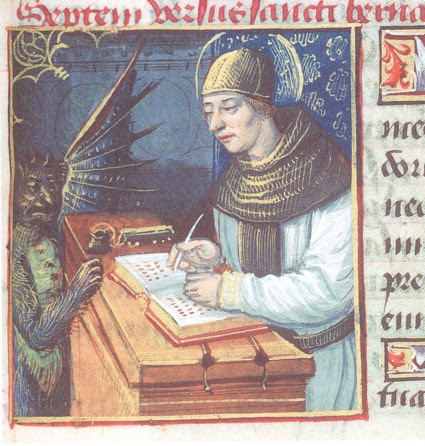
    Writing has never been easier these days than in the bygone days before the advent of the computer. If you are unsure about how to spell “Tomato,” then the computer will spell it for you by way of auto-correction. And it can even reconstruct your sentences like a pro. The magic is inside the computer, as if it has a mind and even a soul, as it were. This wizardly power of auto-correction can sometimes, however, lead you to an embroglio of nonsense, especially when writing emails or tweeting. Quite devilish, so I think and wonder: are things like auto-correction and the likes a wicked invention of science or science of diabolical existence? Hence, I am talking about Titivillus, the patron demon of scribes.

    The birth of Titivillus could trace back to the 13th century when Franciscan theologian John of Wales pinpointed the malicious demonic trickery for the scriber’s mistakes. That’s not a footless excuse for the faux-pas made in a beautifully ornamented medieval script. In medieval times, copying the passages of the Holy Scripture was a painfully punctilious task for a monk to accomplish with perfect penmanship and exquisite illuminations. And the job cost a good amount of his youth with arched back, squinted eyes, and cramped arms and fingers, not in the least due to the time spent scribing. Toiling (even though for the glory of God) and Rejoicing (for the joy of self-fulfillment), Sorrowing always hoovers over the glories. Titivillus often brings this Sorrowing by making the scriber err in labor, such as misspelling or miscopying. When that happens, a corrector scraped off with a penknife or an acidic solution was applied to loosen the ink. Or sometimes he just made little dots under a wrong word, meaning the reader should ignore that bit. In case of more significant errors, the passages were sometimes lined through, and the correction was written in the margin or copied on a smaller piece of parchment and glued into the book.


    To think of it, Titivillus has not returned to the Ninth Circle of Hell, always making himself a reason to stay as long as humanity continues writing. Writer’s block is a dark cloud hovering over the soul’s palace, the dome of thoughts. Philological carbuncles, including misspellings and awkward syntax, combine the demon’s interruption and the writer’s fear of writing. The fear is more than devilish trickery or neurotic obsession because it stifles creativeness and imagination of the writer. Still, I cannot help but think that today Titivillus manifests himself in the form of auto-correction, which can change the entire meaning of a whole sentence, often most embarrassingly and awkwardly. You agree?

  • Hounds of Night

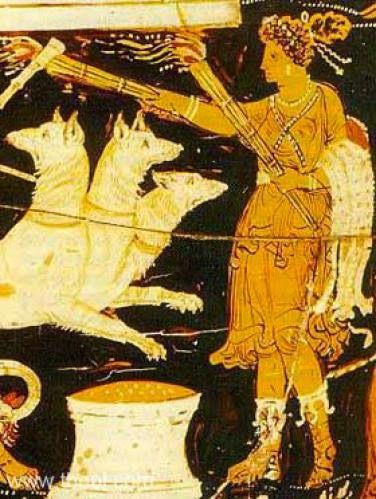
    The curtain of the night has drawn. Selene has started her nocturnal promenade with a moon mirror carried on her celestial chariot across the starry highway. Then the earth begins to bellow with great silent roars, trees to dance with leaves rustling in the wind as the chariot is racing, owls to call with their wings flapping, and the hounds howl from the end of the horizon in the glimmering light of the distant stars like lamps flickering in the desolate wilderness amid the haunting sound of Pan’s flute yonder. It’s Hecate’s Time, the Wandering Goddess of Night, appearing from the crossroads with her faithful hounds, heralding the staging of their divine mistress.

    Hecate has often been associated with all things witchery, magic, and death, not in the least due to modern-day Wicca practice identified heavily with the Greek goddess, but there’s more to her. She is a protector of the wrongfully accused, a goddess of retribution against injustice and impurity, and an advocate for underdogs. Perhaps, that’s why her animal is a dog, not a cat, which betrays a common association of the latter with someone like her. (In fact, Artemis is the only goddess whose animals are a cat because she was once transformed into it when chased by a besotted man.) Her hounds all have names: Kynegetis (Leader of Dogs from the Orphic Hymn), Kyneolygmate (Howling like a dog), Kynokephalos (Dog-headed), Kyon Melaina (Black Dog), Philoskylax (Lover of Dogs), Skylakitin (Lady of the Dogs). Of all the hounds, Kyon Melnia, aka Black Dog, used to be the wife of the last Trojan King Priam named Hekabe, who threw herself into the sea after the collapse of Troy by the Greeks. Hecate took pity on the queen and transformed her into a great black dog that became her familiar. What a manifestation of divine mercy it was.


    It is said that dogs and cats see the spirits of the dead, especially at night. If you have heard a dog howling, another howl, then another, and so forth, as if all of them sing in a canine polyphonic coda. When Hecate’s hounds howl, mortal dogs respond to their divine canine entity as the goddess and her entourage pass by. The hounds also bring victuals offered to Hecate to their mistress at a cemetery where she partakes her daily victuals. So if you think it’s just an ancient myth, listen carefully when your dog or any dog within your earshot howls. It’s either it sees a spirit or Hecate and her nine hounds. For me, well, I have a tabby cat named Toro, and he sees it and them but won’t participate in the chorus because he has her mistress at home.

  • Adieu, my friend

    A week has passed since the Beluga whale died in transit from the Seine to the sea. The question remains with the image still fresh on my mind refusing to fade away with my heartstrings pulled in all withers: did he break away from his kind to find a treasure island like Jim did? Or did malice of fortune take him away from the tribe on a lark to see if he could make it back to where it came from? What is the meaning of all of this anyway?

    He had no name because he had so little time to live in this world, and I mean the Beluga whale stranded in the Seine River in Paris, France, and ultimately died in transit to a sea last week. No one knew why he swam all the way up to the freshwater, which was not a typical habitat for the whale species. IT wasn’t the first time to see a whale end up in the river following an orca in May that died of natural causes, but the Beluga whale still lingers in my mind a week after his death. Maybe it’s because of his ever-good-hearted-looking appearance that oozes out a sense of pathos from my feelings. Whatever it may be, he endeared me like my two-year-old tabby tom Toro, and I had been following his tale of the river, which seemed to me his journey to the resting place – among humans with whom he might have cherished good memories. Maybe he disliked his kind, so he ran away from there. Come to think of it, do we also not do the same when we can’t take any more violence, disappointment, betrayal, and arrogance?

    Although I admire the efforts made to revitalize the Beluga whale and to send him back to the sea, I cannot help thinking that there should have been more professionally effective operations to achieve the noble human intention to save nature. We live in an information-saturated, expert-ridden global world, but why is no such help readily unavailable in dire need? Are outstanding vets only for YouTube channels and other media outlets via which they can amplify their view to lucrative celebrities? But the argument is futile since he’s gone. By recording what my heart feels about him, I want to pay tribute to his incredible journey to the human world by himself with kisses and tears. Good-bye, my Beluga whale.

  • My Cat Toro and Samuel’s Hodge

    Toro is a very fine cat indeed

    Since I don’t like the word “pet,” I won’t say it when I refer to my two-year-old tabby, tom Toro, a family member. Toro pays a portion of his rental fee and is a controller of rodents in our dilapidated humble apartment we long to escape. But that’s another story, and this story I am going to unravel is for Toro.

    Toro before entering the clinic

    It was that time again to get Toro’s annual physical exam, also required for his Hills prescription Urinary care food. So we took a trip to the vet at Little Tokyo, and all’s well that ended well. His weight was steady at 11 pounds, the same as the last year (what an excellent dieter he is!). He got his FVRCP, FelV, and nails done and was proven generally healthy. What a relief because I had been concerned about his taking more naps than usual and tired expressions with half-cast eyes. The doctor told me that it was customary for cats to show such symptoms as they grew bigger. So albeit my mom thinks that I am overly concerned about Toro’s otherwise fine status quo, aren’t we all concerned about the general well-being of our flurry fur babies?

    Samuel Johnson and Hodge

    It all makes me think of the story of Samuel Johnson and his cat Hodge. Samuel Johnson, one of the greatest men of letters from 18th century England and the author of A Dictionary of the English Language, had his beloved sale-furred cat Hodge, who was immortalized in literary works and as a bronze statue outside his guardian’s once resident abode. We first come to know of Johnson’s cat Hodge thanks to his lawyer friend and biographer James Boswell’s Life of Johnson. Johnson used to go out to buy Hodge’s favorite food, oysters. He refused to let his loyal and faithful Jamaican-born master-servant Francis Barber because he felt that it would be degrading to Francis to do such errands for him. But I like to think that it was more affection toward Hodge, whom he called thus: “He is a very fine cat, very fine indeed.” When Hodge was nearing to cross the rainbow bridges due to his old age, Johnson would get valerian, an herbal painkiller extracted from the flower to lessen his fur baby’s pain. But the end of Hodge wasn’t lost in the inner circle of the ether, for his life was memorialized in ‘An Energy on the Death of Dr. Johnson’s Favorite Cat’ by Percival Stockdale, published in 1778:


    The general conduct if we trace
    Of our articulating race,
    Hodge’s, example we shall find
    A keen reproof of human kind.

    Samuel Johnson is one of my most admirable literary persons because of his humanist rules of thought articulated in his mastership of the English language. Hence it gives me a feeling of kinship with his love of Hodge. His affection for Hodge felt genuinely caring and familial, which was never mawkish or superficial. So, likewise, my cat Toro is a muse of my writings: whimsical, independent, intelligent, and affectionate. Sometimes, I wonder if Toro is really a little boy bespelled a tom. Well, what more can I say? Toro is a very fine cat, very fine indeed.

    Hodge’s bronze statue was inaugurated in 1997 by Sir Roger Cook, the then-Lord Mayer of London. Note the oyster at his paw as his eternal token of Johnson’s affection.