Category: Miscellany

Anything that’s on my mind.

  • friends or foes?

    I always feel guilty about leaving Toro alone when I go to work. It would be best to add another feline companion, but the existential circumstance prevents it. Hence the flying tenants moved in. The new parakeets are Sera (Blue) and Pippi (Green), who demonstrate that the phrase “eats like a bird” should be part of the Woke movement of removal. They are also unknowingly clever and perceptive that I wonder if they are secretly enchanted humans serving their time for misdeeds till the spell is cast off.

    Toro, aka the Curious Cat, also seems to know that Sera and Pippi are a joint force to be reckoned with, so to speak, but nevertheless shows undeterred attention to every move the duo takes with feline discreetness. Timid but curious, Toro wants to touch the moving feathers of parakeets whenever they come out of the cage for sauntering. But the birds show no fear but irritation against the unwanted friendship from the lonely feline. Poor Toro. I console him after Sera pecks his little nose with her dainty beak in protest against his pawed touch. However, my original purpose of making the birds friends with Toro is still valid because both Sera and Pippi do not altogether repulse Toro with wild shrieks of danger.

    I hope the birds will be warm to Toro as time goes by till we move to a bigger and better place to live so that I can bring another cat to the family.

    Twinkle, emerald dreaming,
    Love flocks in blue and green,
    Curiosity stalks love’s gathering,
    Loneliness emboldens attempting
    touch of love fluttering in longing.

  • TikTok, the Orphaned Marmoset’s Story

    TikTok rescued from a miserable life courtesy of BBC.

    Whether it is my animal zodiac sign of Tiger that is believed to be highly incompatible with anyone with that of monkey, let me just clarify that monkeys are my least favorite animals. However, that doesn’t mean that I should not feel strongly about the article from a recent issue of BBC Wildlife about the U.K.’s primate trade accompanied by the title photo of the baby marmoset named TikTok. Call it milk of human kindness. I cannot just leave the pages closed and forget about it as a piece of memory. The images and words still haunt me, which prompts an enduring reckoning, resulting in writing this essay.

    The primate trade in the U.K. and here in the States evokes the human history of slavery. Under slavery, human lives were counted as chattel, and the families were continuously disintegrated because of volatile trade-offs. On the same token, keeping primates as pets seems no less different from colonialists or slave owners whose eyes were set upon the exotic physical attributes of the people they subordinated.

    The article has also taken me to my brief research into the U.S. primate trade with the following facts: in 2012, 19 states, including California, where I live, had outright bans on private monkey ownership. The primates are considered a threat to wildlife and public safety and health because their habitats and nature are not agreeable to our environment despite our conventional knowledge of primates as the closest to our species lost in the evolution tree. Come to think of it, the idea of “Planet of Apes” has a point in reversing the directions of gaze from humans to apes, and vice versa, showing us why the two species could not cohabitate by confining them in the opposite environments.

    We should not think of animals as live toys or ornaments that will satisfy our whimsical, capricious tastes. From pets to wildlife, animals are not our property but companions. I know it for sure when I feel a little heart of my cat Toro sleeping at my feet.

  • Triumph of the Will

    Like Hecate, the goddess of underdogs, I have a soft spot for writers and thinkers who arose above personal hardships and triumphed in the will. If they have not experienced human highs and lows, how could they write and explain the meaning of life? Take the Russian writer Fyodor Dostoevsky whose near-death experience on the gallows and subsequent travails shaped how he viewed humanity, the purpose of God, and the dichotomy of good and evil. I compared the life of Dostoevsky with that of Victor E. Frankl, the father of Logotherapy, who survived five death camps during World War 2 because both men’s intellectual fervor saved them from self-destruction in the darkest hours of their lives.

    Dostoevsky (hereinafter “D”) was a political prisoner sentenced to death for reading banned books. But the most incredible feat of luck pulled him out of the gallows, and he was sent to a Siberian work camp. He forced himself to channel a danger of hopelessness and resignation in such a squalid environment into the world of imagination. His characters were his alter egos trapped in a cycle of solipsistic containment of morality, religiosity, and social justice. In these attitudinal and creative values as a way of relieving himself from the slough of despond, D finds a kindred spirit in Frankl (hereinafter “F”), whose spirit never succumb to the hopeless situations in death camps where life seemed to be a curse. Instead, f kept himself busy by constantly devising his school of thought, analyzing it, and structuralizing the concepts in his head and on any writable medium he could find discreetly. The result is Logotherapy, the third Viennese school of psychotherapy that encompasses philosophy, religion, neurology, and psychoanalysis, whose nature and method are common to all humans and applicable to all regardless of age, gender, race, and culture.

    So much so for the reading of the brief article, but the effect is magnanimous and resonant with a pellucid tenor of a victorious high human spirit with humor as a handmaid to intellect (wit), which would otherwise be grim and dreary subject to temperamental bouts of depression and pessimism. Both men in their prime of youth had their sovereign rights of individualities in tatters and shackles, but their willingness to live and achieve their goals exceeded the compass of the malicious fortune and triumphed in perennial glory. They are, as Ben Jonson in his humor might have concurred, men not of an age but for all time.

  • On Aristotle and Philosopher’s Stone 💫⭐️✨

    Edgar Allan Poe expressed his contempt for readers who habitually flocked to books by famous authors on the sheer merit of their popularity without an individual appreciation of the contents. Likewise, I have a handful of the famous, the great people whose celebrity I hold no regard as I am going to unveil now. I have never liked Isaac Newton, albeit his genius is doubtlessly uncontested. Cantankerous, bellicose Newton was horrible to deal with, especially when you were his servant or maid or whoever he thought insignificant in his Elysium of high intelligence. He was also a closet occultist masquerading with the face of Rational Man with long-faced gravitas adorned in a long wavy wig. So how come Newton became a votary of Aristotle, who took the virtues to be central to a well-lived life? Since I tend to disassociate any such persona non grata (Newton, obviously) from one in my high regard (that is, Aristotle), I wanted to find out the incompatibility of the sullen scientist and the benign thinker.

    Aristotle’s ethics, or study of character, is constituted around the premise that people should achieve an excellent character as a prerequisite for living a meaningful life. It is an essence of metaphysics in which Aristotle holds that there must be a separate and unchanging being that is the source of other beings. Only by becoming excellent could one achieve eudaimonia, happiness/blessedness that constitutes the best kind of human life. This philosophical perspective also applies to the ideas of self-sufficiency by Ralph Waldo Emerson and of Amore fati, the intellectual love of life by Friedreich Nietzsche.

    Emerson regarded two separate elements as being united to create the world inside of you for the former. They are raw experiences gained from somatic sensory stimulation transformed into ideas and thoughts in the realm of reason, a process akin to a caterpillar transforming mulberry leaves into gorgeous silk. Nietzsche’s Amore fati is theologically conceived in an attempt to manifest the presence of Providence or God’s will with his infallible existence through Immanence by which an adequate idea of simple attributes of formal essence of God is applied to an adequate knowledge of the simple truth of things. It might be akin to the Eureka moment when Archimedes started running naked around the town in the enthusiasm of knowing the weight of the gold in the king’s crown from his water-filled bathtub. Or it could be the Ecstasy of Saint Teresa captured by Bernini as a cherub was mischievously thrusting the arrow back and forth into the heart of the virgin. In sum, Aristotle was right in saying that knowledge isn’t innate or guaranteed prima facie but gained from the reports of the senses and logical inference from self-evident truth.

    I still believe that someone like Newton had no regard for moral excellence any more than gaining the knowledge of the universe because studying humanity was anathema to his lofty vision of the world and beyond, such as the alchemical realm. Newton was keen on Aristotle’s theory of the 5th element on top of the earth, air, fire, and water – that is, space of aether. Methinks, Newton was trying to get Rosetta’s stone in manipulating the 5th element proposed by Aristotle. He had not known that it would have become such a magical element to turn stone to gold. Notwithstanding Newton’s beguiled ambition to be a perfect Gargamel with the help of Aristotle, so to speak, my appreciation of Aristotle’s metaphysical school of thought decides that his brilliance is brighter than Plato and on par with Socrate in the constellation of philosophers’ stars.

  • Leave the children out of it.

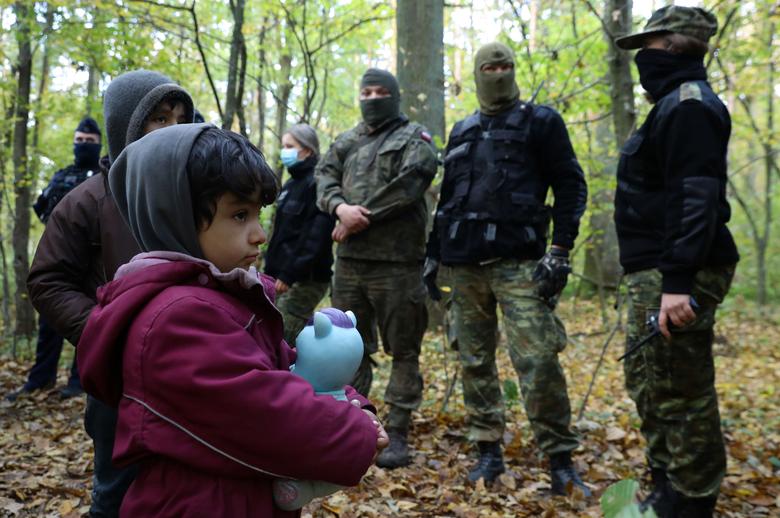
    We tend to be ready and eager to put fingers on those in need as if the milk of human kindness is not fit for them because we don’t like them as we see them. Such is because humans are physical rather than rational, operating on optical illusions to create our versions of reality. The present migrant crisis in the border of Belarus and Poland manifests dominance of Id over Superego, the eclipse of Reason by the Sense, in the face of travails on both sides of narratives.

    Migrants mainly from Syria, Iraq, and Afghanistan now fly to Belarus on tourist visas after paying from $1,000 to $4,000 to brokers and go-betweens in the high hope for a low heaven. They think their and their children’s lives are grim and dreary, with holistically low living quality in their home countries. So, they keep their eyes at the stars in West Europe’s firmament, scintillating bright futures despite the impending hostility toward their religious belief and cultural unfamiliarity. The frigid cold and the equally cold reception do not seem to overthrow the migrants’ will to catch Luck of Troy in Unfriendly Europe. On the contrary, it brings the grist for the mill of furious Belarus disaffected with the EU’s economic sanctions for its still Soviet-era Modus Operandi of the government. Belarus sends the influx of migrants to West Europe through the gate of Poland as an audacious manifestation of vengeance and anger.

    The Polish government defends their territory against the unwelcome intruders, clenching the fists toward heaven that their predecessors bled for the Polish, not for the aliens. The good-hearted people in the border area who help needy migrants face backlash from their neighbors and often become subject to judicial harassment for humanity. In this traumatic atmosphere threatening even the most basic requirement for and right of survival, the presence of children is default to provoke sympathy used as an emotional gambit to win the game of chance – for either side. People should not use children to acquire their political or social demands because that is another form of exploitation of childhood, using the vulnerability of children for soliciting the need for however righteous the cause is.

  • for whom the bell tolls

    Watching the world leaders attending COP 26 and G20 vehemently discussing achieving the net-zero policy makes me wonder how Greta Thunberg can get away with her angry facial expressions and vitriolic remarks that would otherwise have been simply unpleasant. How powerful Greta Thunberg’s vehement narrative on her newfound purpose in life has become! Now the world leaders vow to her harmoniously, when they should know better as expensively educated men that the goal of net-zero carbon dioxide will require live human sacrifice and stultify the truth about carbon dioxide in its relationship with the earth.

    To begin, you have to understand carbon dioxide is not evil but necessary to keep the appearance of this planet. The principal effect of increased carbon dioxide in the atmosphere stimulates plan growth, aka the fertilization effect. Thanks to its grim colorful image of the reaper as a hazardous element, its function to make the green greener sounds cynically antonymous. Also, carbon dioxide warms the planet earth, lest it turns into a dwarf planet like Saturn with frozen lakes adumbrated with gas-filled clouds. Besides, only 1/6 of a degree per decade has been increased, the amount inconspicuously perceptible and critical to producing any apocalyptic effects on the earth’s surface. Thunberg and her comrades command that all nations achieve net-zero in carbon dioxide emissions, which means using fossil fuels, which is too costly for underdeveloped and developing countries to keep up with. The poor always remain poor because of this unfair authoritarian policy without regard to the national economic system and social situations forcefully measured in the Outrageous Bed of Procrustes. In effect, most pollution in the world comes not from Western Europe but from those countries where the industrial revolution was the counter-product of colonialism or communism. Therefore, if these countries strive for the net-zero goal, they will fall by the wayside of their social progress for the welfare of the people by spending the national treasure on achieving the pyrrhic goal.

    I have never seen an aggressive environmental campaign such as this at present. Of course, climate irregularities have always existed, but humans have remarkable skills to adapt to new surroundings with the power to think as a bipedal species. Dostoevsky said we could get used to anything, even hanging. But the current seismic environmental zeal with the Swedish teenager seems more unpleasantly cataclysmic with her militant warrior approach. The matching ensemble of the haughty voice is heartless, laughing at how the famous and influential adults are fumblingly and funnily reacted to her like dolts. Could it be her ambition to prove herself to the world that despite her autism and want of beauty, she could become the most well-known and influential girl in the world? After all, even the women politicians and intellectuals fall in love and even marry. The whole scene reminds me of a teenager dissatisfied with herself venting her depression and anger with a holler from the rebels against the demands placed upon daily tasks of life. In William Golding’s dystopian juvenile literature Lord of the Flies, Jack, the antagonist, plays innocent along with his followers in the eyes of adults. Greta is the female version of Jack. And the world leaders at COP26 and G20 are the officers who rescued the band of children and boarded them on the ship, not knowing what would happen soon. But Greta has much more followers to her alter of Climate Catastrophism.