
You would know him if your sense of style strikes the chords with his idea of beauty that seems a curious conflation of the ethereal with the down-to-earth. Or you would know him as a photographer whose world of beauty betrayed linear conformity in the most brilliant way. If none of the above belongs to you, then you would probably recognize him by his signature silver hair tied in the 18th-century man’s ponytail style in urban tight attire that looked strange but charismatic, decadent but conservative. In the fashion and beauty firmament, Karl Lagerfeld (1933-2019), the creative director of the French fashion house Chanel, was one of the principalities whose dazzling collection of creativity formed a legion of cult.
The death of Lagerfeld seems a bit distinguished from those of other fashion designers to me based on my purely subjective taste and reason: First of all, Lagerfeld was a very intelligent man of culture, judging by his display of erudite knowledge on art and literature due to his voracious reading of books. I saw his interview with Charlie Rose several years ago and was delighted in listening to his conversing with the host because of his intelligence and quickness that was never a bore. Also, Lagerfeld’s world of style is not far-fetched and always mixed with individual attitude that looks so cool and stylish and emulative. Although a gorgeous but exorbitant Chanel tweed jacket is like Jason’s golden fleece to me, I can take a cue from Lagerfeld’s feasible but fashionable style to make it my own in everyday life. Besides, Lagerfeld’s controversial but honest opinion on thinness as an ideal beauty chimes with mine. Call me ever so superficial, politically incorrect, or even persnickety, but the emblem of the flesh as a forced common denominator of beauty and fashion is arbitrary and despotic.
Karl Lagerfeld was the only fashion designer I admired, and his death saddened me when I learned it yesterday from this week’s issue of The Spectator. During his reign of the Chanel House, Lagerfeld used to say, “T-shirts for ten dollars are even more fashion today than expensive fashion.” Must I say more? That is why I liked and like Lagerfeld and his canon of style that is timeless and classic.


 All lawyers are educated, expensive mercenaries of fortune with a high chance of variable expediency in allegiance to whoever employs their burst of legal pep, or “intelligent drudgery,” so to speak. Lawyers know no fear but lots of hubris that can move heaven and earth because of their Napoleonic credo of “There’s no word for impossibility in my dictionary.” To Sally, it’s a real case of Sartre’s existentialism which dictates that “Experience precedes essence.” And yet, the images of gentlemanly lawyers in the characters of Atticus in To kill a mockingbird played by Gregory Peck and Kavanagh QC portrayed by John Thaw are hard to be disembarrassed from Sally’s abstract ideas of fine lawyers.
 Sally’s position of legal assistant wears many hats: secretary, paralegal, accountant, receptionist, calendar person, and whipping girl paid to do a one-man show at a high price. You may yoke the concept of the position into that of a pricey maid, sort of an upgraded modern version of educated head maid you may see in TV period dramas, such as Upstairs and Downstairs, Berkeley Squares, and The Duchess of Duke Street. Accordingly, like a dutiful head maid in a manor house, docile Sally exerts all her efforts to fulfill incredibly hectic demands imposed upon her daily tasks with graceful patience and her very pretty smile.
 “It’s all a mind game, a sort of mental Tetris in which I have to find out a way to accomplish my tasks without being jammed with constantly generating tile blocks to be upgraded to the next level. And I want to win in this game.” Surely, as consciousness is the foundation of the universe, marshaling self-discipline and courage to perform her tasks to the fullest extent possible is the sine qua non of her happy metier. After all, the nature of lawyering turns its practitioner into a professional inquisitor of wickedness of mankind as observed by Arthur Schopenhauer.

 Upon reading this thoughtful and caring reply
 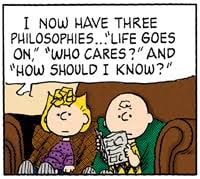 Before calling it a day to say hello to a new tomorrow on a hard day’s night, to happen on this comic strip of my all-time favorite Peanuts seems almost too pat. Provident, even. It chimes the bells of my heart and soul that are dented with the shrapnel of existential vertigo in the most impressively elliptical way: that none other than simple tenets of life are needful to live a less stressful life.

You must be logged in to post a comment.