According to Greek historian Herodotus, there was the Egyptian pharaoh Psamtik I ruling in the 7th century B.C., who was keen on finding humanity’s primal language. Ergo, the inquisitive Pharaoh gave 2 infants to a shepherd to raise and told him not to speak to them because he believed that the first words the children spoke would reveal the Mother Tongue of all of the Human Race. Quite creative, even feasible, but highly abstract; the hypothesis resulted in one of the children’s utterance of the word “bread” in what sounded Phrygian, the language older than Egyptian. Nevertheless, the Pharaoh’s the Up series-like experimentation on human linguistic origin tells us something of a human desire to find anthropological aspects of languages in their origins even before the proverbial Tower of Babel was set about to begin forming.
Here in the States, one does not get bored with a mono language: English (American English, to be precise), Spanish with continental and regional variances, Hindustani, Pakistani, Mandarin, Cantonese, Japanese, Korean, French (mostly of former French colonies in Africa), Tagalog, and etc. So the story of Psamtik I’s ambitious experimentation to parse the root of all languages chimes with the cosmopolitan landscape of everyday life. Apropos of a diverse group of languages, Benjamin Franklin, however, seemed not to be in favor of multilingualism in the States in fear of the country’s being disseminated into a variety of different language communities. To Franklin, the importance of English as a unified official language of the States meant a national sovereignty and cultural identity that would bind people living in the States into one cohesive cultural group. In this respect, the English language as an official national language of the U.S. is the sine qua non for a lingual and social unity of a country as much heterogeneous as the States. That said, it is beneficial to know of the lingual root of the English language as well as of the other related language.
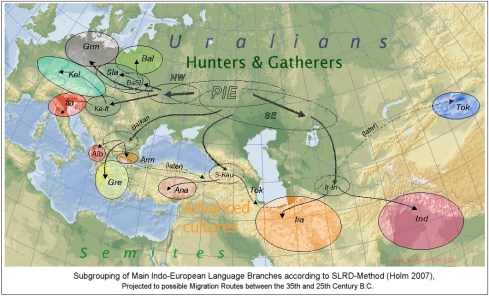
One of the most popular Indo-European languages in terms of active speakers, English belongs to the Germanic along with German and Norwegian under the Indo-European lingual branch, which also includes the following groups of language:
- Indo-Iranian: Persian, Urdu, Bengali, and Romani
- Greek: belongs to its own family
- The Italic: Latin and the Romance
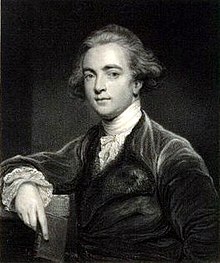
The reader may be surprised by the fact that Persian, Urdu, and Bengali spoken in the Near East Asia and Asia are also a lingual family with English, but according to British jurist and amazing polyglot William Jones in Calcutta, India, Sanskrit, an ancient Indic language, had common ancestry with Greek and Latin because many of the words were similar to those in Greek and Latin. For instance, take the word “Fathera”. The Indo-Eurpean term is pater. Sanskrit is Pitar; in German, Vater; in Latin, Pater; in French, Pere, and in Spanish, Padre. In fact, Jones’s elation of the ancient Indic language in his industrious study of its deep cultural influence as well as lingual traits on the Germanic paved a way to modern comparative linguistics. In terms of the cultural theme of Indo-European cultures, the idea of trinity in aspects of life that are sacred, social, and economic can be traced in the old caste system of India comprised of Brahmans (the Priest), Kshartyas (The noble and the King), and Vaishyas (the Commoner). Likewise, in Greek myth the 3 Fates who are the beginning, the middle, and the end of each mortal’s life and the Holy Trinity of Christianity adumbrate a cultural connection between the continents that look remotely different at a first sight and yet interestingly alike with deeper insight.
To encapsulate, the relationship between language and culture is the sine qua non of human civilization, the inseparable archeological, anthropological, historical, and linguistic artifacts to study the origin of humanity and its misty pasts. The development of languages also relates to an expansion of its influence by means of trade, war, and migration that are still in progress in our time. It is a product of collective enterprise in the form of textual artifact. Otherwise, who would have thought that English, an obscure west Germanic language, would become a modern day lingua franca spoken across the five continents and six oceans? For what it’s worth, T.S. Eliot elegantly summed it all thus: “For last year’s words belong to last year’s language and next year’s words await another voice.”

 To come upon Word of The Day, Tsundoku, as I was checking messages on Facebook during my lunchtime at a regular Starbucks shop gave me a fillip to thinking of my unread books I have piled up, untouched, since my new job became my primary reality. A Japanese word for a pile of unread books, Tsundoku has become something of new word that describes a tertiary group of books attempted but disinterested, or tried but forgotten. Which is what my tsundoku are comprised of. My books pending my reading speak to me: “Have you deserted us?” Nary a One Bit, My Dear Textual Friends.




 The lucky winner of the happy opportunity was Rosetta whose honest-to-goodness character and sweet smile moved Andy’s robust stoical temperament at the interview. So Wendy came aboard as a new cute attendant at Andy’s, and she loved every minute of it, serving customers with care and smile, grilling sausages, flipping buns, frying french fries, and performing all other miscellaneous tasks given ad hoc by Andy or his wife Martha, who always religiously brings her homemade buns, sausages, and other condiments to the establishment every day and attends to customers in the morning until 11:00 AM.