One word is insufficient, for you and I are not a manufactured byproduct of living organisms. So I will defy it with the following parade of words that tells about me: munificent, seI am sentimental, sympathetic, compassionate, funny (in a delightful way), naive (but more leaning toward gullible), agerasia, Renaissance, timid, introverted, vivacious (only when I am in the mood under right conditions with right company), blue-stocking, independent, unreconstructed, passionate when talking about books and history with kindred spirits, ambitious, neverending, resilent, optimistic, silly, sometimes pretty when my spirit is high, sybil, Cassadra, ancient, cosmopolitan, spiritual, witch (a good one), dreamer, laid-back, warm, dilligent, genuine, trusty, mysterious, and hopeful.
What is your middle name? Does it carry any special meaning/significance?
Sometimes I wonder what if I had a different middle name. Would I have been living a different life – for brighter and better? Nominative determinism is not entirely superstitious because your name gives you an identity, an existence. My middle name is Joori, the first name used in Korea, while my first name Stephanie is my baptized Christian name, used in the church community.
Korean is a unique phonetic language of the Ural-Altaic linguistic family, which includes Japanese, Finnish, Hungarian, and Turkish. “Joo” means red, and “ri” means beneficial. My paternal grandmother named me after the family tradition of using the same first letter of the name according to the gender of the progeny. For instance, my cousin’s name, the daughter of my father’s elder brother, was “Joohyun,” meaning red wisdom. Then the grandmother was then in a cult of an angel called “Chulrikyo,” from which the word “ri” originated. Hence my name is a work of a family tradition and angelic cult.
My mother has recently revealed that I had no name for a year after the birth for reasons unknown. During the unnamed time, I was called “the baby.” A fortuneteller once told me that I should change my Korean name because it would bring no happiness to my life. Whether or not it is true, I don’t want to dwell on it because, anyway, I am not in Korea, where the spirits of the land may not/will not exert their supernatural concoction to frustrate my life to the extent possible.
It came again. The premonition that it won’t work and that she has to find out another job looms large in my daily life. She thought this time would be different. She believed this time was a tide in her affairs. But then the curse returned, and demons and ghosts appeared with Pan’s fanfare.
Daniel Kahneman, in Thinking Slow and Fast, voiced that the acquisition of skills took three elements: (1) a regular environment, (2) adequate time to practice, and (3) rapid constructive feedback. While the first element fits the requisite, the other ones do not relate to her situation now. The young associate whom she closely work with bypasses the other two elements only to show his disapproving acceptance of no more mistakes and rash disappointment in her performance of work. It has been over a month now since she started working, but my hopeful expectation to succeed in right her ship seems to be at stake because, once again, she is unlucky with partnerships with other people, especially at work. The associate is short of temper and not ashamed of displaying an ingratiating attitude toward the department manager. He knows that she is inexperienced in drafting legal letters and agreements, but the past mistakes conditioned him to regard me as a good-for nothing woman who fumbles and appears to be servile. Now she has lost her faith in the people she is working with. She should find and secure a better job before the probation period ends.
She deserves to work in a suitable environment where she is treated well, taught with patience and understanding, and appreciated for who she is.
Stephen King, the King of Horror, said we make up horrors to help us cope with real ones. Some people drink themselves to numb their existential maladies of daily life, or some abandon themselves to unguarded sensual or psychedelic pleasure. But I seek refuge in the stories about the supernatural world that have to be the actual, not the second-hand replica of the author’s imagination that I find hard to be connected. That said, to descry the headline title ‘The Horror’ from a recent issue of the New York Times Book Review delivered on my kindle seemed too pat not to feel psychic about it with a jolt of fillip bolted to my neural circuits. Reading it allowed me to reflect on my affinity for supernatural scare about whys and wherefores.
The article posits that horror movies scare us through exteriority with image and sound to create the illusion of danger, whereas horror fictions are more sophisticated and cultured to understand the complex interiority of the characters by passing over to the creator’s mind. But why do I have to play an amateur psychologist to analyze the inner world of an author when I try to find a niche for my battered spirit in a supernatural realm where no bullies, despots, or melees would follow me? My kind of horror has nothing to do with overtly thought-provoking fictional narratives that are more like psychological thrillers than supernatural ones. That is why I favor the Japanese ghost stories bereft of bodily fluids and materials but full of silent terror in the presence of a sorrowful dead refusing to depart for the Otherworld. Fear is universal. However, its expression is nuanced in the ordinary landscape of daily life, with the undead still among the living in their everyday attire as if they were still alive, not least because Japan is a country of spirits and gods dwelling in nature among the people.
The article is correct in saying that a love of the horror is a part-time love with a mysteriously eerie beautiful parvenue in Howl’s Moving Castle. By wallowing myself in the supernatural, I feel anxiety loosened, nervousness coaxed, anger diverted, sadness halved, and depression diluted to a certain degree. You may say it is another form of a psychedelic illusion of escapade from reality, then let it be. After all, aren’t we all addicted to something to that effect to relieve ourselves from existential frustration in a socially acceptable way?
Freya rides in her new celestial chariot driven by two Norwegian Forest cats named Bygul and Trjegu. The Norwegian forest cats came from a single-fathered family when their father felt unsure how to raise them after their mother left the family. So the father asked Thor for godly help. Thus Thor gave the kittens to Freya, thinking that they might be helpful to her as companions or messengers.
But the intelligent and beautiful Freya has a better idea: they could drive her divine chariot to travel across the skies and seas, not to mention land given proper training and times of experience. So rather than smothering their natural agility, unfailing alertness, and admirable persistence, all of which are excellent traits for hunting prey, Freya finds the most brilliant way of a beautiful kind to let her cats drive the chariot. There’s no need to goading or hollering to spur Bygul and Trjegu because such application is unnecessary for performance when the cats love their roles with all their hearts, souls, and minds. When in doubt, read Old Possum’s Book of Practical Cats, and you will soon believe me. If you have cats, see for yourself, for they do when they like, not what you want them to.
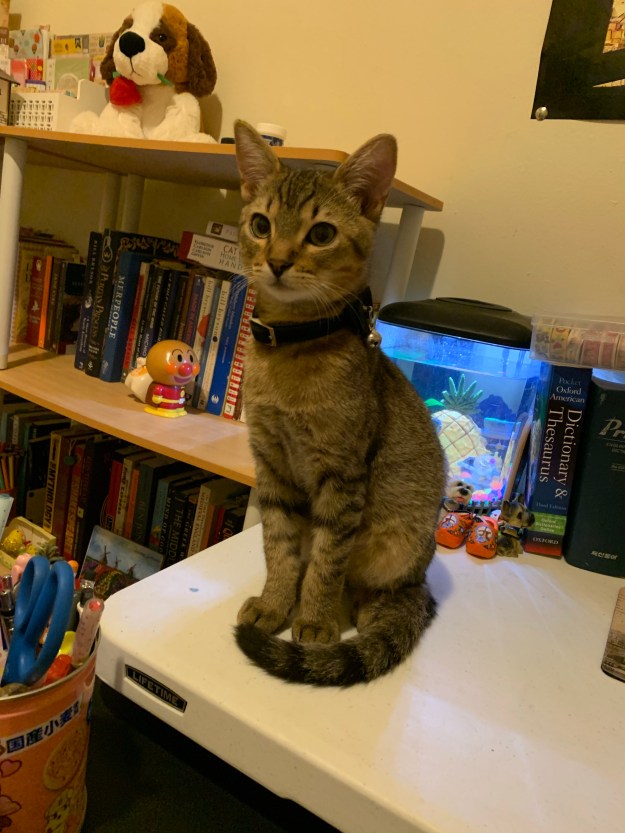
Toro, aka the Curious Tabby, is contemplating joining the team, imbued with high hope of running Freya’s chariot from sunrise and sunset, flying from one end of the horizon to the other, over the ruffling waves of the deep cobalt seas. As one year and three months old, Toro thinks he can apply for Freya’s training school, where Bygul and Trjegu are instructors. At the thought of it, euphoria envelopes his body in a vista of the magnificent chariot, and his spirit now soars up in the garden of ether, intoxicated with the weightless levity. No more boring days, no more need to call the attention of Judy, his human sister, to let him out to the living room, which is always and ever tiresome.
It’s not that Judy lacks care and affection. Hardly so. It’s because of her cantankerous elderly mother, who doesn’t like him to roam around the living room where she usually stays, watching the repeats of talk shows on YouTube. Toro understands Judy’s dilemma between her willingness to let him out and her submission to her mother’s scolding because otherwise, she knows that the mother will discipline Toro with her walking stick. Toro loves Judy, but his curiosity doubles up with aspirations, whetting his desire for driving Freya’s chariot at least just for once. But then it would mean leaving poor Judy alone behind with the horrible old woman. Hence Toro is thinking hard again.
There’s once a cat name Romp Pomp Bunter, aka the Curious Cat, who liked to romp with pomp and bunt his head against his guardian, the woman with the beautiful but lonely heart. She named him in rapt contemplation of the thought, of the thought of his name; his ineffable, effable name, debonair and extraordinary.
The Romp Pomp Bunter has a secret that no one knows it: The Romp Pomp Bunter once saw a grand statue of Bastet In a book on the history of cats originating in ancient Egypt And was so impressed with the splendid grace of the goddess That he wanted to emulate the mysteriously beguiling poise Even if he was a Californian moggie tomcat of Los Angeles.
But the Romp Pomp Bunter, ever the Curious and Adventurous, An orphan kitten whose parents nobody knew or cared even, Felt that he was originally from the Ancient World with a reason That he looked nothing like the ordinary domestic short-haired, The insignificant, the common, the trite, the obsequiously tamed Breed of Cats that contrasted the Egyptian Mau, the First of Firsts Endeared to Pharaohs, Queens, Priests, Soldiers, Farmers, and Artists.
So, the Romp Pomp Bunter believed that he was the Royal Descendant, The indolently elegant, adoringly capricious, the inscrutably alluring Egyptian Mau, the paragon of the goddess Bastet, divinely beguiling. You see, that is why his name is the Romp Pomp Bunter, the Curious Cat.




You must be logged in to post a comment.