Into the silence of the gentle night
The soft breeze of the distant forest
Blows sweet to the leaves of the trees
Which begin to flutter in the gentle wind
Whispering to the lunar beauty alone
Listening to her susurrus of chaste heart.

Into the silence of the gentle night
The soft breeze of the distant forest
Blows sweet to the leaves of the trees
Which begin to flutter in the gentle wind
Whispering to the lunar beauty alone
Listening to her susurrus of chaste heart.

Many moons and suns ago when the Nymphs of the West
Tended and guarded the Garden of the Hesperides,
In the city of Alcantara, there lived a king, the most
Loving father of all who loved his only child in spades,
So utterly ugly in every possible variety of imaginations
That her presence made the beholders into muted stones.
They called her Ugly Altamira, but the king called her Love,
Showering her with Bounty of Beauty, Treats of Tenderness,
Telling her how beautiful she was as a magic spell of love.
Whereas the princess in her father’s glamour spell drove men away –
Prince Alanbam, the hundred knights in armors, and the barber –
All fleeing with horrors of taking her hand and kissing her lips.
Then the king told the princess to marry the Church in a veil
To which she retorted, “I will not marry the Church but find
A husband in the land beyond the sea where the day never dawns
And the night is eternal, so beauty is seen common in darkness.”
Therewith, the princess amounted her beautiful white horse
For departure to the land of equality when the elegant figure
Suddenly appeared at the gate of the castle whose visage was
Beaming with beatific beauty with a voice sonorous and melodious.
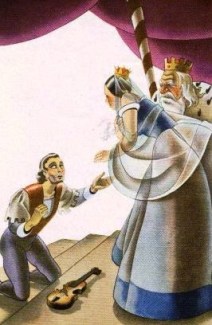
Felisberto, the blind fiddler, exclaimed in the bliss of love mysterious:
“Princess, you need not look anywhere else but to behold one
To whom night and day, ugliness and beauty are all but one.
Since all your suitors are too bashful to marry you so beautiful,
Allow me to be of your service as a husband who makes you happy,
For beauty is as beauty does, so is the pleasure of love in all fancy.
Thereupon, the princess dismounted her beautiful white horse
walked to the handsome fiddler and touched the beautiful face
of the man with tenderness and love full of passion and felicity
by which the man became ecstatic with the sensuous touch
of the delicate beauty of the princess and kissed her tenderly.
Thereafter, the princess and the fiddler married and lived happily
In a castle from the window from which they could see the Hesperides
Water the garden of divine golden apples and dance around the tree always.
P.S. The subject matter of this poem comes from a Spanish folktale of ‘The Ugly Princess” who was so homely that everyone except her loving father couldn’t stand the sight of her presence as though she had been a violation against the natural law. The father’s indoctrination of confidence as a positive reinforcement into his daughter is worth noting as a proto-clinical behavioral therapy in relieving the patient’s depressive obsession with her unattractive physical trait. In fact, the king’s therapy was so successful that the daughter’s identification with prime beauty that was deemed too high for the underserved was remarkable and seemed simply magical.
From movies to novels to the profiles of the authors and of the administrators of social media platforms, the social spencersim of the beautiful champions the law of attraction, whether or not you will vehemently disagree with that usual enforcement of the mantra of self-confidence equipped with a feminist armor and a diversity-rule shield. For beauty gives confidence to a woman in a social setting, and that’s the truth. No wonder folklore treats beautiful women as a rewarding virtue that handsome men are worth fighting for.
Although the ending of the Ugly Princess is unrefutably sweet and happy, I cannot help but relate it to the ending of ‘Plain Girl’, by Arthur Miller – review in which the not so attractive but intelligent protagonist Janice Sasson ultimately finds the consummate love of eros and psyche in the figure of the handsome blind musician. Does the happiness that Janice so cherished have to be in the form of blindness? Can’t a woman deprived of glamour and the matching social adroitness meet and fall in love with a handsome man full of warmth, tenderness, and understanding? Does it have to be a blind man to whom nothing is different, hence an absence of beauty is acceptable? Does love agree at best only at night?


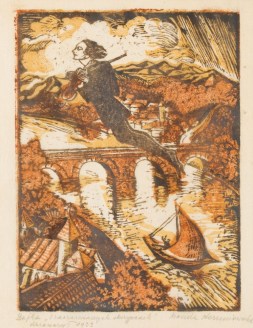
The magic violin of Paganini plays the lover’s concerto in
Largo, lento, adagio, andante, moderato, allegro, vivace, vivace presto
And tames the heart of a brute with lustrous intoxication
gathering a Sylph flitting, humming, dancing in
the twilight ablaze with the breeze of the sun.

Where the earth meets the sky on the mountain,
An old mountain spirit opens and closes the doors
Of Day and Night every day at the proper hours
And works the wonders of nature in the divine design.
The vault of heaven, the dome of Sky God’s palace
She frescoes with celestial ephemerals every night
With new moons hung and old moons cut into stars
Sprinkled across the nightly firmament golden bright.
The garden of the earth, the parterre of Earth Goddess
She waters with rains spun out of soft summer clouds
Woven by early morning’s gossamer cobwebs and dews
Flake after flake, like those of fluffy white cotton balls.
The wise mountain spirit, the wonderful divine artist
Adorns the heaven’s frescoes every night with cheer;
The wise mountain spirit, the wondrous fairy gardener
Cherishes nature’s garden every day with delight.
P.S. This poem is based upon my reading of Washington Irving’s ‘Rip Van Winkle’ in which the fictional historian character named Mr. Knickerbocker relates to the native American legend of an old squaw spirit living on the Catskill Mountains in New York. I envision her as a fantastic fairy version of Michelangelo frescoing the vault of the Sistine Chapel and as a fabulous gardener tending the earthly garden with tenderness and quiet assiduity. What a fascinating vision of a magical magnitude it is!

The owl hooted on the oak,
The crow cried in the dark;
Dogs howled on the hills,
Cats purred in the bushes;
The Night was ripe and ready.
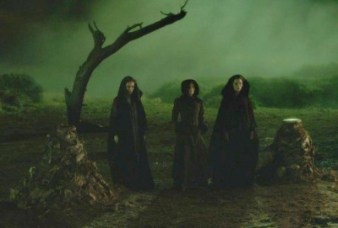
Fee-fi-fo-fum, Fee-fi-fo-fum,
The Three Witches began to hum
Standing in the grim gray garbs
With the gray eyes glaring in silence
They were ready to tell his destiny.
“Scotland, the jewel of thy crown,
The sword calls for thy title to own,
The blood is thy sacred power,
As it runs redder and deeper.”
Thus, the prophecy of his fate’s cast in
Fee-fi-fo-fum, Fee-fi-fo-fum, Fee-fi-fo-fum!
P.S.: This week’s #FairyTuesday theme on Twitter liberally encompasses witches, ghosts, and other supernatural beings, so my choice is the Graeae, the Three Sisters personifying the Fate of Man in the ancient Greek mythology. They had only one eye and a tooth to share, but the pre-Herculean Mycenan hero Perseus intercepted the eye when the Sisters fumbled with it in the air and forced them to answer the whereabouts of Medusa. They ultimately relented to the demand, whereupon Perseus set about killing Medusa.
This image of the Three Sisters is then also wondrously associated with the Three Witches of Shakespeare’s Macbeth by the sheer dint of the somber, dismal greyness of the three uncanny women. But as Mcbeth was a tragic figure consumed by guilt and greed, so were the Three Witches, malevolent and dystopian, vis a vis the somewhat faltering and fumbling Grey Sisters menaced by Perseus bullying them to elicit what he wanted to know.
This poem, however, is more of Macbeth’s Three Witches leading him to perdition because the grim image of the witches conjured up by Shakespeare is terrifically atmospheric and dismally spell-bounding without the pageantry of words and expressions.

Once upon a time, in a kingdom of the shore
A wicked witch queen out of envious spite
turned her eleven stepsons into swans, wherefore
Elisa the dolorous sister drifted away in a plight
Till she chanced upon the fairy queen in her chariot
Who saw the golden heart of the princess that moved
The fairy caprice and told her with thorny nettles to knit
Shirts for the swans to break the spells with her lips sealed;
Such was Elisa’s vow, and the vow took her to her encounter
With a gallant beauteous king of the strange land faraway
Falling for her silent beauty, keeping her in his chamber of amour;
But the zealous archbishop and his ilk viciously sent her away
To a stake for witchery, for her silence was otherworldly;
As the ambers of fire were bursting around her fast and faster
The swans with crowns appeared in the dusky sky from the yonder
And Elisa threw the shirts at the swans, and lo! the men stood there;
Then the fiery fires blossomed into pretty white flowers around Elisa
Lying on the bed of the flowers, which the king plucked and placed
Upon his lover’s bosoms with drops from his welkin eyes, whereupon
Her spirit returned from a departure to the ether exalted, elated
By the end of the old and the beginning of a new life in the kingdom
Where there’s no other world beyond the lovers’ union heart-to-heart.
P.S: One of my favorite fairytales of all time is “The Wild Swans” by Hans Christian Andersen because of the travails that the princess Elisa endured for the love of her brothers and her fathomless patience akin to that of martyrs of the early Church in spite of unthinkable pains of horrendous tortures and gruesome ways of execution for their unswerving faith. What’s more, I love the fact that the king was not only infatuated with her external beauty but also her internal virtue distinguished from all other beautiful women who would vie for his kingly attention. Their love was no less glorious than that of Romeo and Juliet, for the king loved her for the dangers she had passed, and she loved him that he loved all about her, still and ever. Hence this is my contribution to #FairytaleTuesday whose theme for today is a fairytale with an element of lovers in love on Twitter.
You must be logged in to post a comment.