Blog

  • bath of oblivion

    516478
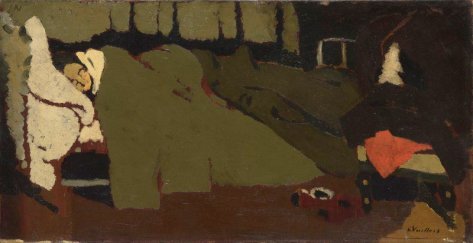
    Sleep by Jean-Edouard Vuillard.

    Sweet sleep, gentle sleep, nature’s kind nurse
    puts me into the bath of Lethean forgetfulness
    with the balm of rosebud for the heartaches
    and wipes away my tears from the sorrow eyes.

    Author’s Note: I hope to forget all things, erase all things, clean all things from the tablet of my mind, which is filled with woeful stories and unpleasant scenes of the day. Sleeping has been the only natural medication that relieves me of the hurt mind.

    저장

  • Lifeline advice from Francis Bacon

    Some wise people take shadows for true substances. Like medieval mounted knights in body armors, they skillfully protect themselves from the exploitation of their true substances in everyday interaction with the people they are forced to work with. How the wise accomplish this art of shielding amounts to an art of war in its defensive and offensive strategical tactics as well as to a discipline of cognitive behavioral therapy in its practical approach to noogenic neurosis or existential crisis. English philosopher Francis Bacon (1561-1626) knew all about this intricacies of human nature in conflict with existential planes, ergo he advised to the posterity how to keep our individuality from pressure of false conformity under the pretext of socialization.

    According to Bacon, simulation and dissimulation are an armor and a shield to guard oneself from being a subject of malicious gossip or cruel bullying, if used wisely. The dichotomy of two principles is simple: simulation as being what he is not. That is, he pretends to be someone he’s not. Dissimulation as being what he is not by way of concealment. However, simulation and dissimulation should not be confused with signs of diffidence or cowardice. On the contrary, it is for the benefit of anyone whose softness is often mistaken for weakness, his hamartia in all things he hopes to achieve. In fact, Bacon posed the advantage of simulation and dissimulation as thus: (1) to quell opposition and to surprise – that is, being a wolf in sheepskin can be a good thing in social interaction as long as you do not hurt anyone with claws and teeth; (2) to reserve a fair retreat to a man’s self – which means by concealing himself to a certain measured degree, he can protect himself in a situation that he feels inappropriate to him. It’s better kept to yourself in a situation that feels and seems a bit averse to you; and (3) to discover the mind of another by letting the other party open himself and turn his freedom of speech to freedom of thought. Simply put, let the other one do the talking until the tower of barbel rings the bell of the talker’s mind to retreat into his chamber of thought. In the end you will remain unsullied by the pompous self-revelation.

    As a coin has two sides to it, the principles have the disadvantage that is inescapable. It casts a shadow of fearfulness that discourages people to flock around the quiet one. Also, it transmits a false impression on others who might otherwise corporate with the the reserved one, which then unfortunately begets a deprivation of camaraderieship or closeness that the thoughtful one does not deserve. Hence, it will be the best to concoct doses of (1) prepossessing demeanor; (2) secrecy in habit; and (3) concealment in use – all for the power to feign, so as not to get hurt unnecessarily by those whose intellect, characters, personalities, and habits do not amount to your class and thus are unworthy of even tying your shoelaces. Bacon’s elegant treaty of simulation and dissimulation may seem heretical, treacherous even to the minds of today’s world where stark self-revelation is highly prided and treasured as a modus operandi of self-empowerment paddled by motivational speakers, clinical social workers, therapists, celeb-turned authors, etc… However, of all the chanting mantras of “being yourself”, Bacon’s method of being yourself by means of simulation and dissimulation to guard your most sacred mental sovereignty is still powerfully resonant with its practicality that strikes the hearts of those whose mildness is used against by the rabble.
  • Alas! poor lady! I know her, Horatio.

    Loaded, not armed, she crept along with
    pain and humiliation, despairing of success,
    ambitious to vanish into the ether…
    Fired with indignation, distracted with despair,
    Amid the barbarous ranters, she flew.

    Author’s Note: There she was, an alleged witch brought to the Inquisition, for no other reason than being heretically angelic.


  • Live to Tell: ‘Hold the Sun in Your Hands: The Erika Jacoby Story’

    Hold the Sun in Your Hands: The Erika Jacoby Story from Cheri Gaulke on Vimeo.

    Great Philosopher Spinoza advised the mankind of how to endure suffering in days of yore: “Emotion, which is suffering, ceases to be suffering as soon as we form a clear and precise picture of it.” The essence of this suprameaning of emotional suffering, which Spinoza also poetically termed Amore Feti (Love of Fate), is to endure what you can’t change but to accept it as it is, for there is a meaning to it in the dark night of the soul.  In the terrible ordeal of the tormented soul, one has two choices to make: to yield to the force of deception calling for total abandonment of hope or to force oneself to turn to the voice of hope to sustain strength of the heart. The sovereignty of humanness is manifested by this holy office of selecting the spiritual choice in the darkest hour of the soul in the deepest valley of the abyss. “Hold the Sun in Your Hands: The story of Erika Jacoby”, a short documentary produced by Harvard Westlake-School, is one such tale of a survivor from the atrocity of moral and physical turpitude as a young child at Auschwitz during World War II.

    A curious alchemy of illustrative animation and neorealist documentary delivers a momentum of pathos without elaborately scripted lines or special effects in the most powerfully elliptical way, which adds to the authority of truth that the story itself owns. Ms. Jacoby’s straightforward narration without a prolix litany of her woeful past is felt through the heart of the viewer, and it communicates to the mind of the viewer her smothered traumatic experience at Auschwitz, where she had to witness the death of her beloved and the enormity of evil reincarnate in the Nazis’ mass killing of the Jews and the violence against humanity through the eyes of a young girl.  Accordingly, the film is seen in the perspective of a young child whose innocence betrays ingenuousness of the story and thus delivers the profoundness of such experience that sublimates it into the highest form of Art in the context of regarding Da Vinci’s aphorism of “Simplicity is the ultimate sophistication.”

    This short documentary has chimed the hearts of thousands, including those judges at the Cannes Film Festival, which is one of the most highly regarded film festival (note that it’s not an “award” ceremony where only gowns and jewelry and tuxedos and fake smiles are visible.) in the world. It will be shown at the American Pavilion at Cannes this month as part of a series on young, emerging film makers, one of whom includes Ian Kim, who is son of Mr. Harry Kim, a corporate lawyer at a law firm I am privileged to work. The creators of this documentary will appear on stage at Cannes, ergo it will be a festivity of creation, a festivity of humanity. Above all, the fruit of this film is a triumph of human will that rose above the carnage of war and the degradation of dignity and a manifestation of meaning of life, will to meaning, freedom of will as also corroborated by Dr. Viktor E. Frankl, founder of Logotheraphy and also a survivor of five concentration camps during World War II. Ms. Jacoby shows us what it means to have hope as long as she lives. Dum Spiro, Spero. This documentary will strike the highest notes of your heartstrings.


  • goodbye to april

    2014_CKS_01534_0320_000(henry_moret_le_faucheur)
    Le faucheur by Henry Moret

    When the hounds are on
    winter’s trails

    The Lady of Seasons in
    meadows and fields

    dons the barren places soon
    with green sleeves and emeralds.

    Author’s Note: It’s the end of April, which will never come back, vanishing to the horizon of time and space, the misty past with memories and images. I was on my last train home after work this evening and wanted to record this last day of April of 2019, which was my first April here in California. So as a ceremonial gesture of farewell to my Californian April, I wrote this poem as I was basking in the bright golden rays of the gorgeous Californian Sun that began to stay a little later than before.

  • for love of a tabby

    praying-cat
    Praying cats

    As a dog person who always has a soft spot for the man’s best friend, I tend to give a rather stoic glance on a cat that seems so high and aristocratic to reciprocate my regard. Cats are the cool, agile, cynical, and independent lords of the households, the poised and legal Pharisees of the animal kingdom. Yet a comparison of superiority between the canine and the feline is a puerile way to exert one’s favoritism of one species to another, which is reminiscent of eugenic theory of a superior race aggressively peddled by intellectuals in the early 20th century. That said, this note on cats reflects my findings of cats as man’s timeless companions in historical contexts, casting different lights over their stereotypical sinister image that I had about them.

    170px-Interior_of_a_school_in_Cairo_(detail)
    Mohammad and Muezza

    Cats as a symbol of witches betray the fact that a revered religious figure such as Prophet Mohammad was very fond of a cat. So much so that his pet cat named Muezza was treated with the utmost tenderness. It is said that Mohammad used to shiver without his cloak in the cold rather than disturbing sleeping Muezza. Further to the Mohammedan episode of his beloved cat, cats have a sacred pedigree in Christianity as well. It is said that a local tabby, after a fresh wash, instinctively jumped in and laid down next to Baby Jesus. The cat’s warmth and soothing purr, all the more added by a pleasing after-wash scent, were conducive to an undisturbed sleep of the baby. In fact, researchers claim that letting a cat sleep on your bed at night will relieve you of symptoms of insomnia due to its calming purring sound that sends relaxing positive signal waves to your mental as well as physiological wavelength.

    51m9fTbUyKL
    C.S. Lewis and his Cat

    C.S. Lewis, Author of the Chronicles of Narnia, also loved cats and had a stray cat he loved tenderly. Every morning he took his hat off when greeting his cat with pleasantly resonant “Good morning.” Moreover, when his veterinarian told Lewis to euthanize the cat due to its senility, the great Lewis refused to do so and nursed the cat for years until it finally met its creator.

    Baby-Jesus-and-the-tabby-cat-artCome to think of it, cats have appealed to the fountains of imagination and boundless perception in the human mind. The ancient Egyptians worshiped the lithe beauty of cats that distinguished itself from other animals. Edgar Allen Poe also saw something magically fascinating in a feline creature as his creative muse in literature. For me cats do not seem to be as cold, arrogant, and coquettish as they used to be. I even say hi to my neighbor’s big beautiful cat in sight, although it sends me a quizzical look as if I were a Prodigal Daughter. But above all, now I think that not only dogs but also cats will go to heaven.