Blog

  • ‘My Girl, Fiona: A Collection of Essays’ by Denise Gwen

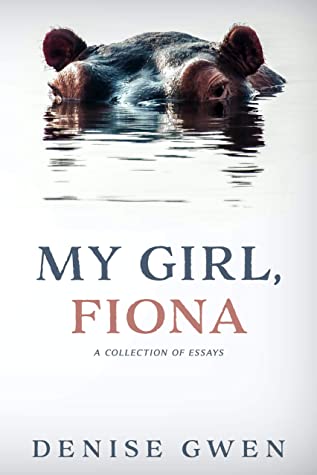
    My Girl, Fiona: A Collection of Essays by Denise Gwen

    My rating: 4 of 5 stars


    Sometimes we see ourselves in animals – here I mean the mammals, especially — and relate our mental images to them, whether they are pets living under the same roofs or wild ones in nature or zoos. That is why animals are apropos mediums to project our mirror images into their figures without exposing our naked selves outright. And that is what Denise Gwen does in her elegantly poignant collection of essays My Girl, Fiona.

    Fiona is a hippopotamus the author adopted emotionally from her struggling birth into the world at Cincinnati Zoo. Abandoned by her enormous mother, the vulnerable yet adorable baby Fiona chimed the emotional bell of the author on the octaves of her family. Fiona, the name of Gaelic origin, provokes the image of a vivacious fairy whose feistiness and resilience elements make her all the more mysterious and, not to mention, beautiful. But the beauty is uncommon and only kind, which strikes Edgar Allan Poe’s wise dictum that “There is no exquisite beauty without strangeness in proportions.” Then the adorable hippo Fiona becomes a kaleidoscope of images of women, representing the Exquisite Beauty Tribe. It consists of her youngest sister, whose name is also Fiona, her feisty Welsh late mother, and herself in midlife crisis blotted with sentimental reminiscences. Added to this tribe is Shrek’s wife is Princess Fiona. Her transformation from conventional slender beauty to a green-colored ogre-like her beloved hubby is a guest of honor in the Fiona Parthenon. One way or another, they all share the beauty marks of uniqueness, confidence, and self-esteem as the author brings them into life in the alchemy of words, brewing the images into a fascinating pastiche of the Fair Fiona.

    Animal stories charged with human emotions may well turn to the art of anthropomorphism in which animals speak like us with accents varied from Brooklyn to Los Angeles. But the author nuances the overtly human sentimentality in her narratives lest they should become schmaltz through Fiona, the lovely hippo. Also, the way she narrates with an elegantly apt choice of words and poignantly witty expressions is reminiscent of the British writing style I am familiar with. In fact, before finishing the book, I suspected her of being British for the reasons mentioned above. Consequently, I wasn’t miles away from the speculation because her mother was a proud Welsh who remained Welsh in her spirit and language during her lifetime. My Girl, Fiona is a thoughtful and heartful memoir disguised as short fiction apart from egotistical meanderings, which many celebrities nowadays indulge in stories that lack universal empathy. It is also a compact book you can read without leaps of attention and boredom in your spare time.


    View all my reviews

  • Braveheart

    Beneath a new visiting sun
    Sees a woman through tears,
    Sorrow of the heart she feels
    As it deepens into a sea of pain.

    Beside her an ailing old woman
    Lies in natural amnesia for woes
    She wishes to send away in vain
    When a life’s grip is relentless.

    Fear crowded, tension soaring
    Zealots of God clad in weapons,
    Fierce eyes searching for victims
    Outside is the terror reigning.

    Demands of life, duties of care
    A caryatid bears on her head,
    She faces the faces of terror
    With a brave heart for the fate.

    Author’s Note: Yesterday, I wrote about my essay on the current situation of Taliban-seized Kabul in Afghanistan but still could not take it off my head because I felt for their fear for unknown futures. An article of the day from Reuters was about the ordinary Afghans who had to make livelihood even against a possibility of danger that lurks around everywhere where thousands of people are attempting to escape from the new Taliban regime, often futilely. Therefore, this little poem, albeit insignificant willy-nilly, is my small tribute to the brave ordinary people on the frontline with life in Afghanistan who are just like you and me. The heroine of this woman is another Me in Afghanistan who shares a similar life story.

  • Living in the historical moment – the Collapse of Kabul

    The Buddhas of Bamiyan Valleys before the destruction by the Taliban

    One of the four reasons why George Orwell wrote was to record historical events in his time with a sense of writer’s responsibility to witness the moments for posterity. Imbued with the Orwellian spirit, but more egged on by the concern for the reign of terror, as a citizen of the world, I care to write about the current volatile situation in the Taliban regime of Afghanistan. Now I can see a danger of theocracy in which religion is a leviathan consistency master computer that controls people’s lives and psyches. Religion becomes an authoritarian Big Brother, the Demiurge that plays the absolute moral and ethical being in the mask of profoundly sacred deity leading to hatred of the physical world we live in. In this situation, the beauty of art intrinsic to our human essence is a decadent luxury, expendable to the bargain in the politics of heritage.

    The fate of Buddha before the killing

    The reinstatement of the Taliban government in present Afghanistan provokes the image of the great Buddha statues located in Bamyan, Afghanistan, until the Taliban obdurately and proudly destroyed in 2003 because the statues were idols opposite the teachings of Allah. The Taliban ignored pleas from the UN, including Islamic countries, that urged them to preserve the world’s treasure of civilization for humanity. The statues of Buddha represented Gandaha art, a wonderous syncretism of Hellenism of ancient Greek culture and Buddhism of Indus Valley civilization. It’s an exquisite synthesis of the West and the East, which tells us that people found a way to cross vast continents and seas and mingled to blossom into a new civilization even a millennium ago. Thanks to the one and only Macedonian Alexander the Great, emblematic of the wise and cultured political and military leader of all seasons, our human civilizations dispersed farther. They prospered further, as evidenced by the now begone great statues of Buddhas built by Bactrians, the descendants of soldiers in Alexander’s army who remained in modern-day Afghanistan by force and perforce and founded Hellenistic Bactria. By the way, there are still the descendants of the ancient Greek forefathers living in the area, even though their cultural expectation in the form of the statues of Buddhas have become mysterious wonders of the ancient world.

    The artifact of humanity is gone

    I am not condemning the religious whose faith is commensurate with their regard for others because a true believer of any faith is also a good person. The world’s representative religions do not promulgate violence and antagonism, at least not in their sacred texts per se. Still, misinterpretation or over-interpretation of the words have been the seeds of discord in history. I remember Mother Teresa of Calcutta once said that you don’t have to be a Christian to be a good person. If you are a Hindu, be a good Hindu, a Muslim, a good Muslim. I wish people of all faiths would take her words to heart. Then we could place the Republic of Heaven on earth.

  • On Philip Pullman’s Republic of Heaven

    A great writer of our time is Phillip Pullman in his moment of pleasure.

    Great writers are great because they know how to tell entertaining and enduring stories without religious and didactic overtones. Moreover, they are unafraid of speaking their minds without a qualm of conventional belief or sectarian principles. Yesterday, I read an essay called “The Republic of Heaven” from Demon Voices by Philip Pullman, a renowned British best-selling writer whose intelligently tongue in cheek styled narrative raises the dander of the Catholic Church for his acerbic view of the orthodox teaching. With my reading of Candide by Voltaire still fresh in mind, I find Pullman and his philosophy of free thought familiar with that of Voltaire and realize that true intellectuals think among people and live in social companions of public spirits for the good of humanity. Thus, here is my discursive impression of Pullman’s “The Republic of Heaven.”

    Pullman urges us to step aside from habit, a banal molded frame of life, to see the world outside the box, which will lead to an immense world of delight, the Republic of Heaven, for we are worthier than we think we know because we are such stuff made of wonder. Pullman’s heroine is Charlotte Bronte’s Jane Eyre, who has resisted against the magistrate of grim and gray puritanical ethos that decries an expression of feelings and emotions under religious disciplines. She remonstrates against the cold-hearted Mrs. Reed thus: “You think I have no feelings and that I can do without one bit of love or kindness, but I cannot live so.” Her demand for love stems from her need for it, which is an essential food for the soul that serves a purpose and pique for life. This sense of love so wanting in Jane cannot be quelled by false optimism that such distress is the best for the best of all possible world. On the contrary, it is an outcry of the soul desirous of warm and soft human touch that thrills the heart and invigorates the mind. Human beings cannot live by Reason alone, forced to utilize when the right of five senses is forfeited and bound by misconceived religious concepts and false moral measures.

    The founder of Logotherapy, the third Viennese school of psychotherapy, Viktor E. Frankl, witnessed a learned Jewish woman in his concentration camp killing herself despite daily recitation of wise sayings of the Torah supposedly being a consolation. Frankl affirms that we humans cannot live without the joy of life, that is, an appreciation of pleasure to the senses because otherwise, we will degenerate to a provisional being living day to day like prisoners of dreary dungeons in the darkness of hopelessness. Pullman agrees with Franklin the creative and experiential values of pleasure that keep a journey to live a purposeful and meaningful life.

    The creation and experience of art spark the joy of moments that can be synonymous with a meaning of happiness in life. Some find consolation in religion, but it does not give them whys to live for, nor kindness to show hows. Pullman’s concept of the Republic of Heaven comes to a head prominently when we are stranded in the chaos of existential vacuum, the kind of which the loyal and conscientious butler Stevens felt when he lost his faith in his idealized employer in Kazuo Ishiguro’s The Remains of the Day. However, if Stevens pursued his love for Miss Kenton and appreciated the pleasure of love he consciously denied, he would not have felt the sudden void in his life. The sense of delight in the physical world is the essence of the Republic of Heaven that he and we are conditioned to ignore. The point of Pullman’s philosophy is that we are too serious about the pleasure our physical world provides. And it’s not a chemical-induced euphoria for escape from the world but a new attitude toward our perspectives of it. Elenore Roosevelt also knew how to become a citizen of the Republic, thus: “Do one thing every day that scares you.” I should try that.

  • Philosopher, Poet, and Doctor

    Edgar Allan Poe’s tribute of “To the glory that was Greece” sprang from my mind when I received this month’s subscription to a British history magazine BBC History Revealed. It came in the magnificent package of ancient Greece Special, ranging from the Archaic to Hellenistic periods, from slaves to Socrates, and from Auspices to trepanation. I feel dutiful that writing about my thoughts from the reading serves a purpose of writing to achieve experiential value to gain refreshing knowledge about the famously glorious ancient Greece and creative value to record my thoughts about following impressive findings.

    Surprising Opponent of Democracy
    Socrates was the one who called upon Philosophy from celestial paradise into the world, took her to the villas and huts of mortals, and persuaded her to stay among them. He was indubitably the father of philosophy as Herodotus was of western narrative history. His submission to drinking fatal poison as execution for corrupting the Athenian youth by saying “Bad law is still law” is immortalized in works of art from painting to engraves, poems and plays. Woe betides anyone who would disbelieve that the most democratic thinker opposed democracy in his time. Yet don’t let sorrow turn into disappointment in betrayal because democracy in Socrates’s time was different from our modern concept and practice of republican democracy. Athenian democracy directly involved people of all classes in politics without representations for constituents. Any Athenian citizen- excluding women, slaves, and foreigners- could voice out and execute their wills however uncouth and unreasonable. This form of mob-style demagoguery without desires being reined by the judgment is what Socrates criticized, not freedom of human spirits. Naturally, having seen his venerable teacher killed by the will of demagogues, Plato was an even stronger opponent of Athenian democracy that ceased to reign in the early 4th century BC following the Greeks’ unsuccessful revolt against Macedonia rule.

    Nothing is better than the simple.
    Anyte of Tegea was a very popular poet of circa 3rd century BC. Anyte is considered one of the first poets to focus on the simplicity of beauty found in nature and life, which is different from most ancient Greek poetry eulogizing the mighty achievements of heroes and the majestic powers of gods. Her eloquently crafted poetry with comprehensively accessible use of simple language gorgeously manifests richly delicate emotional sensitivity that collapses the millenniums between her writing and our reading them. Although her popularity earned her the sobriquet of “Female Homer,” a comparison to nineteen-century American poet Henry Wadsworth Longfellow is deemed more apposite and understandable for both poets sublimated the ordinary to the sublime with the feeling of beauty and love for nature and life.

    A hole into the skull
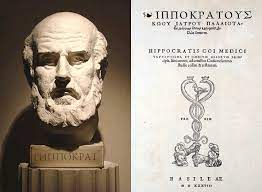
    Trepanation was a medical technique that Hippocrates, the father of medicines and doctors, codified in circa 5th century BC. He believed that there were four humors in the human body: Blood – Air, Yellow bile – Fire, Black bile – Earth, and Phlegm – Water. The idea of humourism consisted of thus: if one of them was redundant or deficient, ailments of spiritual and physical kinds arose. Therefore, drilling a hole into the skull of the affected suffering from depression, headache, fractures, or other symptoms of a mystical condition, would relieve the patient of malady. The Inca civilization was indeed famous for successful cases of trepanation, more favorably effectuated than those of 19th century American Civil War experience. However, it was Hippocrates who contextualized the procedural and impacts of the prehistoric operation. Trepanation is still performed today in the name of craniotomy.

    The mists of the past seem strangely distant due to our conditioned sense of evolutionary scale in the continuum of prehistoric and modern times. However, history shows us in today’s world that the people who lived before us millenniums ago had emotions and concerns similar to ours and that human cultural progress is a collective enterprise without fully recognizing it within the circumferences of time and space. Just as Herodotus was gobsmacked by the sight of great pyramids built centuries before him, our descendants will be awe-struck to see the ancient ruins of the Statue of Liberty or the Empire State Building and the tires of the New York City or of Los Angeles. Time and culture are ephemeral, but cultural heritage and artifacts in the treasure of works of art and humanities passed down to posterity are eternal as long as the human race exists.

  • An Invitation from the Forgotten

    12504609_f520

    Of the dusty ruins of the misty pasts
    When gods were kings of kingdoms
    Far across the great divide of the seas,
    Lies a vase carrying ancient stories.

    Love, War, Nature, and Magic – Humanities
    Of Ancient Life, so distant in times and spaces-
    Are conjured up in holography, jettisoned from
    The spell of Oblivion of Time by the Cycle of Time.

    Suddenly, from the horizon afar that seems endless
    An Old Man appears in a grand chariot of two horses
    And tells me, “I am A’as, king of gods of the Hittites.”
    I ride his great chariot and vanish into the endless horizons.

    저장