
Hounds are racing; horses are galloping,
She is running up on the hill so steep bedraggled
Panting in staccatos of fleeting hopes
for her star that someone stole away.
So she runs up on the hill again and ever
Till she finds her lost star.
Hounds are racing; horses are galloping,
She is running up on the hill so steep bedraggled
Panting in staccatos of fleeting hopes
for her star that someone stole away.
So she runs up on the hill again and ever
Till she finds her lost star.
Music is a universal language of humankind, as perspicaciously illustrated in a segment of the film ‘Mission’ where benevolent Jesuit missionary Gabriel plays the oboe on the top of the stiff cliff surrounded by the heathen natives. The beautiful Gabriel’s melody enters the souls of the natives, stays there in wonder, enough to disarm all hostility toward Gabriel and open their hearts. The language of music intoxicates the heart and satisfies reason and nothing more.
But that is not what it is like in this world we live in. Music is perceived as an ideological, political tool for suppressing and propagating specific ideas by persecuting the proponent of a theory that irks the majority populace, as posited in scholar John McWhorter’s article “Is music theory really #SoWhite?” The article’s gist is that two music professors at Hunter College are in a row because of their different opinions about renowned Austrian music theorist named Heinrich Schenker criticized for his openly racist views on just about everything. Schenker is long dead, but his genius in musical theory still retains magnificence among academics worldwide, including those whom Schenker might not have regarded as kindly and respectfully. One of the proponents is professor Timothy Jackson, who highly esteems Shenker’s musical theories irrespective of his personal belief and ideas.
The nemesis comes in the name of professor Phillip Ewell. He is also a cellist and half-black, attacking his peer Jackson to defend Schenker’s racist views that are an essential part of his music theories, so to speak, campaign for Jackson’s dismissal from the college the count of racism. That is not the end of Ewell’s fury against Shenker and his admirer. The arrow also shots Ludwig Von Beethoven’s bust, whom Erwell thinks doesn’t deserve the genius composer’s high appellation because the panegyrics from white supremacists ornaments his abilities.
Reading the article with the images of the dead Shenker and the two professors at tirades, so to speak, in my mind’s vision, I feel like watching an inquisition tribunal or communist party’s kangaroo court where the innocent not committed crimes regardless of his/her personal faults or weakness is savagely summoned and tried without attorney testifying the truth. The truth, said Edgar Allen Poe, is the satisfaction of reason, the fulfillment of judgment. I understand Erwell’s fury erupted in the BLM movement’s wake, which brings the suppressed matters into the light. But the accusation of Jackson as a racist that hurled him to the center of controversial debates at the expense of his livelihood because Jackson spoke for Shenker’s work as values attributable to the benefits of arts doesn’t seem to hold water. You can have a heart burning with passion with a head kept in the cold with reason.
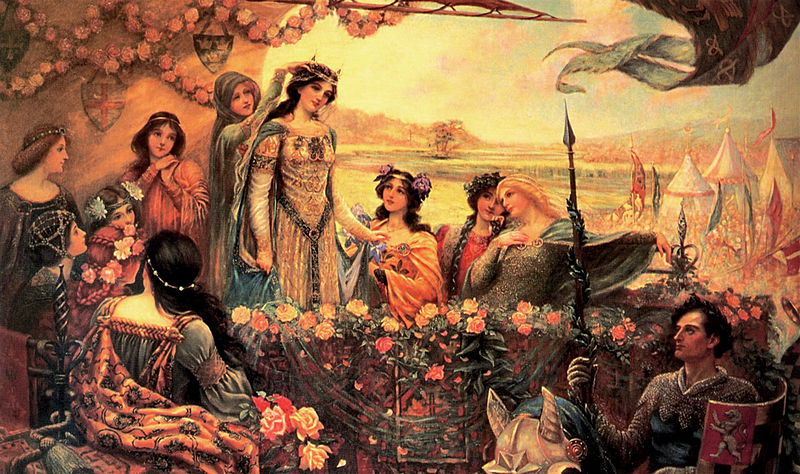
Across the five continents and seven seas
Beyond the bridges of time over the Lethe
There is the Fortune Isle – enchanting Avalon
Where all things grow and perfect themselves
Not by physical labor but by nature’s magician
in the sovereignty of nine faerie queens’ realm
of Prudence, Justice, Fortitude, and Temperance
Adonized in Beauty, revered in magnificence
As Morgan Le Fay, the Queen of the queens
Keeps the Holy Grail under the Sacred Oak
With her half-brother, once mortal King Arthur
Whom the Queen has brought from the battlefield
By Black Boat from which her paramour Dane Ogier
Came to Avalon, where his journey ended in a tryst
With the Queen by the lake of shining waters
Where she brought her son Oberon into light
who became the king of faeries and married Titania.
Avalon is near and far, real and mythical from whither
Truth and wishes are sought after and eloped together.

It is supposed to be about being a woman that binds all women regardless of race and ethnicity across a great divide of time. Forget all others and let us focus on the parallel circumstances and kindred experiences as women. But alas, that seems only a tale told by a romantic fool such as I am. If you think this is hyperbole, then I suggest you read the tweets and comments on the recent news that a black actress plays the role of Anne Boleyn, the second wife of Henry the Eighth and the mother of Elizabeth the First, in the upcoming British periodical drama, which went viral among the learned and the general. In addition to the vehemently acrid narratives on the racial authenticity of Anne Boleyn – especially from fellow women-, the juxtaposition of the two women’s images, the actress Jodie Turner-Smith and the queen Anne Boleyn itself, belies the popular sentiment as though to mock the actress’s appearance in the fashion of the Tudor period by making parallels with the classical portraiture of the Anne of 1000 days. It has produced vociferous tweets full of fury from people who regard the role as audacious cultural appropriation faithful to the PC ethos of the time.
Actress Turner-Smith’s playing the Tudor woman Anne Boleyn is indeed an innovational idea of breaking the typecasting based on the physical distinction for the roles thinkable and conventionally conceivable for the specific attributable characteristics of certain characters. Thus, non-whites playing the roles conceived for whites are seen as usurping the equilibrium of cultural heritage, upending the very foundation of national identity translated into racial identification, a sentiment prevalent even among the professed liberals anti-everything related to Trump, Republicans, and racism. The rejection of the race crossover representation on screen is supposedly due to the difficulty of following the story’s fluid narrative, unable to be absorbed in the story, not least because performers’ distinctive physical attributes mar the harmony of racial fluidity. But do we really?
I have watched a few good dramas (British) in which the races of performers do not pin down them to the racially charged roles. To illustrate, in Benedict Cumberbatch’s Frankenstein, the wife of Victor Frankenstein was played by a black actress. Besides, his father, M. Frankenstein, is a black actor, a fine ensemble of excellent thespians whose energetic performance brought Mary Shelly’s original Gothic story to a theatrical feast to the eyes and the mind. While watching the drama, I was not distracted by the black performers’ appearances being the father and Genevan Victor Frankenstein’s wife. Instead, the powerfully emotional and assiduously methodological performances resurrected the textual characters to real humans, full of pathos with vigor and wonder. Also, British Asian actress Gemma Chan, who played the role of Elizabeth Hardwick in ‘Mary Queen of Scot’s,’ is known for her versatile roles transcending her racial background. Her recent performance as a cyborg with a touch of humanity named Anita in ‘Humans’ is as naturally harmonious as streams of a river flowing into a great ocean, not highlighting her physical differences.

So why the fuss full of sound and fury of the people who cannot accept the black queen in the Tudor drama when they are boastful of the most advanced mind since the age of Enlightenment? In the wake of the global Black Lives Matter movements, people have become afraid of the wind of changes as a frightful tsunami to subvert social foundations, upending the social orders adverse to their belief systems. Although I don’t eschew their concerns for the wind of changes as I am also conservative, not conventional in belief, the current vehemently acrid opinions about the black woman becoming Anne Boleyn are tokens of latent racialized hostility surfaced by the deluged dissents pouring forth from the socially suppressed sentiments. Indeed, you can’t ignore the differences between the two Anne Boleyns. Still, there are more commonalities than the images seen through your optical sensory input: that they are both women of elegance and confidence who are not afraid of expressing what they can. The actress shows she can pull off the character with what she has, and the queen her the courage to confront the criticism for being the cause of subsequent religious turmoil that changed the face of Christendom in spades. Let not prejudice darken entertainment.

Where the ocean sends forth
The breeze of the shrill west
Pegasus gallops over the waves
Neighing in wondrous force, full of pathos
Dolorous, vigorous, resembling
The great conch of Poseidon, resounding
Across a boundless reach of the sky.

From Plato, who believed that the dead walked around a cemetery, Pliny the younger who told of his friend’s in Greece encountering a ghost of an old man in a chain, and Arthur Conan Doyle, who himself manifested as a revenant looking for his lost diary in his former early abode, there is no distinction between the learned and the general in acknowledging the existence of spirits. There are more things on earth than are explained in theories. Poltergeist: Then and Now by Wayne Ridsdell revisits the places where the noisy spirits were/are reputedly manifesting themselves and lets the reader judge the veracity of the existence of the century-old poltergeist on his own.
The book reads like an anthology for the history of poltergeist 101. The author has gleaned several famous poltergeist cases from the Cock Lane Poltergeist to Borley Rectory Haunting, The Enfield Poltergeist, and the Rosenheim Poltergeist. They are all too familiar to stimulate the reader searching for a new case of the subject, even if it may not be as sensational as the aforesaid famous cases. But in all fairness, the instances’ enumeration latently serves as suggestive DYI touchstones for discriminating the genuinely supernatural from the others, including mental illness, fraud, or overt imagination. Take, for example, the Cock Lane Poltergeist and the Mayfair Ghost, aka Berkeley Square ghost. Despite the shocking incidents recorded in the annals, the circumstantial evidence surrounding the cases arises from a jilted lover’s malice, the rage of failed expectation, and rambunctiousness of avarice, manifested in one big hoax of an invented poltergeist. Although the authors do not directly debate the cases’ truthfulness, the detailed accounts of the stories behind the issues bespeak the possibilities of stratagem.
What lacks in the originality of strange poltergeist incidents makes up in the unveiling intelligence about historical and literary relations to the ghostly phenomena. For example, the haunted 50 Berkeley Square in London inspired Rudyard Kipling’s “Tomlinson,” a poetic version of the Book of Dead retold in his poetic vision is a gem to discover. From London, the reader travels to the ghastly Glamis Castle and finds himself in the secret chamber where the sinister force originates from, which no one but the first-born son at his twenty-one birthday can access to. The secret remains intact to this date in the Bowes-Lyons Family, the castle owner, who included Queen Elizabeth, the Queen Mother, and the unfortunate Nerissa and Katherine, who were locked up in an asylum for their prenatal imbecility till their death, eschewed by their loyal cousins. The reader’s thirst for the supernatural piquancy in the context of historical evidence is adequately quenched in such information.
The reader keen on supernatural (not paranormal, psychic, or psychological) stories based on real events might find this book mediocre in contents that are a well-organized summation of case studies. Still, the book is a good primer for the world of poltergeist and its historical record that links the past to the present, which the noisy spirit knows no boundary of time and space. What happened before happens now and will happen tomorrow. I think this is what the author wants to ascertain in this book.
View all my reviews


You must be logged in to post a comment.