Tag: american literature

  • ‘Plain Girl’, by Arthur Miller – review

    Plain GirlPlain Girl by Arthur Miller

    My rating: 5 of 5 stars

    When I first came across this book while looking for my next read on the train, I was immediately hooked on by the simple no-nonsense title of Plain Girl and incredulously surprised by the famous name of Arthur Miller, a celebrity playwright who had once married Marylin Monroe in his prime. Such an incongruous admixture of the images sprang in my mind like phantasms from a presumed association between the Dolorous and the Gorgeous, the Lonely and the Lovely, the Unlucky and the Lucky, all compactness in this beautifully elliptical and deeply heartfelt story about a plain girl whose jewel of beauty was wrapped in a dull, grey, crude titular epithet.

    Janice Sessions, an intelligent young Jewish woman living in New York City, seems to share the sentiments of the introverts whose quiet modes of behaviors and shyness often make them unnoticed, if not obscure, among vociferous, glamorous crowds. Think Maupassant, who at the hour of his death confides in his close friend, “I coveted everything and enjoyed nothing.” And Charlotte Bronte, who always thinks she is deprived of beauty and fortune, which prevents her from a delight of love as a prerogative of beautiful fortunate women. And then the Monster created by Dr. Frankenstein whose deformity puts him in a cruel shackle of absolute loneliness with an outcry of “I see inside but dare not to go inside!” They are the concerted echoes of estrangement – whether voluntarily or involuntarily imagined or devised – from lonely souls roaming around, wandering about in a search of happiness in life that can culminate in the union of loves, both Eros and Psyche, the spiritualization of sensuality in totality. This Janice is in want of, this is the source of her existential distress, noogenic frustration that keeps her away from anything miraculous and wonderful every happening to her.

    In fact, I wonder if Miller writes this story of a plain girl on the thematics of existential frustration in which his protagonist is made to believe what she really isn’t, whereas her extraordinariness of resilient spirit against endless disappointment and distress renders her all the more distinguished from her peers whose ordinary femininity looks banal and trifle without stories to tell. Such emotional distress may arise from an existential vacuum caused by a collective value, such as in this story the disillusioned tenets of political and social ideologies ultimately culminating in World War II and the aftermath thereof. And Miller so elegantly and dexterously accounts for a woman’s solitary quest for the meaning of life, a sense of purpose in life as a woman of true value against epochal tides of world crisis. The apex of Miller’s literary finesse manifests in every sentence delicately nuanced sentiment wrapped in his elliptical expressions and laconic use of plain words, defying every streak of intricately baroque literature that does not communicate straightforwardly to the hearts of readers.

    This book is not to discuss woman’s liberation or to lecture about the superiority of spiritual beauty over physical beauty that so many of you would quickly respond with stock answers. Janice’s doubt about her value of being loved and her preoccupied consciousness to her appearance makes her all the more palpable and realistic to those of you who find a kindred spirit in her and feel that you are not alone in loneliness and that what you think you are may not be the truth. Janice doesn’t need the glamour spell to transform herself into beauty because Janice is not a plain girl, nor has been, and will never be. The same goes for you.

    View all my reviews

  • ‘West from Home: Letters of Laura Ingalls Wilder’, by Laura Ingalls Wilder – review

    West from Home: Letters of Laura Ingalls Wilder, San Francisco, 1915West from Home: Letters of Laura Ingalls Wilder, San Francisco, 1915 by Laura Ingalls Wilder

    My rating: 5 of 5 stars

    Looks can be deceiving, for sure. It can yield an ill-judged misapprehension of the true person and therefore, form a certain prejudice about the person. A person’s appearance is a false shadow for the substance, but our faculty of mind based on a sensory perception with the works of imagination often falls into fallacy. That said, this charming little book comprised of lovely missives to her beloved husband Almanzo back home in Mansfield, Missouri comes surprisingly pleasant twist of the image of Laura Ingalls Wilder, the creator of Little House on the Prairie, whom I always considered to be stoic and imperturbable, a kind of austere and puritanical mid-west matriarch, who turns out to be one sweetheart with the untainted sensibility of feminity.

    In these letters written to her batter half she called ‘Manly Dear’ during her travel to San Francisco and her stay there too in 1915 following an invitation from her only child Rose, you will read the words of her heart and soul enveloped in tenderness, colored in vivaciousness, and sealed with love, all the marks upon pages in the felicity of vivid descriptions wonderfully mixed with the perspicacity of reflective introspection, so jolly that reading them makes you feel like reading love letters from a smitten maiden to her smashing beau.

    It’s one of the reads that require no practical analysis of the psyche of the author or of the social, political climates to make revisionist commentaries. It’s a pure mental delight of peeping into the inner world of the author that puts a smile on your face. Also, it’s a great read to while away your time at one sitting. On a personal note, if you have read Prairie Fires: The American Dreams of Laura Ingalls Wilder by Caroline Fraser, the magisterial biography of Ingalls, this book is a lovely accompaniment to feel this great American writer of all generations closer to you as none other than her true person, talking about her journey to you as a great story-teller.

    View all my reviews

  • ‘A Summer of Hummingbirds’, by Christopher Benfey – review

    A Summer of Hummingbirds: Love, Art, and Scandal in the Intersecting Worlds of Emily Dickinson, Mark Twain, Harriet Beecher Stowe, and Martin Johnson HeadeA Summer of Hummingbirds: Love, Art, and Scandal in the Intersecting Worlds of Emily Dickinson, Mark Twain, Harriet Beecher Stowe, and Martin Johnson Heade by Christopher E.G. Benfey

    My rating: 4 of 5 stars

    The Greeks called it Ethos, and the Germans named it Zeitgeist. The world has always seen and experienced epoch-making changes of guiding ideals or beliefs that particularize ideology of an era under the cataclysmic reconstructions of social modus operendi, cultural trends, and memes. Something like that happened in the mid-late 19 century post-Civll War America, and it was something of American Renaissance. Emily Dickinson saw it as a flash of a hummingbird’s flight into a route of evanescence – of the antebellum social arrangements, hierarchies, puritanical morality, and intellectual formations, all of which seemed unseemly and even contumacious in a dawn of new era. So Christopher Benfey presents in this beautifully ethereal book his sensitive and illustrative script of Post-Civil War American literary scenes in which the likes of Emily Dickinson, Harriet Beecher Stowe, and Mark Twain are played on the same epochal screen, using the image of a hummingbird as a cross-cutting medium to interweave the lives of the American intelligentsia.

    Benfey draws on his unparalleled knowledge of the American literary intelligentsia with a tender and intelligent contemplation on action and thought in the culturally sophisticated realms of East Coast America in the aftermath of the Civil War. For instance, he introduces the reader Reverend Henry Ward Beecher, a brother of Harriet Beecher Stowe, a passionate collector of expensive paraphernalia, whose Byronic-like charm and charisma led him to a famous scandal involving a love affair with the wife of his friend and parishioner. But Benfey sees the reverend as breath of a fresh air in the stuffy Protestant tenets of mortification of sensualism, which is only a friori natural to God-given human nature. In fact, Beecher substituted the drab and dreary Calvinist doctrines of predestination and infant damnation with the love of nature, the tender love, and mercy of God who created Beauty to be realized and appreciated, not to be despised and avoided. Besides, Charles Darwin’s Evolutionism manifested a perfection consistent with the Christian views: that all living things evolved into their most advanced forms meant the perfect beauty made in the Image of God. Indeed, such perceptions of God and his creations bespoke liberalization of Protestant moral codes that often yielded to perverted acts of unnaturally repressed desires. It was a leap into a new world of “fluidity and flux”.

    All this seemed to conspire to reckon the moment of new arrival of intellectual zeitgeist with a divine revelation or a sibylline prophecy in this book, which is why it is deemed a contemporary nonfiction that reads like a classic fiction. Rich in detail and vivid in description that successfully resurrect the period, it is a riveting tale of the American literary legacy to be told with Benfey’s poetic use of simple language with a fascinating take on the felicitous subject worth the reading. The book embroiders on the lives of the American literary celebrities of the time by interconnecting their lives with the gossamer threads of contemporary providence or fortuity in one way or another, willed or unwilled, when a pre-Civil War mindset and post Civil War necessities still clashed. Nevertheless, Americans after the war came to see a new substratum of social order and diverse directions in all aspects of life, fittingly found in the figure of a hummingbird, an indigenous bird of the American continent, that is uniquely American. IT was also a time of Transit of Venus, as the new tone and sensibility for new era became dawned on the American social and cultural horizon. This book is a tessera elegantly and delicately put together by Benfey’s appealing narrative and approachable scholarship in a mosaic of American Art.

  • Ah, Bartleby! Ah, Humanity!

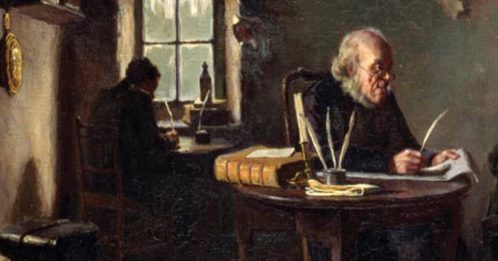
    3-10-2017_bartleby_scrivener_2

    It was more than 10 years ago when I first read Herman Melville’s Bartleby, a short story about an unwonted young man employed as a scrivener by a Wall Street lawyer. At that time, Bartleby stroke me as a very eccentric, imprudent worker who had the temerity to reject his boss’s orders. He was just a mentally deranged man with only a few words, other than “I would prefer not to do …”

    But now I see him different. Since I re-read the story this afternoon, I have felt bottomless sympathy for Bartleby. Mixed with pathos and sprinkles of humor in the narrative of his benevolent former employer, the figure of Bartleby evokes springs of human compassion and humanity itself. And my feelings for this tragic scrivener amount to what the narrator felt about his former employee.

    I am not intent on “analyzing” the psychological aspects of Bartleby and his former Wall Street lawyer boss. And I think not that even the writer Melville himself had such psychoanalytical views on these characters in mind when he wrote the story. To me the story itself shows what made a sensitive man like Bartleby to such demise in the eyes of a compassionate man – and a decent employer seldom found these days. Loneliness, Hopelessness, Sorrow, and Reality of Death all packaged in written forms burned in flames stagnated the humanness in the forlorn scrivener. The Death of Humanity, that is. Having worked in the Office of Dead Letters at Washington would suffice it. Surely, there is no doubt that Bartleby was mentally disturbed, but who would hate or even despise him for his malaise?…

    Then readers might object to the premise that it’s only a fictional story in which no such characters will/would exist in reality. But I think not so. As a matter of fact, I have always believed that fictions are always built upon factual elements of human life to a certain degree. Dismissing stories as creations of imaginativeness seems to miss the fundamental truths laid under changes and choice of our human life with a bit of creative imaginations. Ditto Stephen King, who has once said that the stories are artifacts that are not really made up, but that are based upon preexisting objects we discover.

    The tall, lean, pallid and lugubrious image of Bartleby the Scrivener still lingers in my mind… Having dealt with tons of letters from those who died in despair, those who died hopeless, and those who died suffocated by insurmountable sufferings, Bartleby had lost his own sense of existence, feeling utterly dispirited, pessimistic, and lethargic in performing demands of his duty. It was the loss of meaning of life that made him passively resistant to all the ordinary functions of daily life which all seemed insignificant to him. The life itself was nihilistic and hence non-existential to Bartleby. Humanity in the expressions of feelings and emotions meant nothing to him; it had ceased to exist in the form of dead letter attesting to existential horrors, which had led the authors to death, which had taken the poor Bartleby as the witness thereof.

    Thus, the lamentable outcry of the narrator still deeply reverberates in my mind even after I closed the book: “Ah, Bartleby! Ah, Humanity!”

    P.S. This is my bygone writing about Herman Melville’s classic short story of “Bartleby, the Scrivener” that I had written prior to the inception of my blog.

  • Ditto to ‘On Writing’, by Stephen King

    Camille_Pissarro_-_Flowering_Plum_Tree,_Eragny
    Flowering Plum Tree by Camille Pissarro –

    I have been writing profusely and religiously almost on a daily basis since I created the blog a month ago. I love the process of writing my thoughts and feelings publicly in hope of communicating with the people who can share them and appreciate my writing. Although I don’t have a huge fan base, nor do many people leave comments on my posts, I am not dispirited because even David Hume, the author of Human Understanding received a total lack of recognition upon publication, nor did Athony Trollope’s The Macdermots of Bally Cloran gain any readership. Nary a one bit. What a comfort.

    While reading Stephen King’s On Writing: A Memoir of the Craft, I have been getting many invaluable tips on how to write a story, what to write, and what to possess to write. King’s advice is down to earth, straightforward, honest, and friendly. Also, he is very humble to share his own craftsmanship in reference to his own personal experience which I am greatly appreciative of. Before I read the book, I felt a great distance from the contemporary American writers and their works because they seemed to belong to another world where I could not find myself comfortable with and connected to. However, King with his book On Writing has kindly and warmly invited me to the world of modern American literature and his personal/professional world in a very American way.

    His writing style is precise, perspicuous, scintillating, and personal. There are no belle lettres, no plum words, no grandiloquence, no priggishness, and no platitudes therein. Just a straight story-telling as truthfully as possible. It’s both intellectual and entertaining. Besides, the facts that (1) he went to a state university; (2) he’s not from an affluent or a typical middle class family; (3) his writer wife, who also went to the same university as he did, worked at a Dunkin’ Donuts’ to support their family; and that (4) he plays the rhythm guitar in an amateur rock band consisting of his fellow writers have drawn me closer to appreciate his world of literature, his brilliant creations.

    Furthermore, King seems to have read my mind in regards to my arrested development of writing stories I want the world to read. To write good, I have to read a lot consistently. Also, setting up a writing routine on a daily basis is highly recommendable. He suggests any aspiring writer write at least 500 words per day. So here I am writing this long-forgotten online journal. And the most important thing to keep in mind is that I should not lower my level to expose my writing to any external feedback by publicizing it in expectation of receiving praise or even the smallest comment, unless my writing is complete and reader-friendly after satisfactory re-draft of the original. Besides,  I will not canvass for readership because I don’t want my blog to be tainted by internet marketers of dubious origins and their ilks. In fact, the satisfaction results from writing a story that is honest to myself, that is easy to write about, and that is vivid in telling a story abstracted in my brain. Thus, I have decided to publish my blog post upon thoroughly circumspect review thereof. And I will keep this journal diligently and write a short story per week.

    I will let go of myself in the world of armature writing and see how far I will get to. And if this is not my thing to pursue, then I will toss it to find another avenue in my life. But for now, I will stick to this writing plan.

    *Having done this entry, I have realized 699 words were written! There I go! I have already written a short story of mine!

    P.S. Sir Francis Bacon once said, “Reading makes a full man, conference a ready man, and writing an exact man.” How rightly so.

    The rare equanimity of this Sunday evening (also in celebration of denouement of the senseless Daylight Savings Time in the States) allured me to trace back my bygone days, and hence this entry of my interior monologue I wrote on Tuesday, December 8th, 2015, several days after starting my blog on wordpress.com. I have always liked to write since I could read and write, no matter how amateurish it may be.

    Although I can’t imagine myself earning the bare necessities by means of writing, an act of writing emboldens my otherwise timid self under the aegis of anonymity. Well, I have my name Stephanie Suh manifested as the author of the writings on my blog, but other attributes of mine are protected by stealth, and it will remain so in fear of losing a magical sense of writing as a ghost writer. (Or sometimes, I feel like Artemis, a divine huntress who vehemently protected herself from the leers and jeering of mortals in terms of her fierce guarding of noble independence. ) After all, writing is an act of discovery of a self, ego qua meaningfulness, a search for sense of purpose in life. It’s also a sanctuary, an elbow room of a restive, lost soul on a life sea. It’s also a cultivation of  plants and flowers and trees in your Secret Mind Garden. 


  • ‘Essays of E.B. White,’ by E.B. White – review

    Essays of E. B. WhiteEssays of E. B. White by E B White

    My rating: 5 of 5 stars

    The essay as a respectful literary genre has not yet established its firm meritorious footing in American intellectual society where the novel, poetry, and journals featuring de rigueur social/political issues with gravitas, surrealistic individualism, or puritanical heroism that has recently morphed into a rags-to-riches memoir are the only select legitimate royalties worth being decorated with a laurel. Perhaps it has something to do with the level of American intellectualism being at its still developing stage in consideration of its relatively “youthful” history. For what is worth, despite its general cold reception from the literary hierarchy, E.B. White is nonetheless a quintessential American English writer and a very fine essayist of the twentieth century in the English language into the bargain. In this collection of his essays published in various magazines over the years (from 1920s to 1970s), Whites recorded the overtones of humanity, democracy, and social concerns in ordinary things and experiences described in elegant and crisp prose style that resembles none other than his, thus making him one of the central figures in the canon of American literature without dispute.

    Being an essayist means something of a modern day literary troubadour, an independently-minded man with childlike streaks of artless interest in all things worldly and unworldly and innocent belief that everything he thinks about and everything that befalls him is of general interest. In a way, he’s a likable egoist with venturesome effrontery and verve to write a very egoistic essay on his whims and caprice. However, Whites gently rebukes us for our general perception of the essay as an expression of exalted rootlessness without self-discipline and an intellectual basis; rather, it is a panoply of sensibilities, senses, and intelligence, all broken loose from the hidden private closet of the essayist. For this reason of being egoistically concerned in a panorama of contemporary daily that many serious writers of the other literary genres tend to downplay, an essayist should accept his self-imposed role of small-fry writing gentry in the class of scribe, advised White with a kind of avuncular manner. However, it is this estate of an essayist Whites feels exhilarated about; it provides him with a valve of the emotional influx and outflow, so that he can wield his pen across a page in an expense of his curiosity, conviction, observation, and self-discipline, producing a dazzling delight of literary pleasure in its simplicity of language and subject.

    To illustrate, White’s subjects of his essays vary from his experience of moving from New York City to Maine as in “Goodbye to forty-eighth street,” to the humorous political essay of “Bedfellow,” featuring his canine family member Fred, and from his keen and humane observation of a circus girl rehearsing her show in “The Ring of Time” to his youthful poetic experience of working as a waiter on a ship to Alaska in “The Years of Wonder.”All of the aforesaid deal with a cast of everyday character and contemporary daily life written in simple but perspicacious words to contextualize the inner realm of White. There’s no priggishness or pomposity in his prose style, which I find very appealing and endearing. For someone who’s as erudite and intelligent as White, such simplicity of writing betokens that he wears his knowledge lightly with a general reader in mind. In fact, White thinks it his duty as a writing man to record all items as though he would be held personally responsible if it were to be omitted. This idea of a writer as general secretary of humanity parallels the reasons of writing as posited by George Orwell: It serves as a platform of expressing our sheer egotism, aesthetic pleasure, political evidence, or historical record. A priori, both of the great essayist of the English languages strike the mutual writing chords in their hearts.

    At the heart of the essays lies White’s love of the world where he collected the flotsams and jetsam of what our contemporary human life could bring to us, which were washed up by the waves of time and memories. This collection of essay by White, I think, bestows in spades its sovereign royal heritage of its own on the American essay that merits its own section in nonfiction aisles across the country. That is, in a wide stretch of literary imaginations imbued with historical evidence, the book has made itself the founder of new royal blood in a way that reminds me of William the Conqueror’s  becoming the first Norman king of England by establishing a new royal bloodline in 1066. With a variety of topics, and the practicality of language, this book is a gem that holds the reader’s attention throughout the pages including the unforgettable cover featuring Fred and the author himself, which so fittingly and wittingly demonstrates the Element and Style of Essays of E.B. White. It’s a lovely read that warms your heart and piques your curiosity of the inner world of the writer whose thoughts and feelings chime the bells of ours own in one way or another because White is ageless in his writing and his writing timeless in his essays.